

You're shopping for a birthday gift at 11 p.m., the date is close, and the recipient lives several provinces away. You want something thoughtful and genuinely Canadian, but the product page leaves you wondering where it was made, whether it will arrive on time, and what happens if the box shows up damaged.
That's the challenge with Canadian gifts online. A maple leaf in a product photo doesn't prove where an item was produced, and an attractive candle description doesn't tell you whether the format suits the recipient. Use the checks below to verify origin claims, compare candle formats, understand domestic delivery, and look past vague sustainability language before you pay.
Table of Contents
- Why More Canadians Are Shopping for Gifts Online
- How Big Canadian E-Commerce Has Actually Become
- How to Verify a Canadian-Made Claim Before You Buy
- Candle Gift Formats Worth Considering
- Shipping Realities Across Canada
- Safety and Sustainability Claims Worth Scrutinising
- A Short Checklist Before You Check Out
- Common Questions About Canadian Gifts Online
Why More Canadians Are Shopping for Gifts Online
Online shopping has changed the practical meaning of local gifting. Someone in Winnipeg can order from an Ontario maker, while a buyer in Halifax can find a small workshop that doesn't have a shop on their street. The convenience is obvious, but the responsibility has shifted to the buyer. You now need to confirm the maker, read the fulfilment details, and judge whether the gift fits the recipient without handling it in person.
Canada's online retail market reached a major inflection point during the pandemic. Statistics Canada reported retail e-commerce sales of approximately CAD $3.9 billion in May 2020, up 2.3% from April and 99.3% from February. Compared with May 2019, online retail sales were 110.8% higher, even while total retail sales fell sharply as many physical shops closed or operated under restrictions. Global News' report on the Statistics Canada figures provides the historical context.
That surge affected all 11 retail subsectors that recorded e-commerce activity, so online purchasing expanded beyond familiar categories such as electronics and apparel. For gift buyers, the lasting lesson is simple: a Canadian maker may serve customers nationally, but national delivery requires clear product information, domestic fulfilment, and realistic expectations.
Before checkout, watch for four friction points:
- Origin wording: “Made in Canada” is more useful than “Canadian inspired” or “designed in Canada.”
- Delivery uncertainty: A rumoured carrier disruption, weather event, or remote postal code can change the arrival date.
- Returns: A policy may require the item to be unused, returned within a stated window, or sent to an address where you'll need suitable packaging.
- Product fit: A scented candle may be perfect for a fragrance enthusiast and completely wrong for someone who prefers flameless home fragrance.
Practical rule: Treat the product page, shipping policy, returns page, and About page as part of the product. If one is missing, you're being asked to buy on trust alone.
How Big Canadian E-Commerce Has Actually Become
Canadian online retail is no longer a niche channel for specialist shoppers. The U.S. International Trade Administration, citing Canadian and Statistics Canada data, reports that Canadian e-commerce retail sales reached an all-time high of approximately US$3.82 billion in December 2020, above the previous 2020 peak of roughly US$3.2 billion in May. Its market profile estimates Canada's e-commerce market at US$41.79 billion in 2025, a projection that shows the scale reached after the pandemic-era adoption surge. See the International Trade Administration's Canada e-commerce market profile.
Payment habits also tell you what a competent gift shop should support. Credit cards represented approximately 57% of Canadian e-commerce transactions in 2023, while digital wallets accounted for about 25%, according to the same profile. A shop that accepts familiar card payments but offers no secure, convenient checkout alternative may create unnecessary friction for buyers ordering from a phone.
| Indicator | What It Shows |
|---|---|
| December 2020 online retail sales | Canada's e-commerce channel had become a major retail route, not a specialist option. |
| Projected 2025 market size | Online purchasing continued at substantial scale after the pandemic acceleration. |
| Credit card share in 2023 | Cards remain central to online checkout for Canadian buyers. |
| Digital wallet share in 2023 | Wallet support matters for a broader, more convenient payment experience. |
Scale creates choice, but it also raises the standard for service. Buyers now reasonably expect clear stock information, payment security, delivery updates, and a real person who can answer questions. That's especially valuable with small Canadian businesses, where a named maker or customer-service contact may be easier to reach than a large marketplace seller.
The numbers don't verify a product's origin for you. They explain why you'll find more Canadian makers online, and why you should compare their transparency rather than assuming every local-looking listing is locally produced.
How to Verify a Canadian-Made Claim Before You Buy
A Canadian flag, maple leaf, or red-and-white colour scheme can support a brand story, but it doesn't establish where the product was made. Read the wording carefully and look for details that a seller could answer without reaching for marketing language.
Start with the exact origin words
Look for “made in Canada,” “made in Ontario,” or “hand-poured in Ontario.” Be more cautious with “inspired by Canada,” “designed in Canada,” or “crafted with Canadian pride.” Those phrases may describe the brand's identity without telling you where the item was manufactured.
Next, inspect product photos for a label or packaging statement. A clear "Made in Canada" declaration gives you more to work with than a lifestyle image featuring a Canadian scene. For a useful overview of the surrounding compliance considerations, review Canadian laws compliance from That Blanket Co.
Check the maker and the materials
A candle poured in Ontario may use imported fragrance oils, vessels, labels, or wicks. That doesn't automatically disqualify it as a Canadian-made product. What matters is whether the maker explains the production process and materials plainly instead of implying that every component came from Canada.
Use this five-point check:
- Read the product description. Find the production location, not just a Canadian theme.
- Inspect the label and packaging. Look for a specific origin statement in the product photos.
- Review the materials. Confirm the wax type, wick material, fragrance information, and vessel details.
- Open the About page. A workshop location, named founder, or identifiable Canadian business gives the claim useful substance.
- Search independently. Search the brand name with “made in Canada” and “review” to see whether outside references support the description.
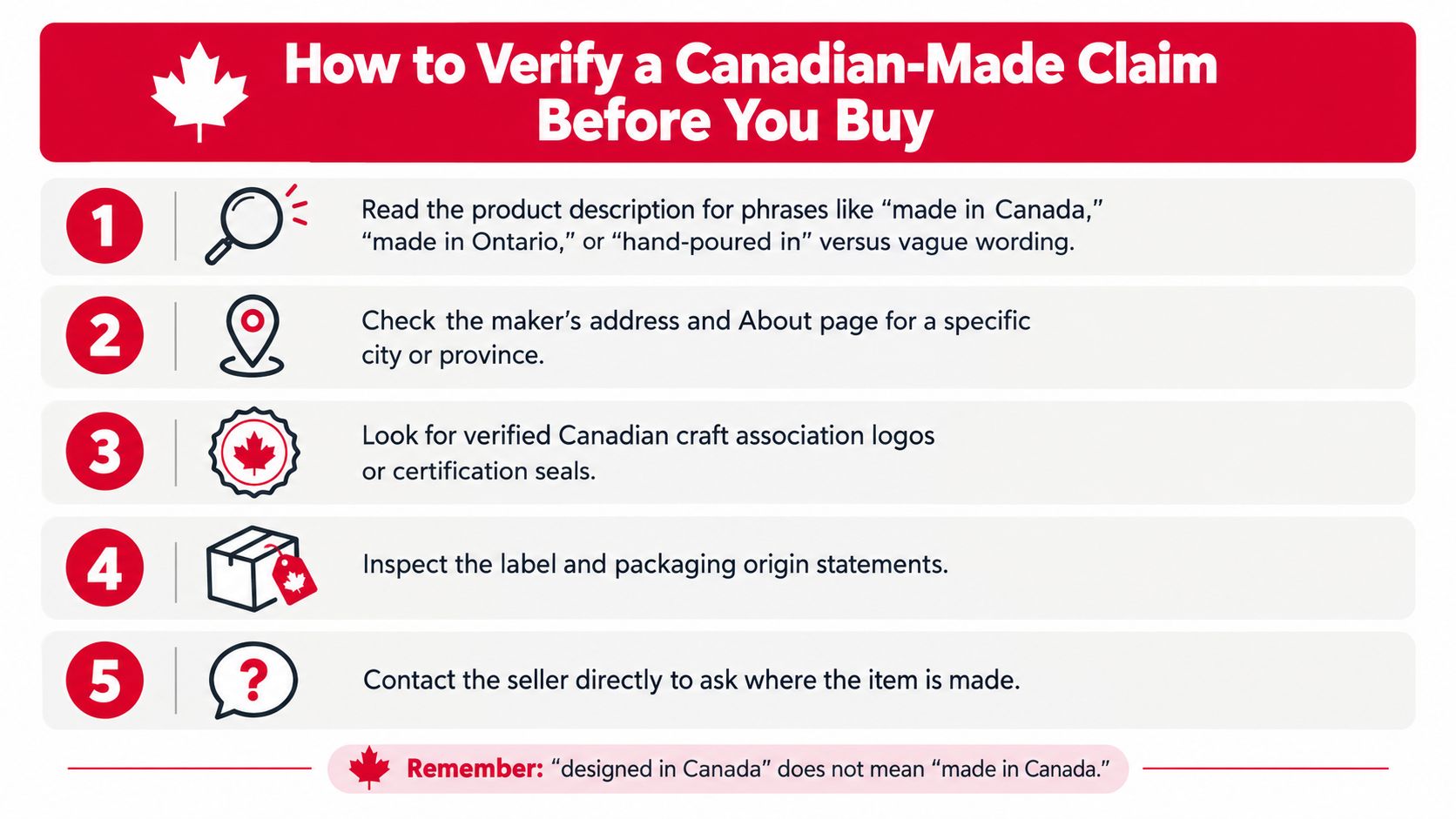
If the product page still leaves you uncertain, email the seller one direct question: Where is this item made, and which parts are sourced elsewhere? A transparent answer should identify the production location without pretending that local production means every raw material is domestic.
For a Canadian-made soy candle, that distinction is helpful. The buyer can verify that the candle is poured in Canada while also understanding what the maker says about wax, fragrance, wick, and container sourcing. These checks take only a couple of minutes and can prevent a disappointing gift.
Why Canadian-made soy candles feel better offers related context for shoppers comparing locally produced soy candles.
Candle Gift Formats Worth Considering
The right candle gift depends less on the label and more on the recipient's home, habits, and tolerance for open flame. A home fragrance enthusiast may enjoy a hand-poured candle, while someone in a small office or shared home may prefer wax melts.
| Format | Best For | Burn Time Range | Gifting Notes |
|---|---|---|---|
| Hand-poured soy candle | Recipients who enjoy a traditional candle and visible ambience | Product-specific. Shivora's 8 oz candles state approximately 40–45 hours with proper wick care. | Check whether the vessel arrives gift-ready and whether scent notes are clearly listed. |
| Wood-wick candle | Buyers who like a subtle crackle and a more tactile experience | Product-specific. Ask the maker for the stated burn expectation. | Wood wicks need appropriate trimming and lighting. Confirm the care instructions are included. |
| Soy wax melts | Offices, dorms, and homes where a warmer is preferred over an open flame | No candle burn time. Usage depends on the warmer and melt quantity. | They're compact and easy to bundle, but the recipient needs a compatible warmer. |
Hand-poured soy candles suit people who want a container they can display and reuse. The most important details are the vessel size, wick material, scent strength, and stated burn time. Don't promise that a candle will suit a scent-sensitive recipient unless the buyer knows the person's fragrance preferences.
Wood wicks create a gentle crackling sound, but they aren't automatically the better choice. They can require more attention during lighting and trimming, and the flame behaviour may differ from cotton-wick candles. Choose one for a recipient who enjoys the sound and ritual, not just because the product page calls it premium.
Wax melts are the practical option for a recipient who already owns a warmer or doesn't want an open flame. They can also make a useful addition to a care package, especially when you pair a complementary scent with a candle or sample-sized product. For a broader gift-planning comparison, see soy candles in Canada for thoughtful gifts.
A candle gift should match the recipient's routine. Don't send an open-flame product to someone who has clearly chosen flameless fragrance.
Packaging deserves the same attention as scent. Confirm whether the product arrives in a protective box, whether a gift note is available, and whether you'll need to add your own wrapping. If you're building a Canadian home-themed package, a candle can sit alongside a small décor item, such as Canada canvas wall art, provided the combined parcel remains practical to ship.
Shipping Realities Across Canada
Domestic shipping is reliable when you plan around the published range instead of the most optimistic estimate. Canada Post lists different standards by service and destination. For shipments between most standard Canadian areas, Priority is listed at 1–3 business days, Xpresspost at 3 days, Expedited Parcel at 4–12 days, and Regular Parcel at 4–13 days. For northern regions and remote centres, the corresponding ranges are 5–8 days for Priority, 5–8 days for Xpresspost, 6–14 days for Expedited Parcel, and 7–14 days for Regular Parcel. These estimates exclude the mailing day, weekends, and statutory holidays, and weather can affect actual delivery. Check Canada Post delivery standards before choosing a service.
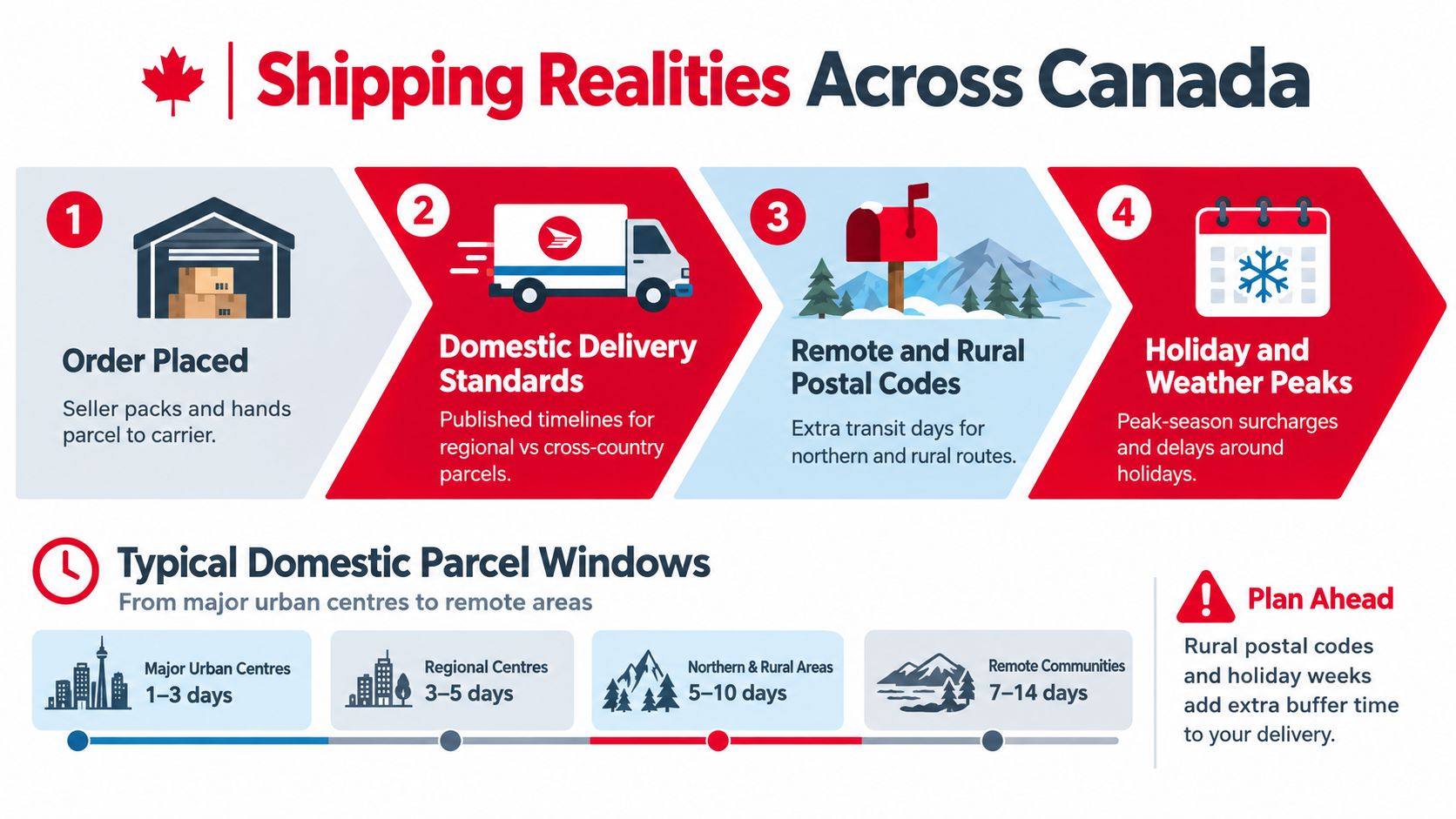
Canada Post describes Priority as its fastest service for time-sensitive items, while domestic parcel services are intended for items deposited in Canada for delivery within Canada. The sender remains responsible for secure wrapping and enough cushioning to prevent damage to the item, postal equipment, other mail, or people handling the parcel. That matters with glass candle vessels, which need protection inside the box rather than a single layer of paper around the jar. Canada Post's domestic parcel guide explains the packaging responsibility.
DHL's Canada e-commerce research adds a useful service benchmark. 82% of shoppers may abandon a basket when preferred delivery options aren't available, and 78% may abandon when preferred returns options are missing. 48% are frustrated by long delivery times, while 76% say free delivery would improve their online-shopping experience. Three in four shoppers reportedly won't buy from a retailer they don't trust to handle delivery or returns. Read the DHL Canada e-commerce report.
For any candle order, check the carrier, processing window, tracking method, and damaged-parcel procedure before you pay. Order earlier for a birthday or holiday, and add more buffer for rural, northern, or remote addresses. Shipping across Canada starts at $9.99. Free shipping on orders of $79.99 CAD or more. Some conditions apply.
For a related look at domestic sourcing and delivery considerations, read candles near me in Canada.
Safety and Sustainability Claims Worth Scrutinising
Words such as “eco-friendly,” “clean burn,” “natural,” and “non-toxic” sound reassuring, but they don't tell you enough on their own. Ask what the seller means, what materials are used, and whether the claim is supported by a specific test or product specification.
Candle safety is not just a marketing concern. Health Canada estimates, using data from Ontario, Manitoba, Alberta, and British Columbia, that candles caused nearly 800 fires annually on average between 1999 and 2008, associated with approximately 8 deaths, 115 injuries, and CAD $26.2 million in property damage per year. The data is historical rather than a current nationwide estimate, but it explains why safety instructions belong on a gift product page. Review Health Canada's candle safety guidance.
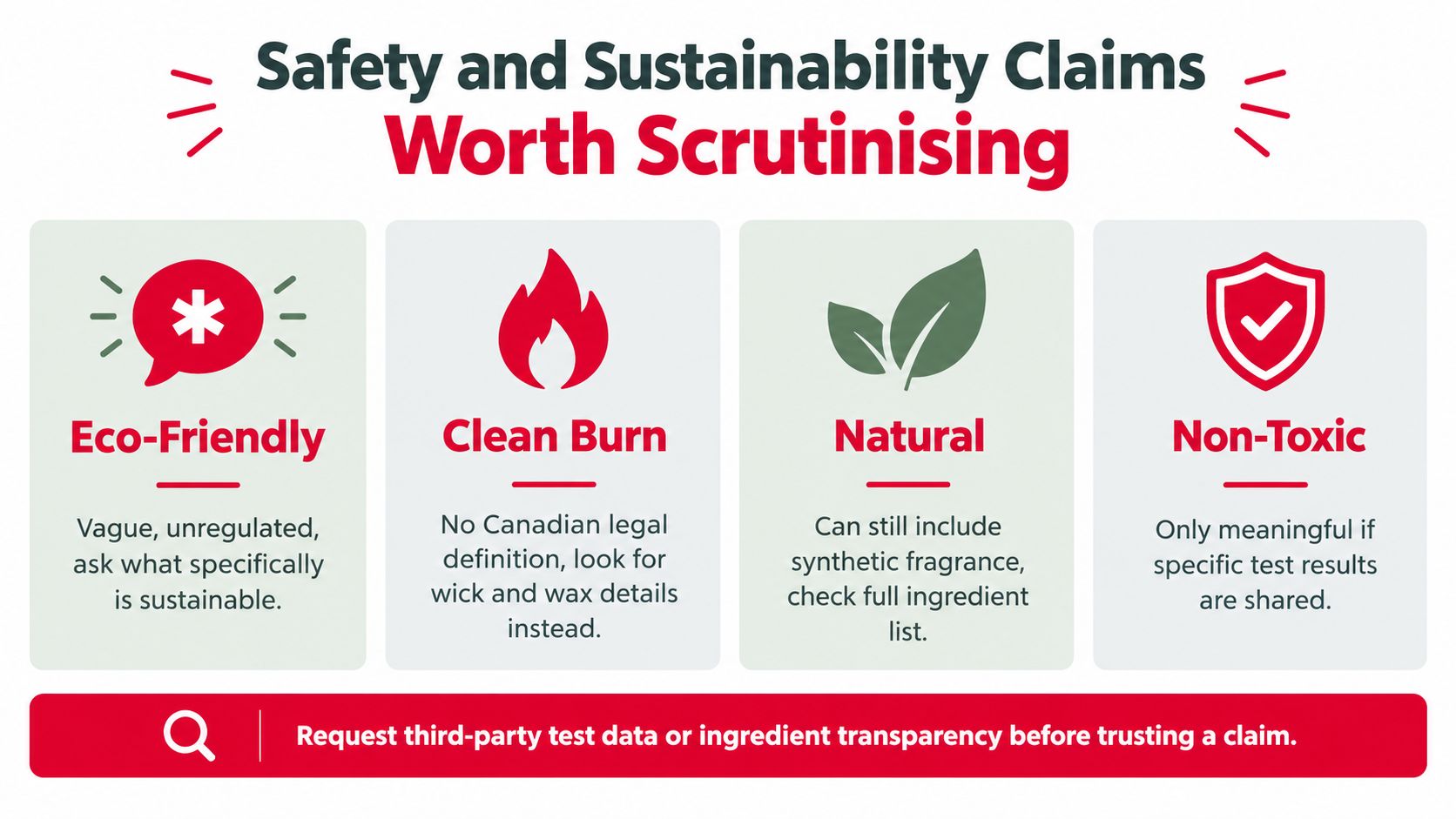
Replace buzzwords with checkable details
- Eco-friendly: Ask whether the claim refers to the wax, packaging, container reuse, local production, or shipping method.
- Clean burn: Look for wick information, care instructions, and a realistic explanation of how burn performance depends on use.
- Natural: Check the full materials description. Plant-based wax doesn't mean every component is plant-derived.
- Non-toxic: Don't accept an unsupported absolute claim. Ask whether the maker provides specific testing or ingredient transparency.
Sustainability is a value trade-off, not a personality test. Microsoft's 2025 Canada holiday research found that 59% of Canadians were interested in sustainable gifts and 61% were willing to pay a premium for sustainability. Yet a Retail Council of Canada and Caddle survey found that only 26% of shoppers sought eco-friendly packaging or sustainable products during Easter shopping, while 41% didn't prioritise sustainability. Gen Z showed stronger engagement, with 33% prioritising sustainable choices. Compare the Microsoft Canada holiday research with the context provided in the verified market findings rather than assuming every shopper values the same trade-off.
For a candle, ask about wax, wick, fragrance, packaging, jar reuse, and product longevity. Health Canada also recommends flameless candles whenever possible, and says burning candles must be extinguished before going to bed or leaving the room. Wax melts can suit recipients who prefer a warmer, but the warmer's instructions still apply.
A Short Checklist Before You Check Out
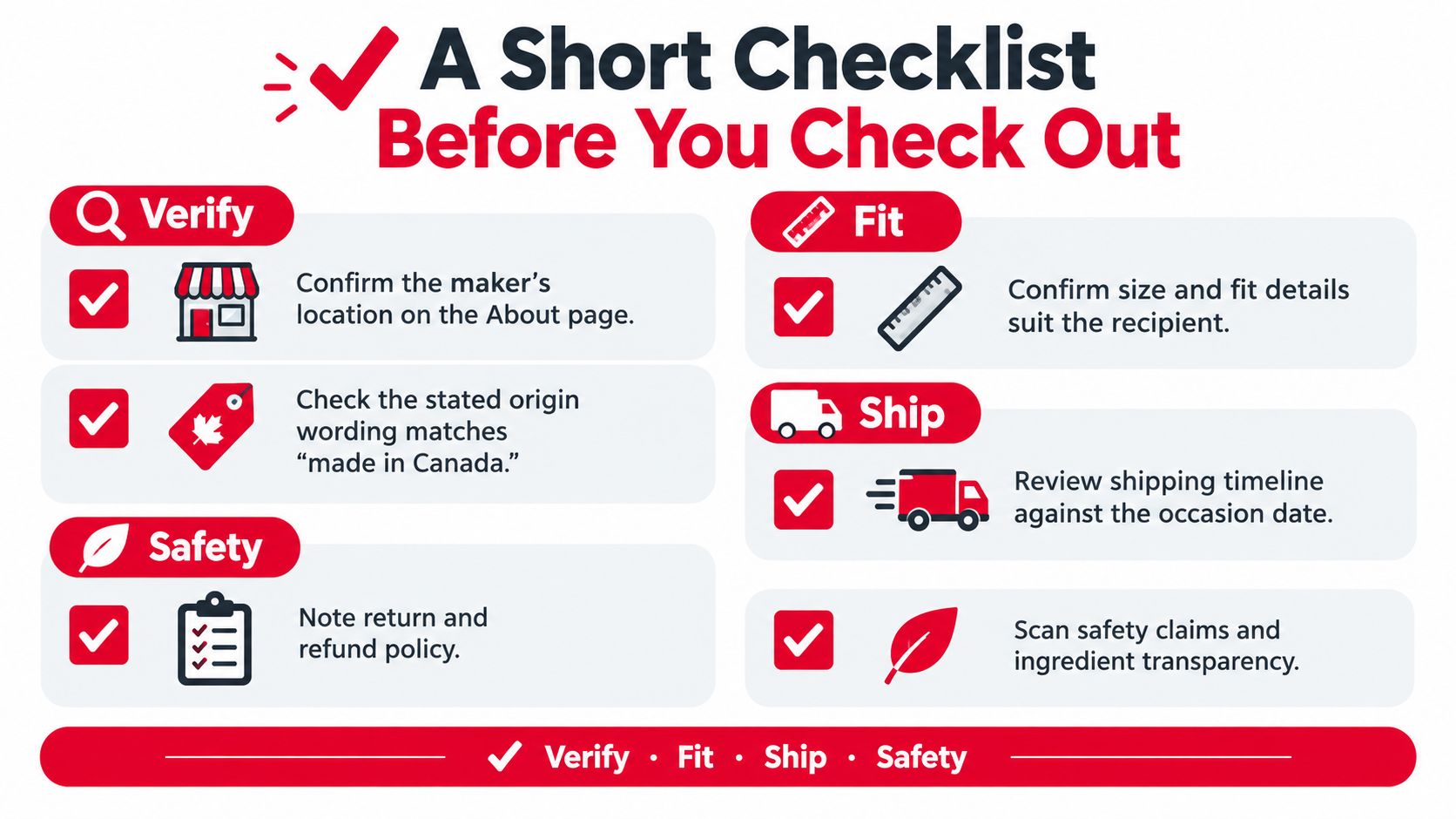
Run this review before entering your payment details. It catches the most common problems without turning a simple gift into a research project.
- Verify the maker: Find a specific Canadian location on the About page.
- Verify the wording: Confirm that the product says made in Canada, made in Ontario, or hand-poured in a named Canadian location.
- Check the fit: Review size, scent notes, wick type, vessel details, and stated burn information.
- Check the shipping: Match the carrier's delivery range to the occasion date, especially for rural or northern addresses.
- Read returns: Confirm whether the item must be unused, how long you have to return it, and who pays return shipping.
- Question safety claims: Look for materials and care instructions rather than vague promises.
Check the total cost, including shipping and any applicable charges, if the retailer appears to be dropshipping from outside Canada. A Canadian-looking storefront doesn't necessarily mean the parcel leaves a Canadian workshop.
For shoppers who want a straightforward local option, Shivora Candles offers hand-poured soy candles and soy wax melts made in Ontario, Canada, with product information that identifies the wax format, fragrance, and wick options. Use the same verification standard with any maker, including Shivora, and consult the candle care guide for practical use advice.
Common Questions About Canadian Gifts Online
How long does standard shipping take within Canada?
It depends on the destination and service. Canada Post lists Regular Parcel at 4–13 days for most standard Canadian areas and 7–14 days for northern regions and remote centres, excluding the mailing day, weekends, and statutory holidays. Order earlier for a fixed event date, and leave additional room for weather or holiday disruption.
Which couriers do Canadian candle shops use?
The shop should tell you at checkout or in its shipping policy. Canada Post is directly relevant for domestic parcels deposited in Canada, but a seller may also use another carrier based on destination, parcel size, or service availability. Don't guess. Ask which carrier will handle the parcel and whether tracking is included.
Do online candle shops ship to PO boxes?
Policies vary by carrier and seller. Check the shipping page before ordering, particularly if the recipient uses a rural route or PO box. If the shop doesn't state its address rules, contact customer service before paying rather than discovering the restriction after the order is processed.
Can I return a candle after it's been burned?
Usually, returns depend on the seller's published policy and the product's condition. Treat an unburned candle and a burned candle differently, and read the return instructions before gifting. If you're organising several gifts at once, you can also browse EasyRegistry for easy gifting to coordinate recipient preferences, then send the appropriate item directly.
Once the candle arrives, trim the wick, place it on a stable heat-resistant surface, keep it away from combustible materials, and never leave it burning while you sleep or leave the room. The Candle Care & Safety page is the sensible next stop for anyone who wants the gift to last.
Shivora Candles offers hand-poured soy candles and wax melts made in Ontario, Canada, with Canada-wide online ordering and practical candle-care guidance. Visit Shivora Candles to choose a Canadian-made home fragrance gift and confirm the product, shipping, and care details before checkout.

