

You've found a candle holder that looks right for your side table, but the candle's base seems a little snug and its flames would sit close to the rim. If you're searching for candle holders 3 wick options, start with fit rather than finish. The right holder needs to support the candle, contain possible wax spills and tolerate heat without crowding the flames.
Table of Contents
- Candle Holder 3 Wick Sizes at a Glance
- Why Three Wicks Change What a Holder Must Do
- Materials That Handle Three Flames Well
- Matching Candle Formats to Three-Wick Holders
- Safety Checks Before You Light Three Wicks
- How to Trim and Light Three Wicks Safely
- Frequently Asked Questions About Three-Wick Holders
- Choosing the Holder and Candle Together
Candle Holder 3 Wick Sizes at a Glance
A three-flame candle on a narrow side table can look beautifully balanced until you notice how little room surrounds it. A suitable three-wick holder gives a purpose-built candle stable support and adequate clearance without interfering with its designed wick spacing or melt pool.
First, distinguish the candle vessel, which contains the wax and wicks, from an outer holder, which supports a finished jar or pillar. An outer holder can't correct poor wick placement inside a candle. Don't add wicks to an existing candle or pour wax into decorative containers unless they're specifically intended for candle making.
The following bands are approximate shopping guides, not tested safety standards. The candle maker's dimensions and the holder manufacturer's compatibility instructions take priority.
Three-wick holder size bands and fit notes
| Inside diameter | Typical candle format | Wick spacing to check | Fit note |
|---|---|---|---|
| Under 3 in (7.5 cm) | Smaller single-wick formats | Don't squeeze multiple wicks together | Choose a different format rather than improvising a three-wick candle |
| 3 to 4 in (7.5 to 10 cm) | Compact candle formats | Confirm that the candle was designed and tested with its existing wick arrangement | Width alone doesn't establish three-wick suitability |
| 4 to 6 in (10 to 15 cm) | Mid-size three-wick jar or pillar base | Look for an evenly arranged, purpose-built wick layout | Compare this shopping band with the candle's actual base diameter |
| Over 6 in (over 15 cm) | Large pillar or statement vessel | Wicks should sit well apart within the maker's design | Confirm burn instructions, support and clearance from nearby objects |
Measure the usable base
Run a ruler across the widest inside point of the holder's base, not across its outside rim. Then check the narrowest opening through which the candle must pass, especially if the holder curves inward.
For a loose, open tray, a finger-width margin around the candle base can be a useful handling allowance. It isn't a heat-clearance standard, and it doesn't establish whether an enclosed holder has adequate ventilation.
Fit check: The candle should sit centred and flat without wedging against the sides, rocking or overhanging its support.
For a jar candle, the melt pool may approach the jar wall as intended. For a pillar, the maker may require an intact outer wax wall, so don't apply jar-candle burn advice to every format.
Why Three Wicks Change What a Holder Must Do
Two wicks set 2 cm apart in a 10 cm jar can form one connected melt pool as the wax softens. That pool's reach, along with the spacing between all three wicks, helps determine how the candle should sit in its holder. Start with the candle's layout and burn behaviour, not the vessel's appearance.
The holder's role is to support the candle without interfering with its intended design. An opening that crowds the flames can restrict space around them, while a tray that is too small may not catch drips from the candle it supports. The base should sit level and remain steady, especially while the wax is liquid.
Health Canada's candle-safety publication reports that candles accounted for 1.1% of Canadian home fires in the early 1980s and 4.7% by 2001, an increase of approximately 327% relative to the earlier rate. It also places candles fifth among causes of Ontario house fires between 1998 and 2002, behind cooking equipment, heating equipment, electrical-distribution equipment and smokers' articles. These are historical figures, not a description of today's fire rate. They underline why a holder should function as support and containment, not merely as decoration.
The practical checks are straightforward: keep the candle centred, leave the wick arrangement unobstructed, and use a holder suited to the candle format. A jar's melt pool may approach its wall as intended, while a pillar may need its outer wax wall to remain intact. Follow the candle maker's burn instructions rather than applying one format's guidance to another.
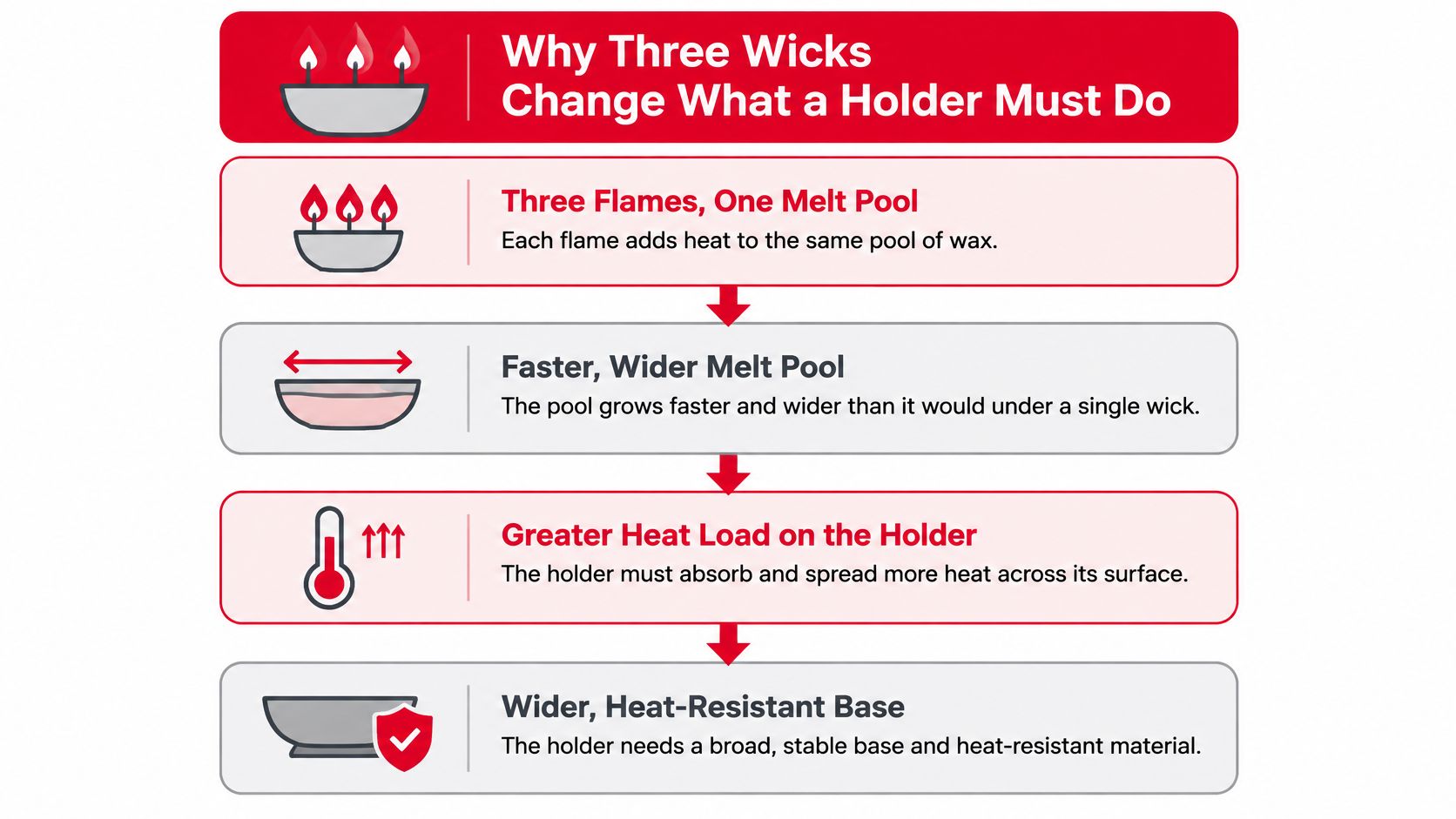
The diagram summarises heat-related design considerations, but it cannot predict how quickly a specific candle will melt. Wax, wick selection, vessel design and the maker's instructions all affect the burn. For everyday soot prevention, check the wick and flame behaviour; a tighter enclosure is not a fix for a candle that is burning poorly. Shivora Candles' Candle Guide resources offer guidance on burn habits.
Materials That Handle Three Flames Well
Holder materials compared for three-wick use
| Material | Heat handling | Stability | Cleaning | What to check |
|---|---|---|---|---|
| Ceramic or stoneware | Choose material expressly suitable for candle heat; thickness and glaze alone aren't proof | A substantial, flat base can provide good support | Smooth glaze is easier to clean than a porous surface | Candle-use suitability, intact glaze, no cracks and a flat base |
| Heat-resistant glass | Use glass identified by its maker as suitable for candle use | Depends on base width, shape and weight | Easy to inspect; avoid sudden temperature changes | Intended use, undamaged walls and an adequately broad base |
| Metal, including iron, brass or steel | Conducts heat, so the exterior can become hot | Heavy, low-profile designs can feel secure | Remove cooled residue without damaging the finish | Manufacturer's instructions and suitable protection underneath |
| Wood or wood-base | Combustible; decorative use needs a purpose-designed non-combustible insert | Depends on the construction | Wax can enter unfinished surfaces and joints | A compatible insert, separation from heat and clearance from flames |
| Cement or concrete | Candle-use suitability depends on the complete vessel design | Weight can help, but the base still needs to sit flat | Porous surfaces can retain wax | Candle-rated construction, appropriate liner or sealant and an intact base |
Weight helps, but construction decides
A substantial stoneware holder may feel steadier than a lightweight decorative stand. However, weight doesn't compensate for a rounded foot, a narrow pedestal or a candle that overhangs the platform.
Look underneath before buying. A holder should rest evenly, without wobbling when you gently check it while empty and unlit.
Likewise, thick walls aren't a heat-resistance certificate. Decorative glass, glazed pottery and concrete containers shouldn't be assumed suitable just because they look substantial.
Give wood the most scrutiny
A wood-wick candle and a wooden candle holder are different things. The former describes the wick; the latter places combustible material around or beneath a heat source.
For a wood-base design, look for a purpose-built metal or suitable glass insert that keeps the candle and hot wax away from the wood. A non-combustible tray beneath the assembly may help catch drips, but it doesn't make an unsuitable wooden enclosure appropriate for burning.
Avoid improvising with a wooden bowl, a coaster tucked inside a decorative box or an insert that leaves flames close to exposed timber. If the maker doesn't identify the assembly as suitable for that candle, choose another holder.
Clean without stressing the material
Let the candle and holder cool fully before cleaning. Where the maker permits it, gently lift accessible wax residue with a plastic scraper rather than a sharp metal tool.
Don't pour hot water into cold glass or place hot glass on a cold surface. For sealed concrete, coated metal or glazed ceramic, use the cleaning method recommended for that finish.
Material reminder: A holder can become hot even when it's suitable for candle use. Never test its temperature with your hand during a burn or expect a decorative finish to keep the exterior cool.
Thin glass and thin metal deserve particular scrutiny. Choose documented candle-use suitability over assumptions based on appearance.
Matching Candle Formats to Three-Wick Holders
Candle formats and their fit in a three-wick holder
| Candle format | Fits a three-wick holder? | Check before use | Styling idea |
|---|---|---|---|
| Purpose-built three-wick jar candle | Yes, if the outer holder is compatible | Jar base, opening clearance and any enclosure restrictions | Place on a clear sideboard with a suitable tray |
| Three-wick pillar | Often, with appropriate support and wax containment | Flat base, no overhang and sufficient drip-catching space | Use a simple tray, with decorative greenery kept away from the candle |
| Single-wick jar or tumbler | Only if the holder is expressly suitable for that finished candle | Secure support and manufacturer compatibility | Pair with an appropriately sized open tray |
| Tealight or votive trio | Sometimes, in a purpose-designed arrangement | Correct individual cups and separated flames | Arrange on a non-combustible tray, away from table linens |
| Wax melts | No, they belong in a compatible warmer | Warmer instructions and suitability for the melts | Use an electric warmer on an appropriate surface |
Choose the holder by the finished candle's base diameter and format. A label such as “three-wick holder” may describe an open pedestal, a decorative sleeve or a tray with separate candle positions. Each design supports a different format, so check how the candle sits and how much space remains around it.
A single-wick jar isn't automatically incompatible
An open tray may suit a single-wick candle if the jar's base sits securely and the holder is expressly compatible with that candle. Check the fit rather than relying on the holder's product name.
A small jar can rock in a shaped recess or sit awkwardly on raised supports. If it doesn't sit properly, select a holder designed for that candle. Don't fill a gap with paper, fabric or another improvised material. Adding extra wicks to make a single-wick jar match a holder's description is not an appropriate fix.
Pillars need drip-catching space
A pillar's full base should rest on flat support, with enough surrounding surface to catch melted wax. A raised edge can help contain drips, provided the candle doesn't overhang the support.
Keep the pillar upright and follow its burn instructions. Its melt pool may reach differently from the pool of a container candle, so size the holder around the candle's base and how far the wax is expected to spread. Wick spacing and melt-pool reach are more useful sizing clues than the vessel's appearance alone.
Wax melts are a separate format. They have no wick and belong in a compatible warmer; an electric warmer gives fragrance without an open flame. Check the warmer's instructions and suitability for the melts before use.
For styling, a clear dining table or sideboard gives the holder a stable surface. Keep paper, greenery and fabric away from the candle.
Safety Checks Before You Light Three Wicks
A three-wick candle can look balanced while its flames sit too close together. Health Canada advises choosing a design with well-spaced wicks and a sturdy holder that resists tipping. Wick spacing belongs to the candle's original design, so check how the flames sit within the vessel and whether the holder can contain and support it securely.
Health Canada's candle-safety guidance says multiple-wick candles can pose added fire risks: closely spaced flames may merge or burn near each other, concentrating heat and creating a large pool of hot wax that can cause burns. Use that information to judge the setup, not its appearance alone. Look for a stable, heat-resistant holder with an unobstructed opening and instructions for the candle format.
The checklist below can help you assess the placement before lighting.
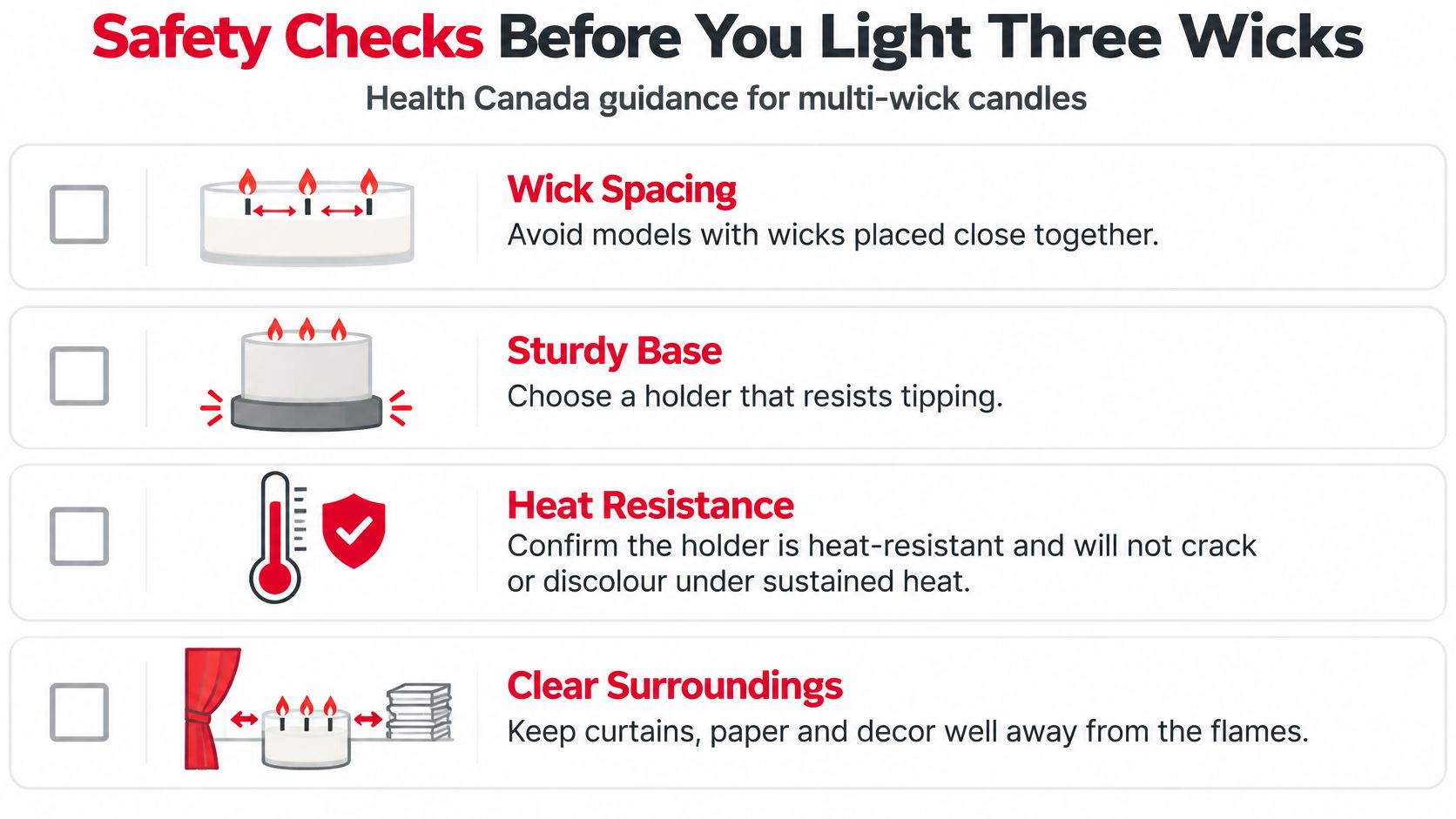
Check the actual location
- Level support: Place the holder on stable furniture and a heat-resistant surface. Keep it out of spots where it could be knocked over.
- Clear surroundings: Move curtains, paper, clothing and decorations away. Leave space above the flame, clear of shelves and other combustible objects.
- Calm air: Keep the candle away from vents, fans and draughty windows.
- Active supervision: Stay in the room while it burns, and extinguish it before sleeping.
- Children and pets: Set it where they cannot reach or disturb it.
- A defined stopping point: Follow the maker's maximum burn time and remaining-wax limit. Stop before the candle burns down to the vessel's base.
For more help deciding where to place a candle and how to build a safe burn routine, see Shivora Candles' guide to candle safety rules.
Read the Canadian instructions
Canadian candle requirements include the Candles Regulations under the Canada Consumer Product Safety Act. The Candles Regulations prohibit candles that reignite spontaneously after extinguishing. Mandatory consumer information, use instructions and safety warnings may also be subject to English-and-French requirements under the Consumer Packaging and Labelling Act.
Before buying or lighting, check that you can understand the instructions in both official languages. They should explain wick trimming, placement, supervision and burn limits. Keep them after opening the candle, rather than throwing them away with the packaging.
How to Trim and Light Three Wicks Safely
Start with a fully cooled candle and its care label. A good routine gives every wick attention rather than trimming whichever one looks longest.
Use this visual as a reminder alongside the candle maker's instructions.
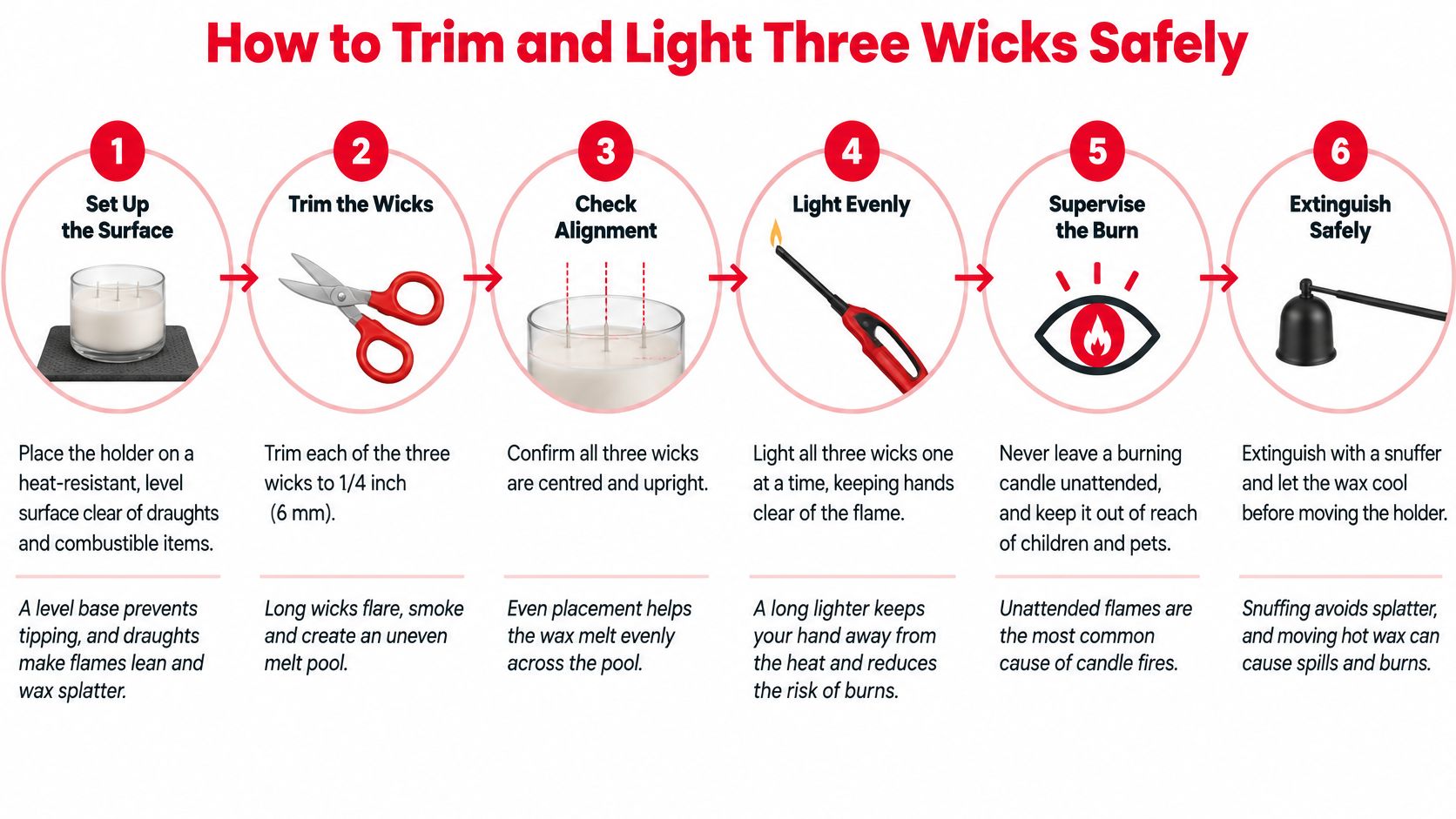
Follow a deliberate lighting routine
- Prepare the surface. Set the holder on a level, heat-resistant surface, with the placement checks already completed. Position everything before lighting so you won't need to move hot wax.
- Trim every wick. The National Fire Protection Association's educational guidance recommends 1/4 inch, or 6 mm, before burning, using a wick trimmer, nail clipper or scissors, and identifies long or crooked wicks as possible causes of uneven burning, dripping and flaring. Check each wick, not just the centre one; follow any specific wood-wick directions on the candle.
- Remove loose material. Lift out trimmings and debris before lighting. Before relighting a wood wick, remove its loose charred portion and keep it short and clean without digging into the wax.
- Light individually. Use a suitable lighter to reach each wick while keeping your hand clear. If flames merge, flare or remain unusually large, extinguish the candle rather than assuming they'll settle.
- Watch the first melt pool. For a soy container candle, let the wax melt evenly across the top, approaching the vessel edge as its maker directs. Don't exceed the stated burn limit while trying to achieve a particular appearance, and don't apply this advice unchanged to pillars.
- Reassess during longer burns. If a wick needs trimming, extinguish the candle and let it cool before working on it. Never reach into a burning candle or cut a wick above liquid wax.
- Extinguish before leaving. Use a candle snuffer, or a lid only when the manufacturer explicitly identifies it as an extinguishing tool. Leave the candle in place until the wax and holder have cooled.
For more detail on tools and technique, use our guide to trimming candle wicks.
Notice when the burn changes
One flame leaning persistently, a wick drowning, repeated flaring or wax melting mainly on one side all deserve attention. Extinguish, cool and inspect the candle rather than tilting the vessel or adjusting a burning wick.
The accompanying video is another care reference; the instructions supplied with your candle remain the priority.
Consult the candle's care and safety information before relighting after an irregular burn.
Frequently Asked Questions About Three-Wick Holders
Can a pillar candle sit securely in a three-wick holder?
Check the candle's base, not just its top width. If the pillar's base is too narrow for the holder's support points, it can wobble or tip. Set it on a level surface and check that it stands upright without rocking before lighting. A snug, stable fit matters because the holder must contain the candle safely as it burns.
What should I do if one wick tunnels?
Extinguish the candle and let it cool before deciding what to do. Tunneling means one area of wax has melted lower than the surrounding surface. Check that the candle is level and that its wicks are positioned as intended. If the uneven burn persists, follow the candle maker's care instructions rather than shifting a wick or adding an enclosure.
How can I tell whether a pillar's base is too narrow?
Try a gentle stability check while the candle is unlit: if it rocks when lightly touched, it isn't secure enough. The holder should support the candle without tilting it or putting pressure on one edge. A wider top does not compensate for an unstable base.
Before relighting: If you can't identify why a candle burned irregularly, don't try to correct it by adding an enclosure, moving wicks or changing the wax.
Choosing the Holder and Candle Together
A holder can look wide enough and still fail to support a candle safely. Start with the wick spacing and the area the first melt pool needs to reach, then check the candle's dimensions and care label. If choosing a holder first, use size bands only to narrow the options.
Check the base for stable support, and make sure the materials suit candle use. Keep combustible parts protected and instructions clear. Once these practical details are settled, browse decorative candle holder ideas for Canadian homes for styling inspiration.
Match dimensions rather than ounces
Shivora Candles offers soy candles and wax melts, with candles available in 4 oz, 8 oz and 10 oz sizes. Ounces describe candle weight, not jar diameter or wick spacing. Choose a holder for the specific candle, and use three-wick sizing guidance only for a candle designed with three wicks.
The Mango & Coconut Soy Candle Canada – 8 oz Cotton Wick and Birchwood & Cranberry Soy Candle Canada – 8 oz Cotton Wick are both 8 oz cotton-wick candles. Their listed size and wick type do not make them three-wick candles.
This product image shows the Mango & Coconut candle, not a universal holder-size reference.

A holder's job is to contain and support the candle, while leaving its intended wick arrangement unobstructed. Use the candle's own dimensions and care instructions to make the final match.
Visit Shivora Candles to browse candles and wax melts, then choose a holder based on the candle's actual dimensions and care requirements.

