

The word “soy” on a candle label settles less than shoppers think. Soy wax starts as soybean oil, which is refined and hydrogenated into a solid, plant-derived wax. That tells you the main ingredient can fit a vegan standard. It says nothing about what else went into the jar.
Online marketplace listings and retailer product pages often lead with “soy candle” because the phrase reads as cleaner and more natural. Treat it as a starting point, not proof. A soy-labelled candle can still use a blended wax, a fragrance formula with animal-derived materials, a wick coating, dye, adhesive or processing aid that fails the same standard.
Check the candle as a whole product. Start with the wax, then ask about fragrance, wick, colourants, adhesives and manufacturing aids, and favour makers willing to answer each component directly. That procedure works at a farmers' market, a small Canadian shop or a national retailer.
Table of Contents
- Are Soy Candles Vegan? Why Wax Alone Is Not Enough
- How Soy Wax Is Made and Where It Comes From
- Checking Every Component for Vegan Status
- Vegan Is Not the Same as Cruelty-Free
- Burn Safety Still Applies to Vegan Candles
- Quick Answers About Vegan Soy Candles
- Confirm Vegan Status Before You Buy
Are Soy Candles Vegan? Why Wax Alone Is Not Enough
A soy candle qualifies as vegan only when every ingredient and production aid in the finished product is plant-based. The Government of Canada guidance on vegan and vegetarian claims defines vegan products as made only from plant-based ingredients, and it notes that vegan claims can reach beyond the ingredient list into how a product is made. For a candle, that pulls the wick, the colourants, the fragrance materials, the adhesives and the processing aids all inside the claim.
A cake works the same way. You would never call it vegan because the flour came from wheat; the butter in the icing decides the answer. In a candle, the wax is the flour. It is the largest ingredient and the easiest one to check, which is exactly why it makes such a convenient marketing hook and such a weak proof on its own.
Federal candle rules will not settle this for you. The Candles Regulations apply to candles imported, advertised or sold in Canada, and their concern is safety: a candle must not spontaneously reignite after being extinguished. They set no vegan standard and require no vegan wording on packaging, so any vegan claim on a jar is one the maker substantiates on their own.
That is what a real whole-product claim looks like. When a Canadian maker such as Shivora Candles states that its candles contain no animal products and are never tested on animals, it is asserting something about the full formulation, not just the wax.
The wax, the fragrance, the wick and the finishing materials each need a separate answer before a candle earns the label, and the component checklist further down walks through them one at a time.
The working rule: the word soy tells you what the wax started as. It says nothing about what else went into the jar.
How Soy Wax Is Made and Where It Comes From
The manufacturing process is short, and seeing it explains why the vegan question moves so quickly from the wax to the rest of the candle.
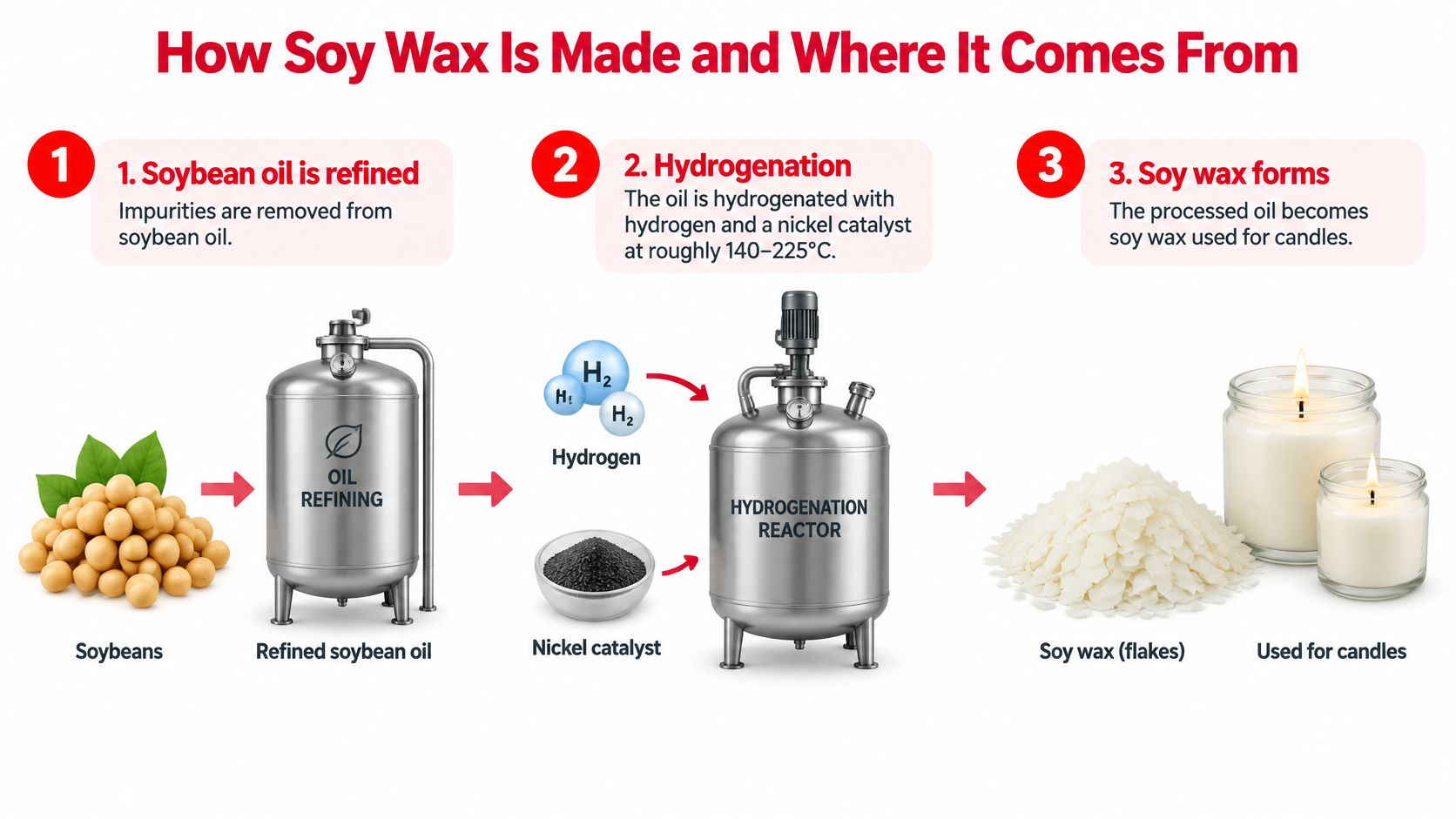
- Refining. Soybean oil is refined to strip out impurities, gums and free fatty acids, leaving a clean oil base.
- Hydrogenation. The refined oil is hydrogenated so its unsaturated fatty acids become saturated or partially saturated. The USDA technical documentation on soy wax describes this step at approximately 140–225°C using hydrogen and a nickel catalyst.
- Solidifying and blending. Raising the melting point turns the liquid oil into a solid wax, which is then blended with any additives and poured into candles.
Nothing in that sequence adds animal material. That's why soy wax is generally compatible with a vegan formulation, and why the question has to shift to the complete formulation and the manufacturing process rather than the word on the lid.
Blends are where the answer changes. A maker can start with soy and add paraffin for a stronger scent throw, beeswax for firmness, tallow, or stearic acid as a hardener. Stearic acid is the sneaky one, since it can be sourced from animal fat or from palm and other vegetable fats, and a supplier statement is the only way to know which. "100% soy wax" supports a plant-based wax specification and nothing further; it doesn't cover fragrance, dye, wick treatment, adhesive or shared equipment.
For a Canadian buyer, that means asking for the wax supplier's ingredient statement and written formulation records. Batch-level documentation beats a wax name every time. Our comparison of soy wax and paraffin wax in Canadian candles covers how those blends behave in the jar.
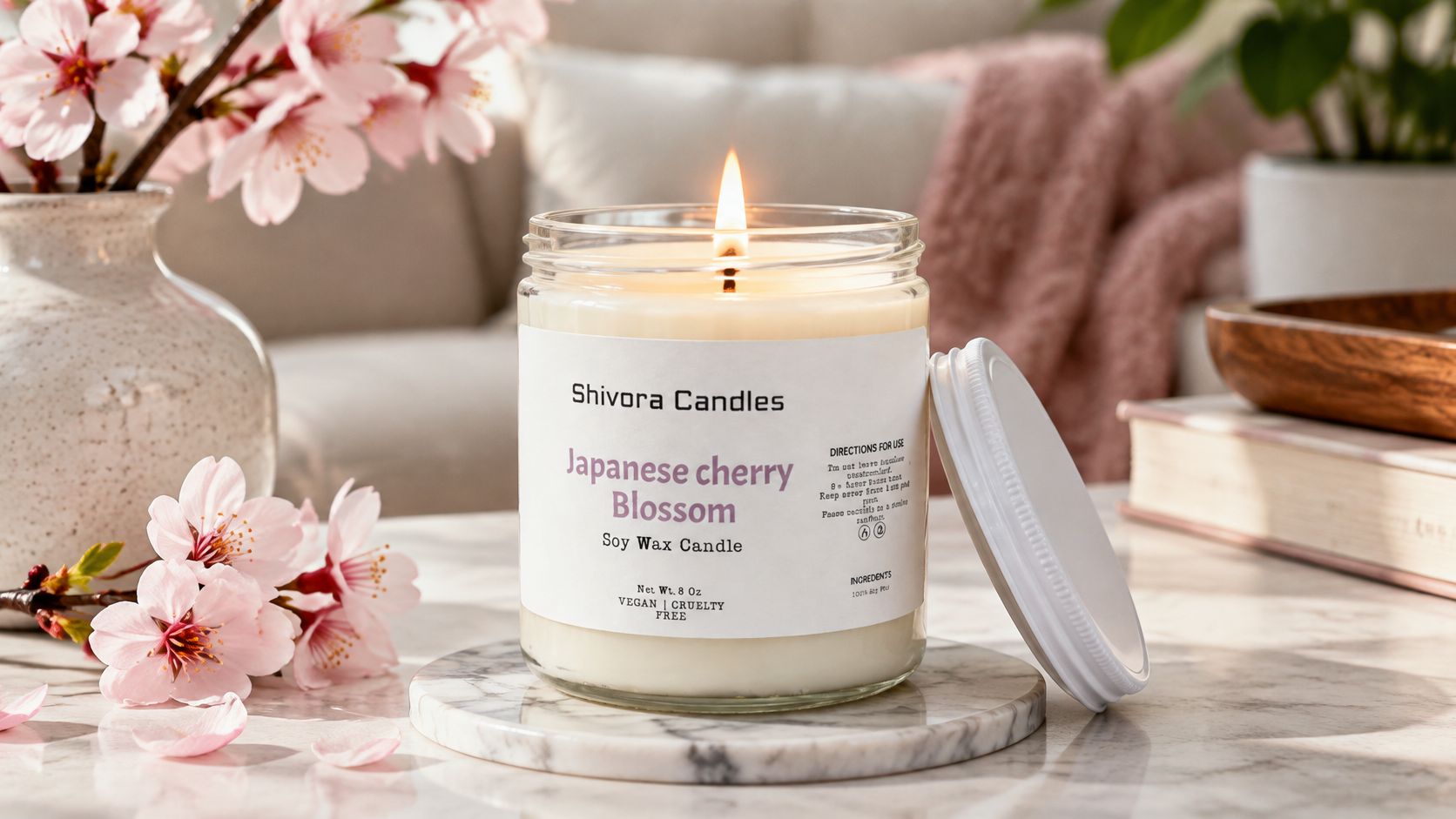
A candle like the Japanese Cherry Blossom Soy Candle Canada – 8 oz Cotton Wick is a useful example of the labelling you want to see: 8 oz, soy wax, lead-free cotton wick, hand-poured in Ontario, Canada.
If you'd rather see wax behaviour than read about it, this walkthrough covers pouring and how the finished wax sets:
Checking Every Component for Vegan Status
A candle is vegan only when the whole object clears the test: wax, scent, colour, wick assembly, adhesives, and the production steps behind them. The Canadian Food Inspection Agency labelling guidance describes vegan products as made only from plant-based ingredients while noting that added criteria may apply; certification schemes often go further and look at processing aids and shared equipment, not just the recipe.
Use the table as a pass/fail worksheet. Any row without paperwork stays a risk.
Candle component checklist for vegan status
| Component | What could be animal-derived or unclear | Question to ask the maker |
|---|---|---|
| Soy wax | A soy label can still hide a blend or an animal-derived hardener; the exact percentage and hardener source need proof | Is the wax 100% soy, and do you have a supplier ingredient statement? |
| Fragrance oils | Scent formulas are proprietary; fixatives, carriers or fatty-acid inputs may be undocumented | Are all fragrance materials plant-based, and does the supplier confirm this in writing? |
| Dyes and colourants | Some colourants, such as carmine, come from insects | Which colourants are used, and are they plant-based or synthetic? |
| Cotton wick | Plant-based fibre; coatings or binders may not be | Is the wick coating or binder plant-based? |
| Wood wick | Wood is plant-based; tab adhesives and coatings need checking | Which adhesive holds the wick tab, and is it documented? |
| Labels and packaging | Adhesives and inks may contain animal-derived materials | Are label adhesives and packaging materials documented? |
Applying the checklist to a real label
A label can be truthful and still incomplete. A jar that reads 100% soy wax, cotton wick, cedar and amber tells you the wax spec and the fibre, but nothing about the fragrance fixative, wick binder, tab adhesive or colourant. If the scent supplier later confirms an animal-derived fixative, the candle fails even though no line on the jar was false.
Two phrases deserve special suspicion. Phthalate-free is about plasticizers. Cotton wick or wood wick names the material, not the coating, binder or adhesive. Fragrance is the hardest row to close: the Canada Gazette notice on cosmetics requirements shows Health Canada requiring cosmetics to disclose ingredients while allowing fragrance mixtures to be grouped under terms such as "parfum" or "fragrance". Candles generally aren't cosmetics, so assume even less disclosure unless the maker supplies it.
How to read a listing in five steps
- Confirm the wax specification and any non-soy remainder. Get the percentage, not the marketing name.
- Request the fragrance supplier statement. It should cover every material in the scent, not just the top notes.
- Confirm the wick and its finish. Ask about coating, binder and the adhesive holding the tab.
- Check dyes and label adhesives. Colourants and glues are the two most forgotten rows.
- Keep testing claims in a separate column. They answer a different question and never substitute for ingredient proof.
Our guide to clean burning candle ingredients that matter explains what these materials do in the burn. If a maker answers four rows and goes quiet on fragrance, treat the fifth row as failed until paperwork exists.
Vegan Is Not the Same as Cruelty-Free
Vegan answers what's in the candle. Cruelty-free answers how it was tested. Asking whether a recipe uses eggs and asking whether the kitchen passed inspection are different questions with different evidence behind them.
That produces two outcomes shoppers rarely expect. A candle can be cruelty-free and still contain a beeswax blend, so it fails the vegan test. A candle can be fully vegan in its ingredients while its fragrance materials were tested on animals, so it fails the cruelty-free test. Neither label implies the other.
Canada's position is specific. Health Canada's guidance on the animal testing ban says claims suggesting a product was not tested on animals, including the words "cruelty-free" and animal symbols, must be supported by evidence. The federal rules took effect on December 22, 2023, prohibiting certain cosmetic animal testing and the sale of cosmetics whose safety relies on prohibited animal-testing data.
Two limits matter for candles. Those rules don't automatically prove a candle is vegan, because ingredients and testing claims are separate issues. And they create no single government cruelty-free certification standard; Health Canada states companies may determine how to word such claims provided they can substantiate them.
Ask both questions in writing: "Which ingredients are excluded?" and "What is your animal testing policy for fragrance materials?" A maker who can answer one but not the other has told you something useful.
Burn Safety Still Applies to Vegan Candles
Two candles sit side by side in a listing. Both vegan, both 8 oz, one with a cotton wick and one with a crackling wood wick. The vegan check settles which ingredients made it into the jar. It does not settle which candle burns more safely on your shelf, and wick choice is where that answer starts.
Health Canada's candle safety guidance recommends trimming the wick to 5–7 mm, or about 1/4 inch, before lighting and trimming again every 2–3 hours to help prevent high flames. The same guidance warns that some multi-wick candles can create intense heat, ignite nearby materials and produce a large pool of hot wax when wicks sit close together.
That warning matters most at the point of purchase. A vegan label tells you nothing about wick count, wick size or how much heat a candle will throw, so read those details on the listing before you buy. A single cotton wick in a mid-size jar asks for routine trimming and little else. A multi-wick candle raises the heat load the moment you light it, and a wood wick needs the same trim-before-each-burn discipline as cotton.
Pick the wick configuration you will maintain, then follow the care card that comes with the candle, since wick size and wax type vary by product. Our guide to soy candle safety and health in Canada covers ventilation, burn sessions and jar care in more detail.
Quick Answers About Vegan Soy Candles
Are unscented soy candles easier to verify? Yes, and it's a real advantage. Remove added fragrance and the fragrance row drops out of the checklist entirely. The wax, dyes, wick coatings, label adhesives and packaging still need confirmed answers, so unscented is simpler rather than automatic.
Do wax melts follow the same checks? They follow most of them. A wax melt has no wick, so the wick rows fall away, while wax, fragrance, dyes and packaging still apply in full. Our soy wax melts are hand-poured in Ontario, Canada, and the same questions about fragrance supply and colourant sourcing still decide the answer.
Are candle gift sets vegan if each candle is? Not automatically. The box, tissue, ribbon and any included accessory each need their own answer, and a set is only as well documented as its weakest item. Ask about the packaging separately from the candle, because the people who source jars rarely source the box.
What if a maker doesn't answer? Record the row as unclear rather than assuming it's vegan. An unanswered question about fragrance materials is not a yes, and a manufacturer with written supplier information can produce it in an email within a day. Choose the maker who replies.
Confirm Vegan Status Before You Buy
The label on the jar will not settle this. A soy candle's vegan status depends on answers the maker holds about fragrance supply, colourants, wick coatings and packaging, and the only reliable confirmation is a written one. Ask directly, and treat silence as an answer too.
Our own position is straightforward. Every Shivora Candles product is made with 100% natural soy wax, lead-free cotton or crackling wood wicks, and phthalate-free fragrance oils, and our candles contain no animal products, are never tested on animals and are fully vegan and cruelty-free. They are hand-poured in small batches in Ontario, Canada, and we will put the materials details in writing for any item in the collection.
Apply the same checks to an 8 oz cotton wick candle in the floral range, or to a wax melt if you would rather skip the flame. Orders ship flat rate across Canada, and shipping is free on orders of $79.99 CAD or more. Some conditions apply.
Shivora Candles hand-pours soy candles and soy wax melts in Ontario, Canada, using plant-based soy wax, phthalate-free fragrance oils and lead-free cotton or wood wicks, and every product is vegan and cruelty-free. Run the component checklist against any candle in the collection before you commit, and ask us for the materials details you need. Visit Shivora Candles to browse the soy candles and wax melts available for delivery across Canada.


