

You've got the guest list, the venue, and the dress sorted, and now the candles are sitting there in your head, changing the whole feel of the day. Maybe you're picturing a candle-lined aisle, a unity candle at the altar, and soft light around dinner tables, then the practical questions hit at once, what kind of candle goes where, how much scent is too much, what holders are stable, and whether the venue will allow a real flame at all.
For Canadian couples, those choices matter because a wedding can move between a religious service, a civil ceremony, a tented reception, or an intimate dinner in one day. A good candle plan has to work in every space, not just look pretty in one photo. If you're building a reception layout too, a practical wedding reception planning checklist can help you keep the décor, timing, and guest flow in one place.
Shivora Candles makes hand-poured soy candles and wax melts in Ontario, Canada, so candle styling can be part of the planning conversation rather than an afterthought. The rest of this guide keeps things simple, from ceremony symbolism to scent zones, venue rules, and what to hand to your day-of coordinator.
Table of Contents
- A Couple's First Walk-Through of Candle Decisions
- Understanding the Unity-Candle Ritual
- Choosing Candle Types, Sizes and Holders
- Picking Scents That Work Across the Day
- Venue Safety Rules Across Canada
- Planning for Guests With Sensitivities
- What Fire Officials Evaluate
- Run-of-Day Timeline and a Natural Shopping Next Step
A Couple's First Walk-Through of Candle Decisions
The first real candle decision usually happens in three places at once. One person imagines tapers along the aisle, another wants the altar table to feel calm and meaningful, and someone else is already thinking about dinner tables and whether the room will feel warm or crowded. Those are all valid instincts, but they point to different candle types and different levels of risk.
Aisle, altar, reception
Aisles tend to favour taller, more visible forms, especially if guests are seated far from the path. Altar tables and ceremony focal points usually need a steadier, more composed look, while reception tables need candles that support conversation instead of competing with it. That's why one wedding often ends up using a mix of tapers, pillars, votives, and tea lights rather than one candle style everywhere.
Practical rule: decide the function first, then choose the candle. Mood comes from placement, not from buying the prettiest jar in the room.
The second decision is scent. Strong fragrance can feel lovely in a getting-ready suite, but it can overwhelm dining areas or clash with florals. The third decision is safety, because a holder that looks elegant in a shop can be a poor fit once linens, bouquets, signage, and moving guests are added to the scene.
The fourth decision is venue approval, and it often shapes the other three. If the room allows open flame only in limited forms, or not at all, that affects quantity, height, holder style, and whether you need a flameless backup. Once those four pieces are clear, the rest of the plan becomes much easier to make sense of.
Understanding the Unity-Candle Ritual
The unity-candle ritual usually uses three candles, two smaller tapers and one larger centre candle. The two tapers often stand for two families, two individual lives, or two histories, while the larger central candle represents the new shared family or future. In many ceremonies, a parent or close relative lights each taper first, then the couple uses those flames to light the centre candle together near the vows or later in the service.
How the sequence usually works
That sequence matters because it gives the ritual a clear visual arc. The separate flames are part of the story, then the centre candle gathers them into one shared moment. Couples often place it near the end of the ceremony because it creates a calm pause before the signing or recessional.
The same format works in churches, civil venues, banquet halls, outdoor ceremonies, and reception spaces. It can also be simplified for intimate weddings where only the couple, or the couple and one witness, are present. The key is not the size of the guest list, it's whether the table, script, and timing support the ritual cleanly.
| Candle | Symbolism | Who Lights It | Typical Timing | Product Note |
|---|---|---|---|---|
| Taper one | One family or one individual life | Parent, relative, or honoured guest | Before the centre candle | Needs a stable holder and a tall, visible shape |
| Taper two | The other family or individual life | Parent, relative, or honoured guest | Before the centre candle | Should coordinate with the first taper |
| Centre pillar | New shared life or family | The couple together | Near the vows or toward the end | Usually the visual anchor of the set |
A simple ceremony table needs enough room for the candles, the officiant's script, and safe movement if attendants are involved. If the venue is tight, the ritual can still work, but the candles need a smaller footprint and sturdier support.
Choosing Candle Types, Sizes and Holders
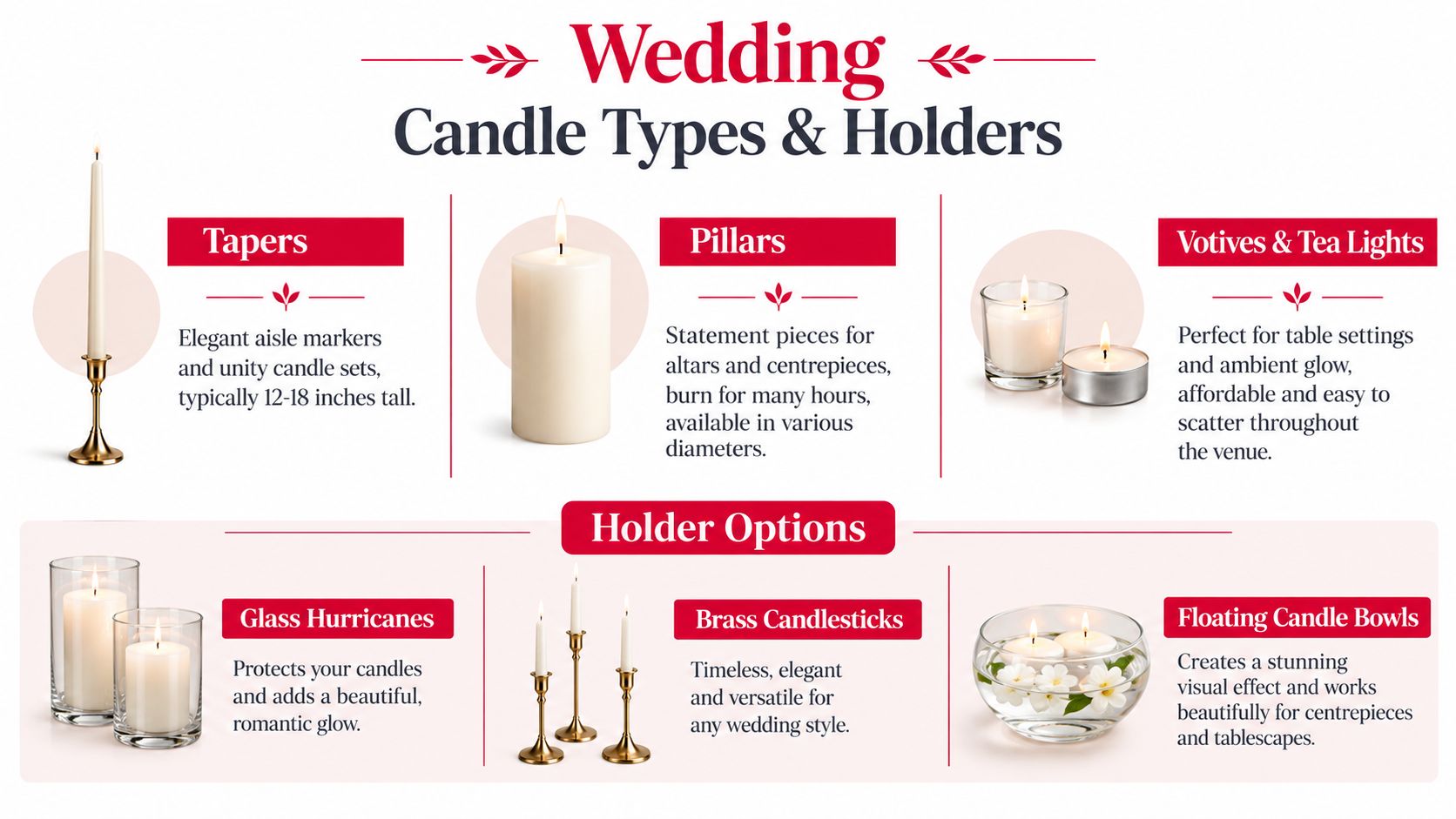
The right candle shape does different jobs in different parts of the wedding. Tapers work well when you want height and ceremony visibility, pillars give you a steadier focal point, and votives or tea lights build a softer glow across tables without taking over the room. Floating candles can be beautiful in bowls or water features, but they need a container that keeps them contained and away from splashes, fabric, and wandering hands.
Matching candle type to the moment
For aisles and unity sets, tapers make sense because their vertical line reads clearly from a distance. Pillars are usually better for altar tables and centrepieces because they feel grounded and can stand up visually in a larger space. Votives and tea lights are useful when the goal is quantity and atmosphere, especially on long table runs where you want light, not bulk.
A good rule is to match height with sightlines and width with stability. Tall tapers need holders that grip them well, while wide pillars need a base that won't wobble or look top-heavy. That's why a shallow dish under a tall taper often feels wrong, and a narrow ring under a wide pillar can look unstable even before the candle is lit.
Holder choices that actually work
Glass hurricanes and cylinders are practical because they create a barrier between the flame and nearby décor while keeping the candle visible. Brass candlesticks suit ceremony tapers and feel formal without being fussy. Ceramic pillars and reusable amber jars are useful for reception tables where you want warmth, colour, and a base that doesn't disappear into the tablescape.
If you're comparing jar formats for the reception, this guide to candle jar sizes is a useful companion. It helps you think about scale before you order too many small pieces or one oversized statement candle that swallows the table.
A candle should look intentional before it's lit. If it only works after the flame goes up, the base is probably too weak for the setting.
Picking Scents That Work Across the Day
A wedding day moves by rooms, and scent should move with it. Fresh citrus can feel bright during getting ready, soft floral notes suit the ceremony, warm woods sit well through dinner, and bakery-style fragrances can work for a late-night send-off. The same candle that feels charming in a suite can crowd a dining room once food, flowers, and conversation are all in play.
Use scent zones, not one scent everywhere
A simple sequence keeps fragrance from taking over. Start the day with lighter, cleaner scents in the getting-ready space, where a touch of citrus or soft herb note can feel awake without hanging in the air too long. For ceremony moments, keep fragrance very restrained or skip it entirely if the altar or aisle is already framed by flowers.
Dinner asks for the quietest hand. Unscented or very lightly scented candles work best near plated meals and head-table settings, while lightly to moderately scented candles fit reception edges such as entry points, lounge corners, and washrooms, where guests pass through instead of sitting still. Stronger fragrance belongs later, such as in a send-off area or a private room, where it can mark the moment without affecting the full guest list. Section on guest sensitivities below covers what to do for guests with asthma or fragrance sensitivity.
For couples thinking about how those candles will read in photos, the wedding photography details to capture guide is useful because it helps you notice the small pieces that show up in close shots.
Wax melts and balanced fragrance
Wax-melt warmers can help when a venue limits open flame but still allows fragrance. They keep scent in one part of the room instead of pushing it across the whole reception, which makes them practical for perfume-like notes that would feel too strong as candles.
If you are comparing scent families for a wedding, this guide to choosing candle scents is a useful starting point. It helps you sort fragrance styles before you assign them to the ceremony, dinner, or late-night hours.
Venue Safety Rules Across Canada
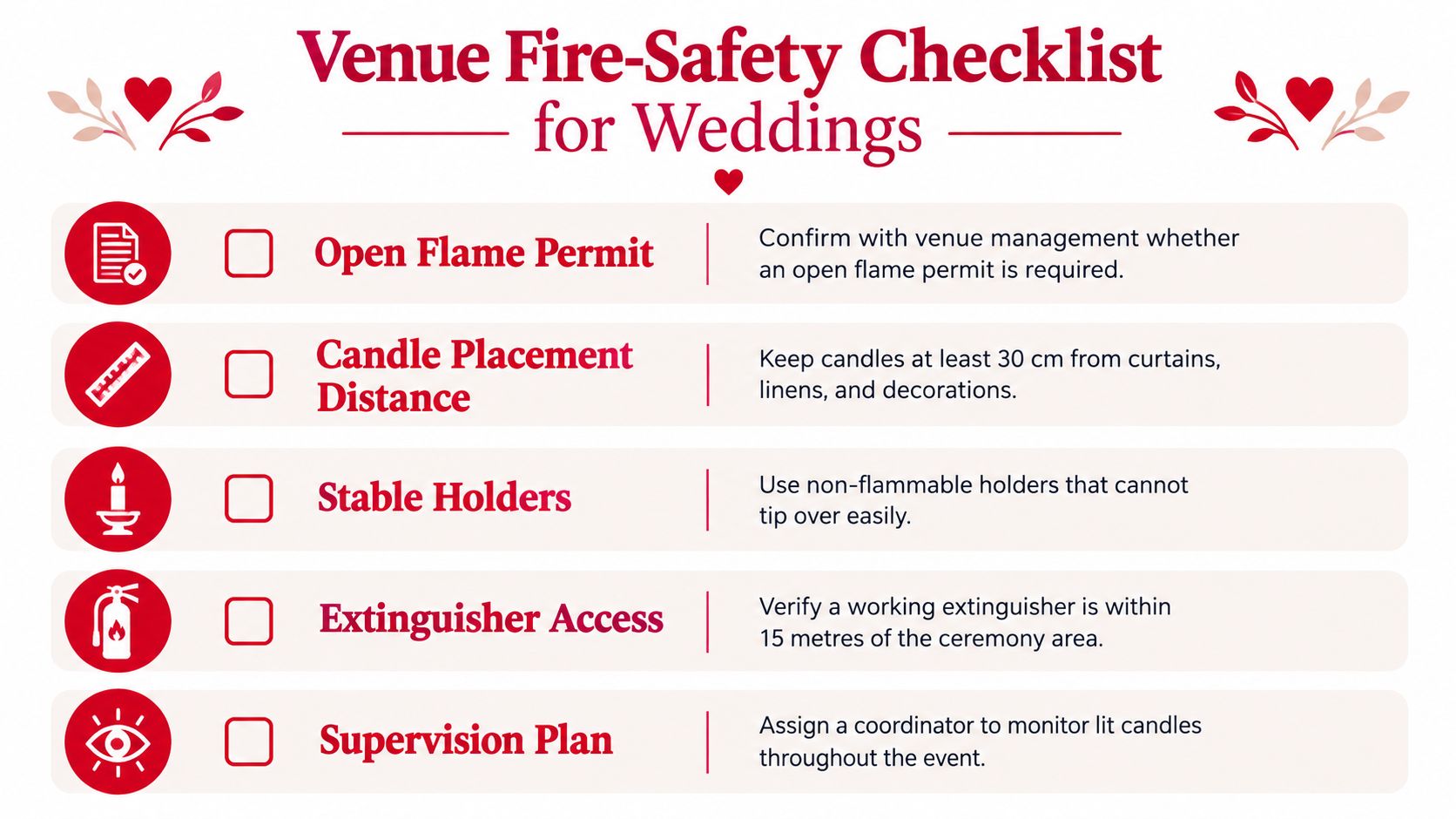
Ontario and Québec don't treat candle displays as casual décor when open flame is involved in public settings. In Ontario public-assembly buildings, open flames can be prohibited when the arrangement creates a fire hazard unless they're approved, and decorative candles need to be securely supported in noncombustible holders and placed so nearby combustible materials can't catch. In Montréal, open-flame devices need a protective element that keeps the flame from contacting combustible materials such as clothing or decorations, and the device must sit in a stable, non-combustible holder.
What to bring to a venue walk-through
A written approval conversation matters before you order large candle quantities. Ask who approves the setup, whether the venue wants the Chief Fire Official involved, and whether the building has rules about holders, supervision, and extinguishing. Religious venues can be treated differently, but they still need notification, so don't assume a church or chapel automatically has the same policy as a banquet hall.
For spacing, Québec's public-safety guidance says to place candles more than 30 cm from flammable objects such as curtains and tablecloths, and Health Canada recommends trimming a wick to roughly 5 to 7 mm before lighting and again every 2 to 3 hours when needed to keep the flame from getting too high. In practice, that means avoiding candles beside draping, paper stationery, florals, or low fabric runners unless the venue has explicitly approved the setup.
Supervision and end-of-night care
Candle safety doesn't stop at setup. Health Canada also recommends sturdy, well-ventilated holders that won't tip, avoiding wooden or plastic holders, using caution with glass that may break if overheated, and never leaving candles burning when no one is in the room. A wedding needs a specific person responsible for monitoring, extinguishing, and cleaning up once the reception ends.
If you want a venue checklist in one place, the candle safety rules guide is a useful companion. It's the kind of page to print before a site visit, especially if your wedding moves between rooms.
Planning for Guests With Sensitivities
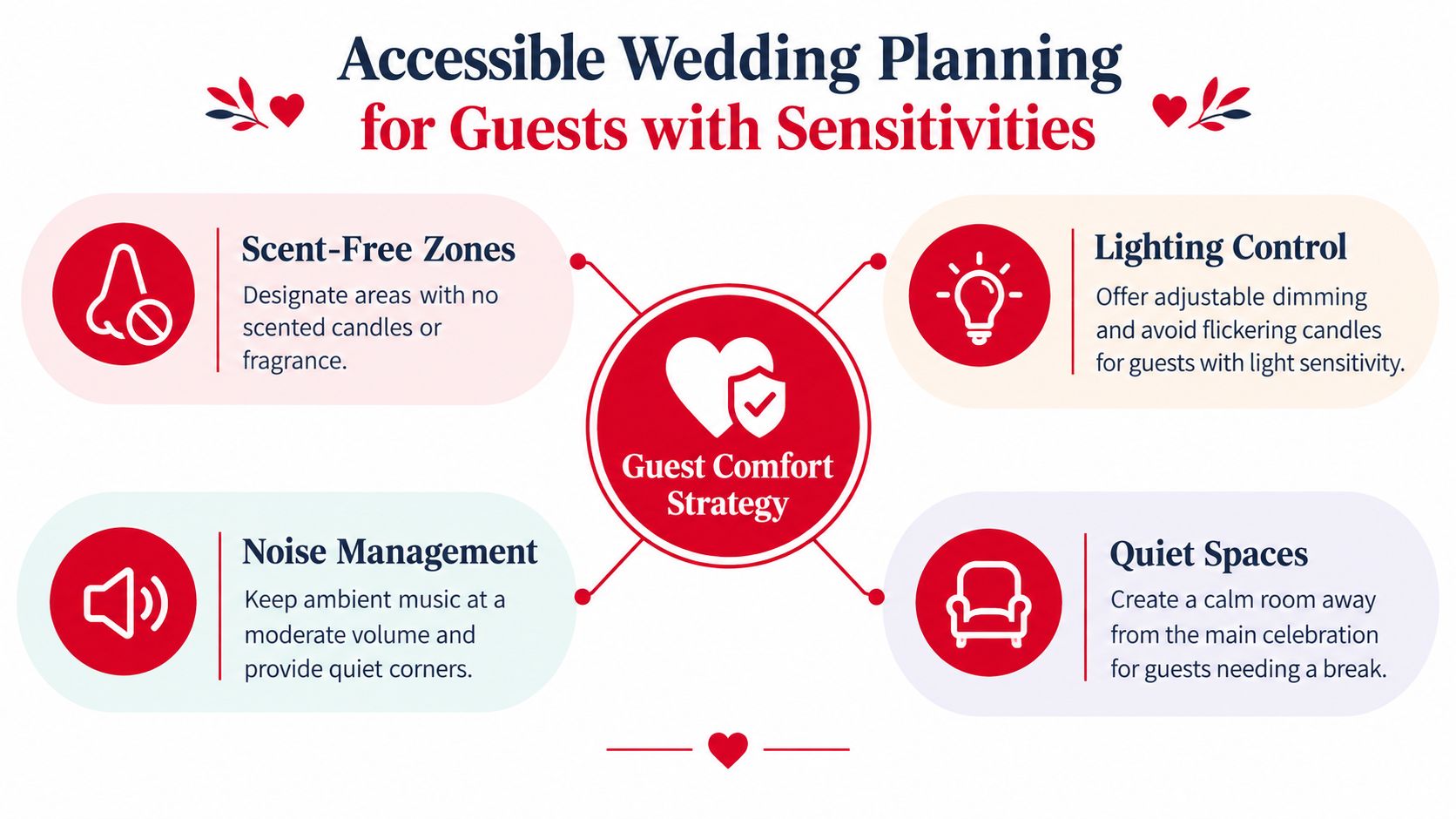
Candles change more than the look of a room. They change how a room feels to breathe in. Guests with asthma, migraines, or fragrance sensitivity can react to strong scents, and too many flames in one space can make air feel heavy even when the venue looks open. Health Canada identifies burning candles as an indoor source of fine particulate matter, so a crowded candle display is an air-quality decision as much as a style decision.
Build a comfort map
Start with the number of candles in the room, then check the room itself. Two or three lightly scented candles in a banquet hall is often manageable, while a dozen in an enclosed tent can become uncomfortable fast, especially if the space has limited airflow. If you can feel scent building at the door, it will usually be stronger at table height.
Say the plan plainly on your wedding website: “lightly scented, soy wax, no cinnamon or strong florals.” That wording helps guests decide before they arrive, and it gives people with scent sensitivity a clear picture of what to expect.
Lighting matters too. Guests who are sensitive to flicker or low light may struggle if candles are packed tightly into one line of sight, especially in lounge corners or photo areas. Comfort covers scent, light, and noise together. A quiet corner, softer music, and a lower candle count can make the whole room easier to stay in.
Give guests a way to opt out
Put the fragrance plan on the wedding website or invitation, and name any scent-free or low-scent spaces the venue can support. Guests with asthma or fragrance sensitivity should not have to guess. If you are using flameless décor, LED candles and wax melts still need venue approval, so the conversation matters even without open flame.
What Fire Officials Evaluate
A candle can look venue-ready and still fail review. Fire-safety officers look at the full setup, including quantity, placement, holder stability, supervision, and the combustible items near the flame, such as linens, florals, paper signage, and hanging fabric.
The setup matters more than the wax label
A soy candle in a paper-lined lantern can still be a poor choice if the lantern, table layout, or surrounding décor creates a hazard. A glass-hurricane-enclosed pillar may be more acceptable because the holder and enclosure reduce contact with nearby materials. The label tells you what the candle is made from, not whether the room can handle it.
Outdoor tented receptions add their own risks. Wind can tip a taper, fabric walls can bring flame too close to soft surfaces, and temporary structures can change how heat moves through the space. A fire officer could cite exposure, unstable placement, or lack of separation from combustibles if the display sits too close to the wall or drape. Religious venues can have different expectations, but written sign-off still matters.
A practical approval mindset
Use this test before ordering anything substantial. Can the candle stand upright, stay clear of décor, remain supervised, and be extinguished without crowding the table or aisle? If the answer is uncertain, the venue is probably the one making the final call.
A candle plan should read like a safety layout, not a mood board. That means checking holder weight, distance from fabric and florals, access to a snuffer, and whether staff can reach each flame without crossing through guests. Written venue sign-off is the only reliable confirmation.
Run-of-Day Timeline and a Natural Shopping Next Step

A smooth candle plan works best when it has a real person and a real clock attached to it. Start with setup, move into ceremony lighting, then hand the reception over to one coordinator who knows when to relight, when to dim, and when to put everything out. That's a much safer approach than treating the candles as static décor.
A simple timeline for the day
Before guests arrive, place all holders on noncombustible surfaces, trim the wicks, and confirm the venue's written approval is on hand. Keep snuffers nearby, assign a coordinator or staff member to monitor the flames, and have a clear flame-versus-flameless backup if weather, airflow, or venue rules change.
During the ceremony, use the unity candles only where the script allows and keep the movement simple. At dinner, reduce the number of lit candles if the room starts to feel crowded or the air feels heavy, then extinguish the ones that aren't doing visual work anymore. If the venue has a hard cut-off for open flame, don't negotiate in the moment, switch to the plan you already approved.
A few items worth packing
- Written venue approval: Keep the email, permit, or venue note with the day-of materials so no one has to guess.
- Wick-trimming tools and snuffers: Health Canada recommends wick care and using a snuffer instead of blowing out candles when possible.
- A named candle monitor: One person should know exactly which candles are lit, which need attention, and which need to be extinguished before guests leave.
- A flameless backup plan: LED candles or wax melts help preserve the styling if the venue changes its mind or the room becomes too crowded for open flame.
If you're planning wedding gifts, reception styling, or a candle table that needs to feel calm and Canadian-made, Shivora Candles offers hand-poured soy candles and wax melts made in Ontario, including options like the Coffee Caramel Soy Candle in an 8 oz reusable amber jar for warm kitchen or tasting-table moments, and Jasmine & White Silk for getting-ready or spa-style rituals. Shipping across Canada starts at $9.99. Free shipping on orders of $79.99 CAD or more. Some conditions apply.
If you're ready to turn candle planning into something simple and beautiful, take a look at Shivora Candles for hand-poured soy candles and wax melts made in Ontario. You'll find options that work well for gifting, ceremony styling, and reception tables, plus scent choices that are easier to match to the kind of day you're planning.

