

The usual advice is to buy a stronger car freshener when the old one stops making an impression. That's often the wrong move. A car fragrance diffuser should add a faint, optional scent to a clean cabin, not cover damp carpet, compete with the heater or announce itself every time you open the door. For Canadian drivers, the most useful feature isn't maximum strength. It's the ability to pause, move or remove the fragrance.
Table of Contents
- What a Car Fragrance Diffuser Does in a Cabin
- Four Car Fragrance Diffuser Formats Side by Side
- Fix the Smell Before You Add Fragrance
- Cabin Safety and Canadian VOC Limits
- Choosing Scent Strength for a Vehicle
- How to Maintain a Car Fragrance Diffuser
- Choose a Light Cabin Scent or Scent the House
- Car Fragrance Diffuser Questions Answered
What a Car Fragrance Diffuser Does in a Cabin
On a winter commute, the heater's running, the windows are shut and a vent clip sits directly in the airflow. A fragrance that seemed gentle when you opened the package can become distracting once warm air passes over it. Turning up the fan changes more than the temperature.
A car fragrance diffuser is a small product that releases fragrance into the passenger cabin through airflow, slow evaporation, a powered mechanism or a manual spray. These methods deliver scent differently, but they share the same setting: a compact space where people sit close to the source.
A cabin isn't a living room
Your car has much less air around a fragrance product than a typical room. Sun warms the dashboard and interior surfaces, while closed windows and recirculation can limit fresh-air exchange. A device doesn't need to look large to feel overpowering beside your seat.
A pleasant smell isn't a measure of air quality. Fragrance changes what you notice with your nose; it doesn't establish whether the cabin is clean, dry or free of pollutants.
Choose a background scent, not a fragrance you have to tolerate until you reach your destination.
Aim for something you can take away
For a practical trial, reassess the scent after you've settled into an ordinary drive. It should feel faint rather than become the main thing you notice. This is a comfort check, not a safety test.
Car and home fragrance are different jobs. An open flame or candle doesn't belong in a moving vehicle, and a household fragrance product isn't automatically suitable for automotive use.
Start with a format you can control, investigate existing smells, then consider passenger comfort and upkeep. The useful outcome is simple: a removable device with an output you can turn down, rather than a stronger scent you're stuck with.
Four Car Fragrance Diffuser Formats Side by Side
| Format | How scent is released | Typical placement | Strength control | Longevity cue | Main cabin drawback |
|---|---|---|---|---|---|
| Vent clip | Passive evaporation into moving air | HVAC vent slat | Remove from the vent or reduce airflow | Check the label; heat and high fan use accelerate depletion | Output can surge when heating or air conditioning runs |
| Hanging card, wood or gel | Slow evaporation from a porous surface or gel | Approved hook, outside the driver's sightline | Limited; remove it from the cabin | Follow the replacement guidance; retire it if the scent turns sharp | Heat swings and possible view obstruction |
| Electric or USB | Powered release using a fan, sometimes gentle heat or intervals | Secured cup holder, approved dash mount or USB connection | On, off or timed intervals, where available | Check refill instructions; intermittent operation can conserve fragrance | Needs power; parked-cabin heat can still affect evaporation |
| Spray or pump | A manual burst of liquid fragrance | Applied away from faces, vents and vulnerable surfaces | Each spray is a separate dose | Short application rather than continuous release; follow the label | Easy to over-apply; liquid can stain or contact skin |
Read strength control and drawback before longevity. A long-lasting product isn't a good match if you can't stop its output when a passenger finds it uncomfortable.
Practical rule: If you can't pause or remove the scent when it becomes intrusive, it's too strong for that cabin. Make adjustments only when safely parked.
Passive formats need a removal plan
Vent clips use the vehicle's airflow rather than a separate powered mechanism. Their convenience can become a drawback when you change the fan setting: a comfortable amount of scent on a quiet drive may feel much stronger with the blower running hard.
Choose a clip that attaches securely without damaging the slat and can be removed easily. Don't reduce the airflow you need for windscreen demisting just to accommodate a fragrance product.
Hanging cards, wood pieces and gels continue releasing scent without the fan. A hot parked cabin can make the next entry feel much more intense than the previous drive. Keep them outside your sightline, and don't assume the rear-view mirror is an appropriate mounting point.
Removal only helps if you can contain the fragrance afterwards. Use the manufacturer's storage method rather than leaving an exposed scented piece in the centre console.
Powered units and sprays offer different kinds of control
An electric or USB diffuser can offer the clearest pause function, provided the model has an off switch or adjustable intervals. Check those controls before buying, rather than assuming every powered device is adjustable. Secure the unit and keep cables clear of pedals, controls and airbag deployment areas.
A spray or pump perfume gives you a deliberate application, but you can't retrieve fragrance once it's dispersed. Apply only while parked, use the smallest label-permitted dose and avoid faces, vents, hot surfaces and upholstery unless the product specifically permits that use. Let the application disperse before deciding whether more is needed.
Environment and Climate Change Canada's application-code list places motor-vehicle air fresheners under C145, covering aerosol sprays and continuous-action products used to odorize or deodorize vehicles. That distinct use category is a reason to choose an automotive product, not improvise with a household room spray.
Fix the Smell Before You Add Fragrance
Fragrance can cover a smell while leaving its cause untouched. A sweet scent over damp carpet doesn't dry the carpet, and a freshener beside the vent doesn't repair an exhaust problem.
Health Canada's guidance on volatile organic compounds recommends minimizing scented products, including air fresheners. Treat cleaning, drying and diagnosis as the first response to an unpleasant cabin smell.
Use this visual checklist to separate a cleaning job from a warning sign.
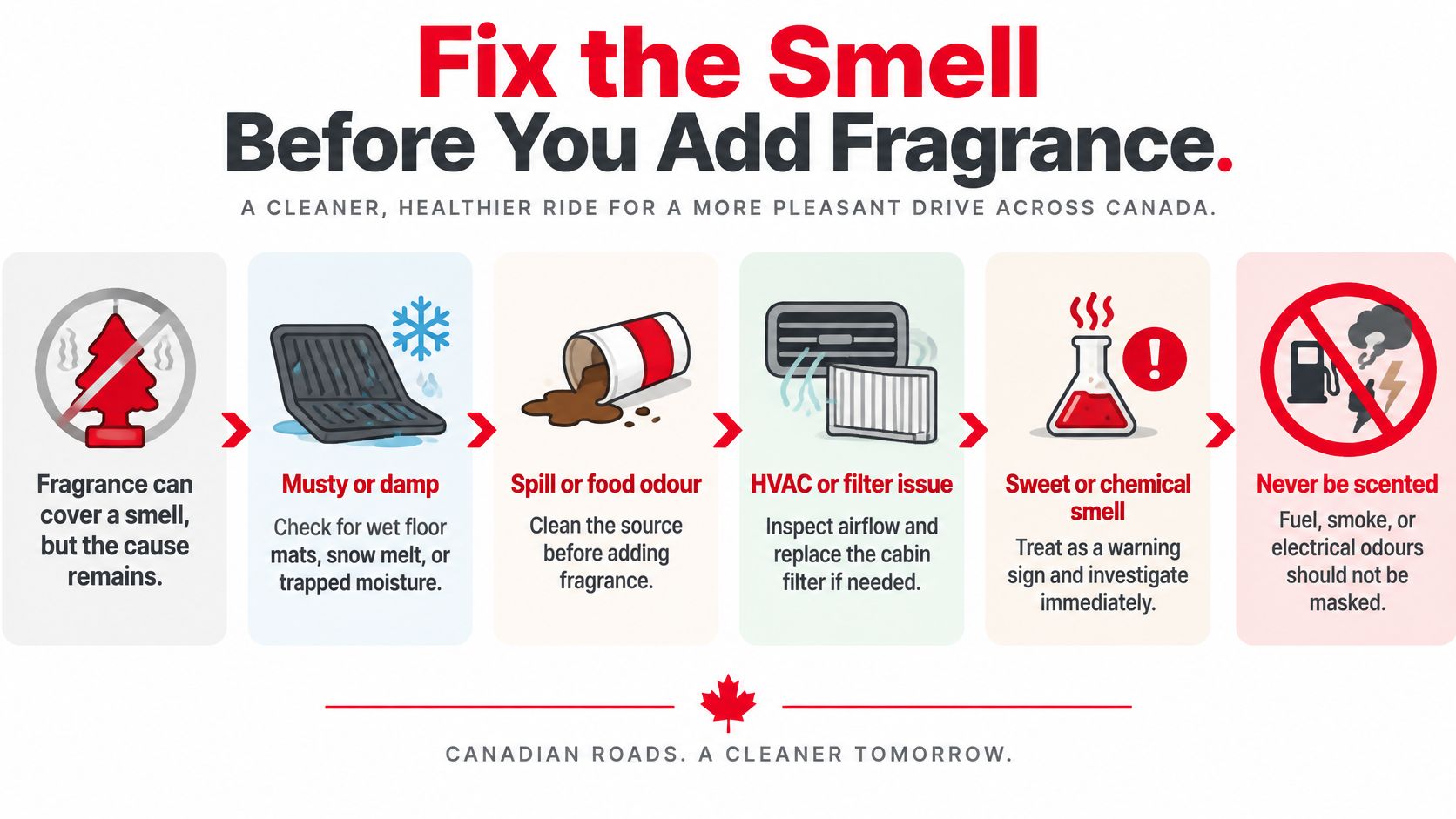
What to do before scenting a cabin odour
These are starting points for investigation, not diagnoses based on smell alone.
| Odour clue | Likely cause | Do this first |
|---|---|---|
| Musty or damp | Wet mats, snow melt or moisture in carpet | Dry the cabin, lift mats and ventilate with fresh air |
| Smoky | Residue in fabric, headliner or vents | Air the car and clean surfaces; don't cover smoke with a sweet scent |
| Fuel or exhaust | A possible mechanical or exhaust problem | Don't mask it; have the vehicle checked |
| Food or spilled drink | Residue on mats, seats or consoles | Remove and clean the source; consider scent only after reassessing |
| Stale air from the blower | A dirty or damp cabin filter, or trapped moisture | Inspect or replace the filter as the vehicle maker advises, then reassess |
Winter boots carry snow and water into the footwell. Lift removable mats, check the carpet underneath and dry wet materials thoroughly rather than leaving moisture trapped beneath rubber liners. For a more detailed moisture checklist, Nanak Car Wash explains how to prevent mould smells in your car.
Smoke residue needs appropriate surface and fabric cleaning. Distinguish an old tobacco smell from new smoke or an electrical burning smell, which calls for stopping safely and investigating the vehicle, not adding fragrance.
Reassess after cleaning
Spring thaw and summer heat can make trapped odours more noticeable. Heat also speeds fragrance evaporation, so don't assume a product that felt restrained in colder weather will remain comfortable through summer.
Once the cabin is clean and dry, reassess it without fragrance. A mild residual smell may be a reason to try a low-output diffuser, but a persistent or returning odour warrants another look at the source.
For an accompanying walkthrough, use the video below.
Restraint has a practical benefit: you're more likely to notice when an unwanted smell returns. A diffuser doesn't purify air, remove mould or fix mechanical faults.
Cabin Safety and Canadian VOC Limits
A vehicle cabin is a small space that's only sometimes well ventilated. Health Canada's indoor-air-quality guidance identifies scented products as sources of volatile organic compounds, or VOCs, and explains that exposure effects depend on the compounds, their concentration and exposure duration.
Odour doesn't reliably reveal whether VOCs are present. Nor can a universal safe diffuser-output number be inferred from total VOC measurements that aren't consistently defined or comparable.
What Canadian limits actually tell you
Environment and Climate Change Canada's consumer-product VOC factsheet lists limits of 18% for liquid or pump-spray air fresheners and 3% for solid or semi-solid products, with category-specific provisions that affect how particular formulations are treated. Those are formulation rules, not ratings that tell every passenger how comfortable they'll feel.
The federal VOC-content guidance also excludes fragrance incorporated at a combined level of up to 2% by weight from its VOC calculation. That technical exclusion doesn't mean a fragrance product releases no VOCs.
Claims such as phthalate-free, natural or essential-oil-based answer different questions from measured emissions. Our guide to understanding non-toxic air freshener claims helps separate ingredient language from broader promises about air quality.
Keep the following cabin-use principles in mind when reading a label.
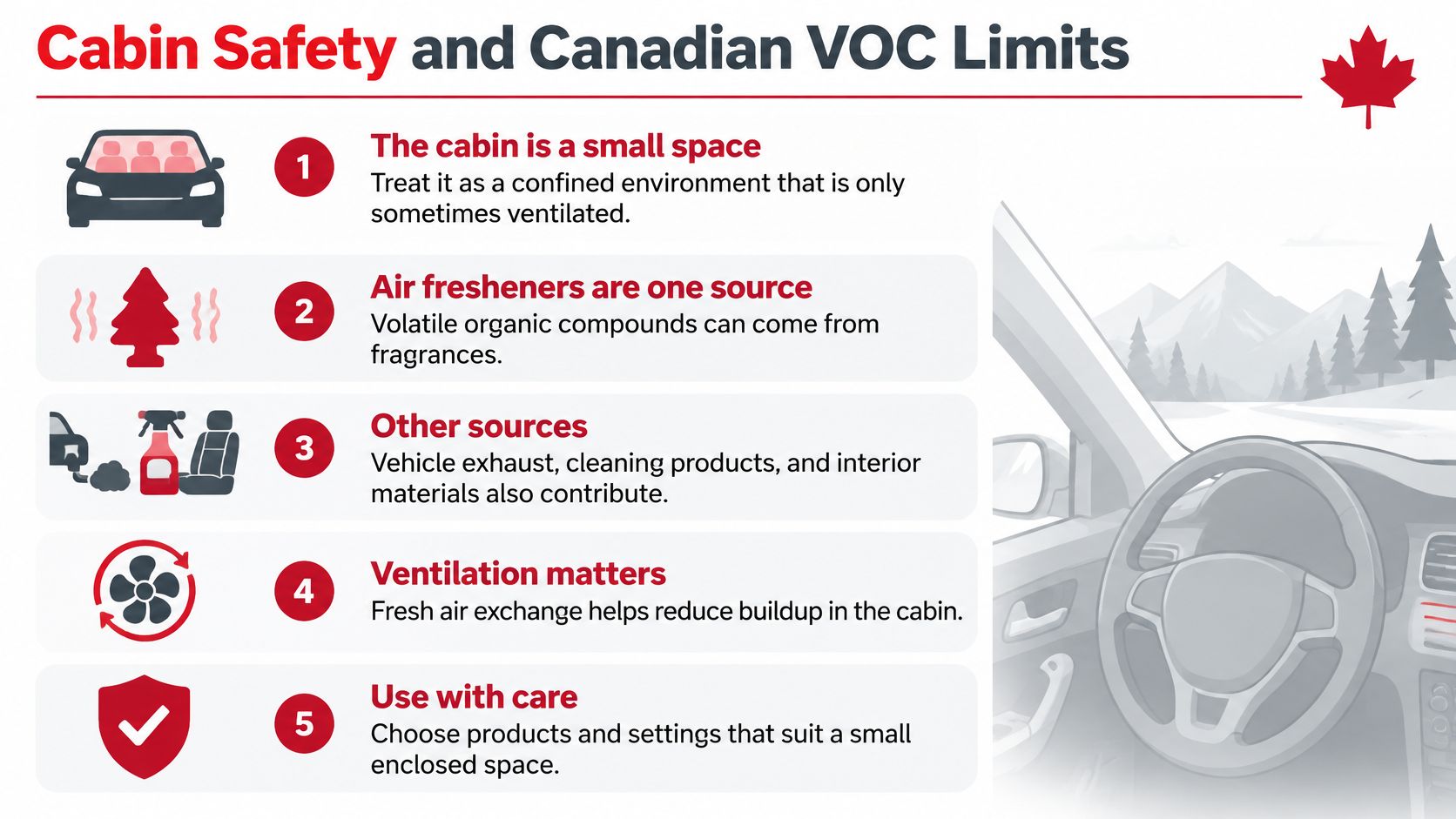
Reduce unnecessary exposure
- Begin with low output. Choose the lowest setting that gives a faint background scent, not continuous high-intensity release.
- Keep some distance. Don't position fragrance beside someone's face or at the HVAC intake.
- Bring in fresh air. Use fresh-air ventilation when practical rather than relying on recirculation throughout an ordinary drive.
- Respond to discomfort. Remove the product if anyone feels headachy, irritated or otherwise unwell. Don't ask them to get used to it.
Winter is the harder case because closed windows and recirculated air can retain scent longer. Maintain the ventilation needed for visibility and comfort rather than adjusting the vehicle around the diffuser.
Health Canada's cosmetic-labelling guidance notes that some fragrance ingredients can cause allergic skin reactions in susceptible people. Cosmetic allergen-disclosure thresholds aren't automatically car-diffuser requirements, but avoiding liquid contact, reading the label and stopping use if irritation appears are sensible precautions.
Ask the diffuser manufacturer for ingredient or safety information, applicable testing and bilingual usage instructions. Compliance and suitability for your passengers are separate considerations.
Choosing Scent Strength for a Vehicle
Start with a comfort test before choosing a scent family. On a trial drive, ask whether the fragrance stays in the background once you've settled into the journey. If it seems to fill your mouth, distract you or announce itself to a passenger immediately, turn it down or remove it.
That's an editorial rule for a restrained cabin, not an exposure benchmark. Fragrance perception is subjective, so individual preferences and perceived strength may vary. Your favourite scent at home may be unpleasant to someone sitting beside you.
Choose a simple profile
A compact cabin usually calls for less complexity and less richness than a living room. Use these as starting points, not guarantees that a particular blend will suit everyone.
- Light citrus. Consider a restrained citrus-style scent rather than an intense, sweet citrus perfume.
- Soft herbs. A gentle herbal profile can work when it doesn't become sharp or medicinal.
- Linen-style notes. Choose a low-output version, remembering that a clean-smelling description says nothing about air quality.
- Quiet, dry woods. A light cedar-style note is a different choice from smoky, resinous or heavily musky woods.
Dense florals, rich gourmands and smoky vanilla can feel cosy in a room but cloying once the car doors close. Don't judge them solely by sniffing the package in a shop or beside an open vehicle door.
Match the setting to the passengers
For children, scent-sensitive passengers or pets, the considerate choice may be to skip fragrance entirely. Don't assume a natural ingredient or familiar scent makes a product suitable for every occupant.
Ask passengers before a longer shared drive. Someone may dislike fragrance without wanting to explain a medical history, and an unscented cabin avoids making them negotiate their comfort.
A passenger shouldn't have to open a window to escape your choice of fragrance.
Sun on the dashboard and a hot parked cabin can increase scent output. Reassess the product when the weather changes rather than carrying the same setting through every season. Don't run multiple fragrance products together to create a more elaborate blend.
If you stop noticing the scent, pause or remove it before adding more. Chasing a fading impression with extra fragrance can leave a new passenger facing a much stronger cabin than you realise.
Save fuller florals, substantial woods and rich gourmands for a setting where you can choose an appropriate room and control the experience. Our guide to candle scent strength explains how to think about fragrance intensity at home without applying living-room expectations to a vehicle.
How to Maintain a Car Fragrance Diffuser
Maintenance should prevent leaks, muddled scent and unnecessary output, not make a tired product smell stronger at any cost. Keep the packaging or photograph its instructions so you can check refill compatibility and cleaning directions later.
Follow a simple upkeep routine
- Start below the label's maximum. Use a lower permitted setting or fewer drops than the maximum allowed. Leave the setting alone through ordinary use before increasing it, so you're not reacting only to the first impression.
- Check regularly for residue. Look over nearby glass, plastic and upholstery as well as the device. Blot leaked liquid promptly, then use a mild cleaner compatible with the affected surface; aggressive solvents can make damage worse.
- Manage powered units carefully. Use an interval setting if available, unplug the unit when parked in sun and use only fragrance intended for its reservoir. An incompatible refill can behave differently from the formulation the device was designed to dispense.
- Retire passive products that smell wrong. Replace a hanging card, wood piece or gel if the scent turns sharp or unpleasant. A faint scent alone isn't a reason to add another product alongside it.
- Store refills properly. Keep containers closed, upright and out of direct sunlight, following the label's storage directions. Keep them away from children and pets.
- Stop using a faulty product. Retire anything that leaks, smells sour or causes irritation. Don't try to rescue it by diluting the liquid or mixing in another fragrance.
Use the visual reminder below alongside the manufacturer's instructions. Refill only when and how the device permits; don't top up a sealed cartridge or operate a unit contrary to its directions.
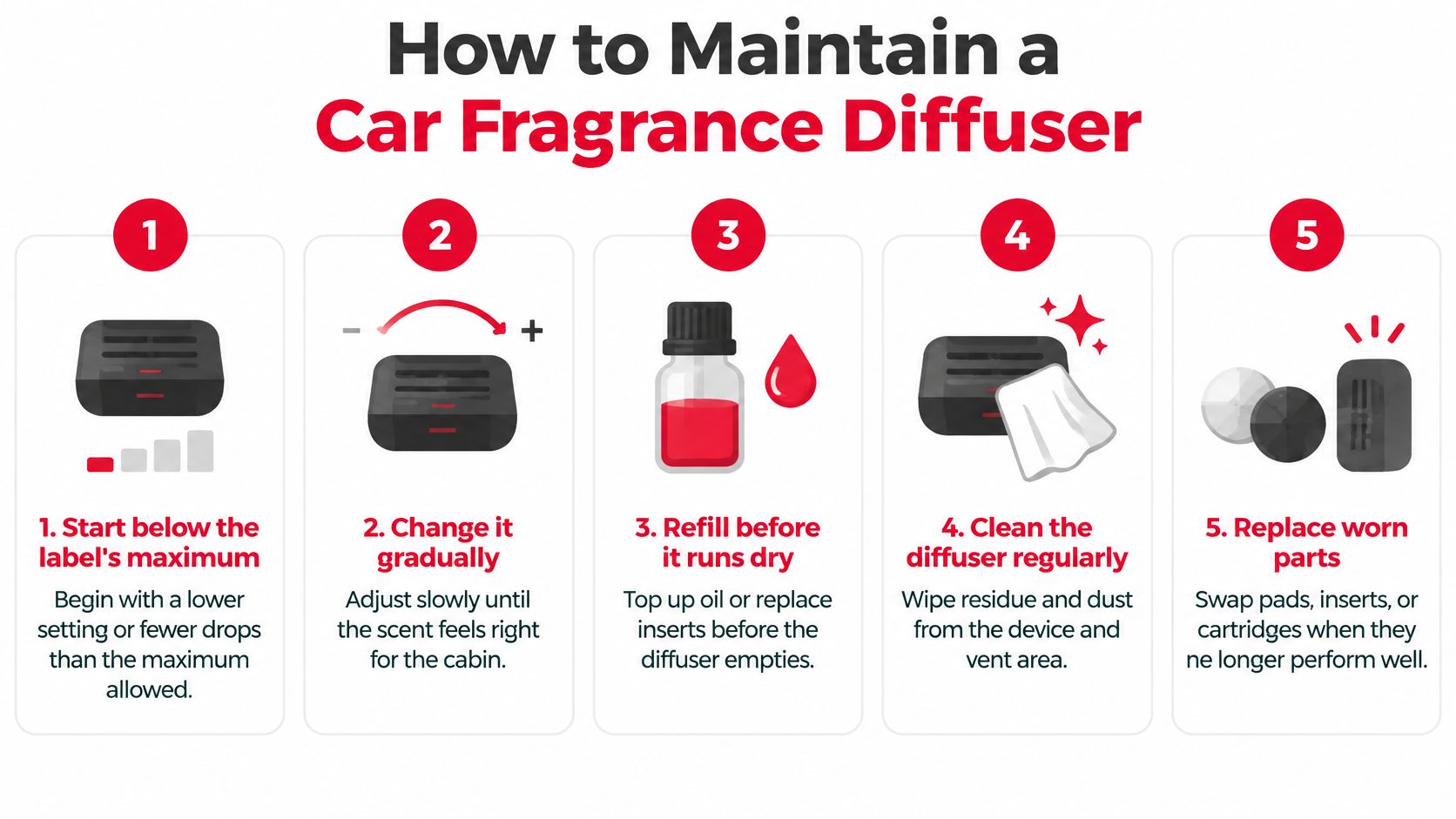
Treat longevity as a cue, not a promise
Passive products last according to their formulation, the label's conditions and the heat they encounter. Intermittent powered release can conserve a refill compared with continuous operation, but it doesn't make the contents immune to a hot cabin.
Use the package estimate as a planning aid. Leaks, altered odour and passenger discomfort take priority over squeezing more use from a refill.
Choose a Light Cabin Scent or Scent the House
A car scent is easiest to live with when you can pause or remove it. After cleaning and drying the cabin, choose a removable, low-output automotive diffuser, or leave the air unscented. A clean, dry interior does not need added fragrance.
At home, you can choose where to use fragrance and keep it away from people who prefer an unscented room. Shivora Candles makes hand-poured soy candles and soy wax melts in Ontario, Canada.
Keep home fragrance at home
The Jasmine & White Silk Soy Candle is a home-fragrance product, not a car accessory. Place a candle on a suitable stationary surface at home.

Shivora Candles uses phthalate-free fragrance oils. Fragrance preferences and perceived strength vary, so choose a scent and intensity that suit the people sharing your home. For room-by-room ideas, see this Canadian home-fragrance diffuser guide.
Soy wax melts provide a flameless option for a suitable warmer. Remelt the wax until its fragrance fades, then let it cool before replacing it. Follow the warmer's instructions for placement and supervision. A warmer belongs at home, not in a vehicle.
Separate the tools from the scent preference
Use each fragrance product only as intended. Do not light a candle in a car or warm wax melts inside one. Follow candle-care guidance at home, including advice on suitable surfaces, wick care and keeping flames away from anything that could catch fire.
An ingredient's origin alone does not determine how a fragrance will feel to each person. Choose products according to their intended use and instructions, and keep cabin fragrance optional and easy to stop.
Car Fragrance Diffuser Questions Answered
Is a car fragrance diffuser safe to run all day?
All-day running is a duty-cycle question. On a 20-minute commute, a timer that starts with the fan and shuts off at arrival gives scent only while the cabin is occupied; leaving the same unit on through errands, school pickup and idle time adds exposure without adding control. Use the cabin-safety checks for ventilation and passenger comfort, then set the lowest output that stays easy to stop.
Should I use a diffuser to cover a musty or smoky smell?
Treat fragrance as the last step. Dry mats, empty trapped spills, clean smoke film from glass and check the cabin filter before a diffuser goes in. Fuel, fresh smoke, exhaust or hot electrical smells call for diagnosis and repairs; once the source is handled, a light scent can mark the cabin as clean.
Which format suits a small car best?
In a small car, pick the format you can pause, move or remove fastest. A vent clip comes off in one motion and can sit out of the direct blast; a powered unit suits drivers who will use a timer and an off switch. Set the hardware while parked.
How long does a refill last?
A refill label describes typical use, while heat, fan speed and stop-start driving change the result. If the scent seems to vanish after a few days, step outside and re-enter before judging; adaptation can mimic an empty cartridge. Turn the unit down or off first, then reassess.
Shivora Candles offers hand-poured soy candles and soy wax melts made in Ontario for fragrance you can enjoy at home. Keep your cabin scent optional, and visit Shivora Candles to choose a floral, woody or cosy room fragrance for after the drive.

