

You're home on a cold Ontario evening, the windows are dark, and you want the room to feel welcoming without lighting a candle. You place a scented wax melt in an electric warmer, switch it on, and wait. Within a little while, the solid piece becomes a glossy pool and fragrance begins moving through the room.
So, how do wax melts work? A warmer supplies controlled heat, the wax changes from solid to liquid, and fragrance compounds gradually evaporate from the warm surface into the surrounding air. The wax isn't meant to burn. It carries and holds the fragrance while the warmer provides the heat.
That simple process has useful safety and indoor-air implications for Canadian homes. Wax melts avoid the specific open-flame mechanism of a candle, but the melted wax, dish and electrical equipment can still become hot. Understanding what's happening makes it easier to choose a warmer, control scent strength and use melts responsibly.
Table of Contents
- What Makes a Wax Melt Release Scent Without a Flame
- The Science Behind Heat-Driven Fragrance Release
- Wax Melts versus Candles, Scent Throw, Safety, and Indoor Air
- How to Use a Wax Warmer Safely and Effectively
- Maintaining Your Warmer and Rotating Scents for Longevity
- What Canadian Research Reveals About Scented Product Emissions
- Choosing Hand-Poured Soy Wax Melts Made in Ontario
What Makes a Wax Melt Release Scent Without a Flame
A wax melt is a small reservoir of scented wax. When you set it on a warmer, the appliance transfers controlled heat into the solid cube or tart. The wax liquefies into a pool, exposing more of its surface to the air. Fragrance compounds blended into the wax then evaporate gradually and disperse through the room.
The key difference from a candle is combustion. A candle uses a wick and flame to heat and consume wax. A wax melt uses a heating plate, bulb or embedded electrical element instead. The melt itself isn't intended to burn, so there's no wick or flame involved.
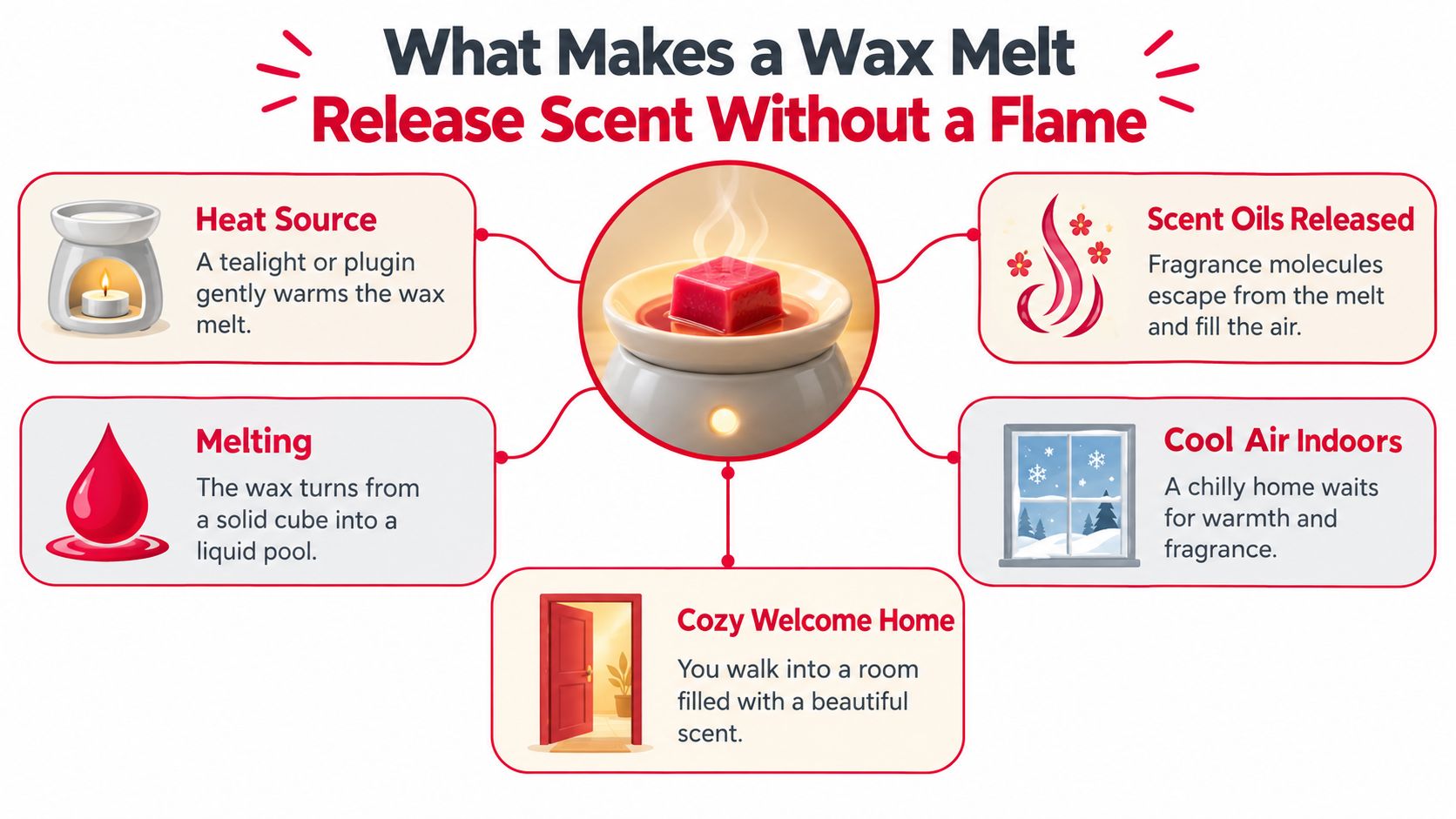
Wax is the carrier, not the fuel
Think of the wax as a reservoir rather than fuel. As long as it stays warm and fragrance remains available, the surface continues releasing scent. Eventually, the more volatile fragrance components become depleted, even though some wax is still visible in the dish. Reheating that spent wax won't restore fragrance that has already evaporated.
That distinction explains why a melt can look unchanged while smelling much weaker. The wax remains as the carrier, but the available fragrance has reduced. Performance also varies with the warmer's temperature, the shape and size of the melt, airflow and room ventilation.
Flameless still needs care
For Canadian households, the absence of a flame matters. Health Canada estimates that candles caused an average of nearly 800 fires annually between 1999 and 2008, based on data from Ontario, Manitoba, Alberta and British Columbia. Those fires produced an average of 8 deaths, 115 injuries and CAD $26.2 million in property damage per year, according to Health Canada's candle-safety information.
Those figures concern candles, not wax melts. A properly operated electric warmer avoids the particular open-flame mechanism, but it doesn't remove every hazard. Keep the warmer away from children, pets and combustible materials, and remember that the dish and liquid wax can still be hot.
The Science Behind Heat-Driven Fragrance Release
The physical process starts with a heat-driven phase change. Solid wax absorbs heat until it liquefies. Once liquid, it spreads across the dish and creates a larger exposed surface than the original cube or tart. That warm surface gives volatile fragrance molecules a route into the air.
The warmer doesn't force every fragrance component out at once. Different compounds evaporate at different rates, so the scent profile can change during use. Lighter, more volatile notes may become less noticeable before heavier notes, while the remaining wax continues acting as a reservoir.
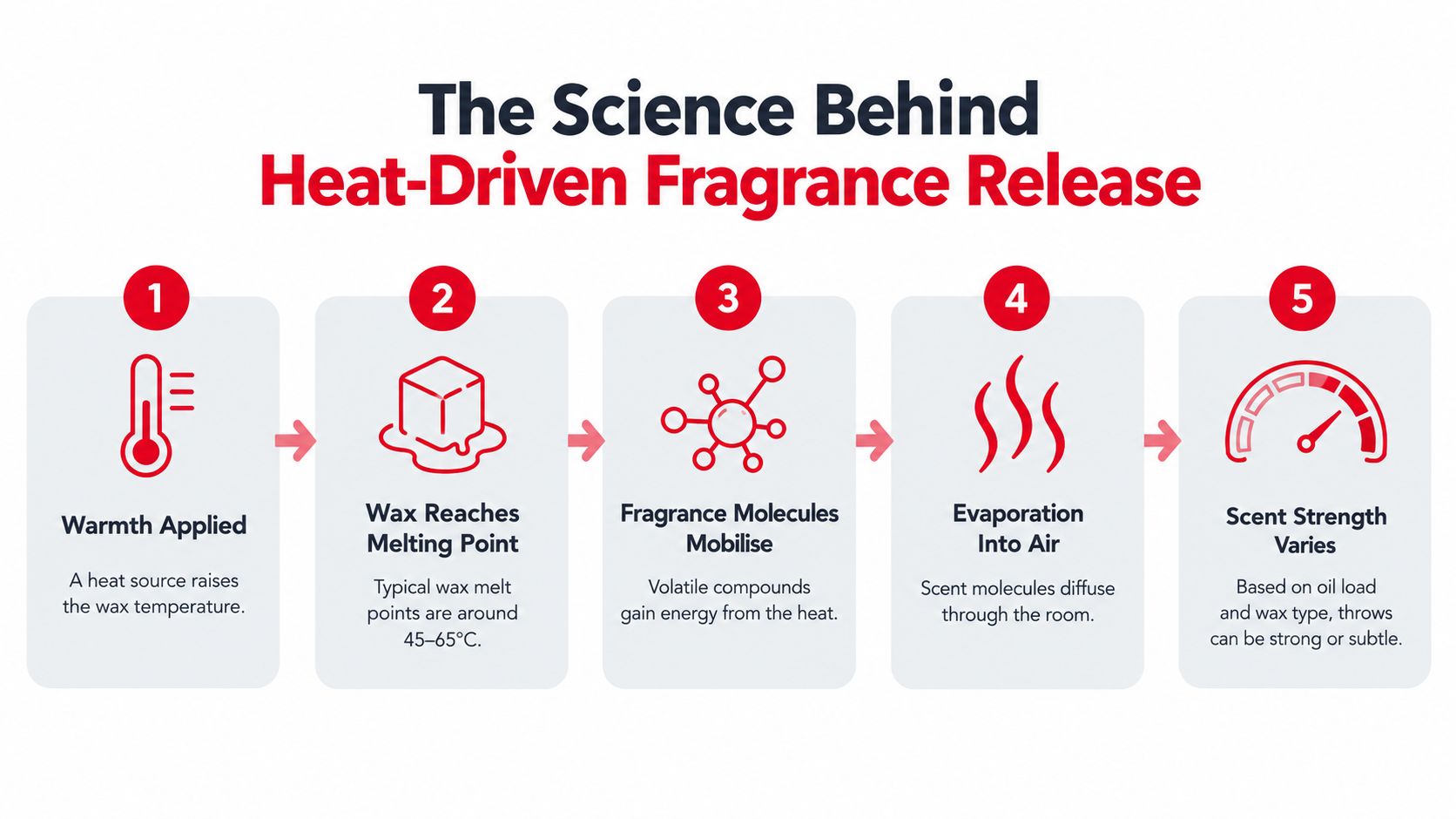
Why one melt smells stronger than another
Several variables shape the result:
- Warmer temperature: More heat can increase evaporation, while excessive heat can create unnecessary risks and use fragrance quickly.
- Melt geometry: A broad liquid surface can release fragrance differently from a deeper or more compact pool.
- Fragrance volatility: Some fragrance molecules move into the air more readily than others.
- Airflow: Air movement carries scent through a room, but strong drafts can also disperse it quickly.
- Ventilation and room size: A large, ventilated room may feel less intense than a smaller space with limited air exchange.
You'll find a plain-language explanation of why scent strength varies in this guide to scent throw.
Practical rule: Use only the quantity specified for your warmer, and treat the warmer's instructions as part of the product, not an optional suggestion.
The indoor-air question
Heating fragranced products promotes the emission of volatile organic compounds, including monoterpenes and monoterpenoids. Research summarised in an indoor-air study found that scented wax warmers and melts released multiple terpene compounds and could have greater terpene emission factors and emission rates per mass of wax consumed than scented candles.
In a well-ventilated indoor environment, the same work estimated that approximately 0.26% to 0.32% of emitted terpenes were inhaled. Lower air-exchange rates can allow concentrations to build, so use a warmer in a normally ventilated room rather than running it for long periods in a small, enclosed space. If the fragrance has noticeably faded, replace the spent wax instead of repeatedly heating it.
Never add water to hot wax. Rapid vapour formation can cause splattering. Let the dish cool before handling it, and use electrical products according to their instructions. Health Canada identifies CSA C22.2 No. 46-13 among applicable Canadian electrical safety standards for relevant electric heating equipment in its portable-heater safety assessment.
Wax Melts versus Candles, Scent Throw, Safety, and Indoor Air
Wax melts and candles both fragrance a room, but they create that fragrance through different physical processes. A candle combusts wax at a wick. A melt warms scented wax without a combustion zone. That difference affects flame exposure, soot and how you manage the product.
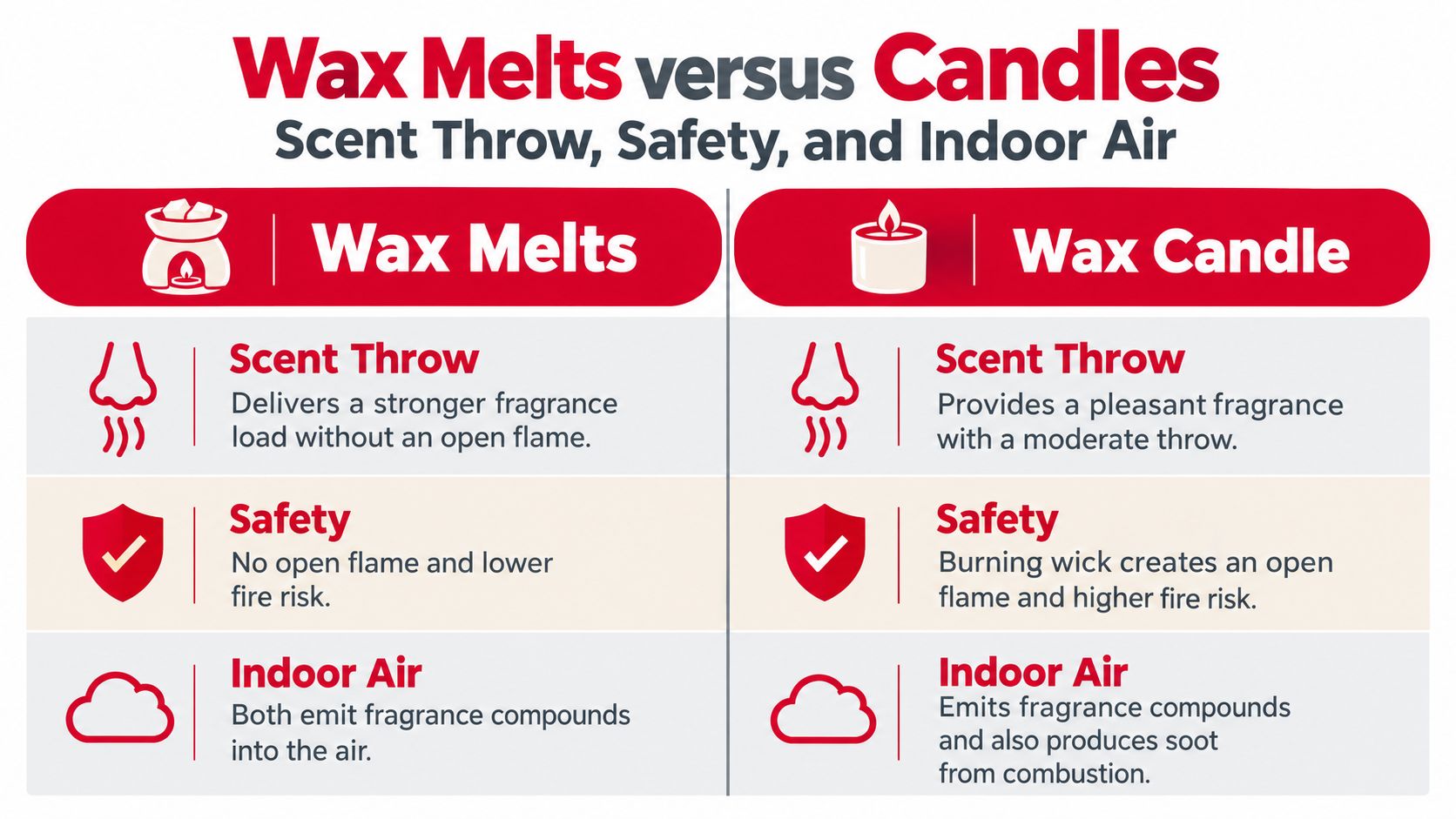
| Consideration | Wax melts | Candles |
|---|---|---|
| Scent release | A warmer heats a scented wax reservoir, allowing fragrance to evaporate from the liquid surface. | A flame melts and consumes wax at the wick while releasing fragrance. |
| Flame | No wick or open flame is involved when using an electric warmer. | An exposed flame remains part of normal operation. |
| Soot | There's no combustion zone in the melt itself, so it doesn't produce flame-related soot. | Combustion can produce soot, particularly when a candle burns poorly or is disturbed. |
| Control | You can adjust the amount of wax and stop the warmer when the fragrance fades. | The flame and burn session determine the rate at which the candle operates. |
| Main heat concern | Hot liquid wax, a hot dish and electrical equipment. | Hot wax, a burning wick, an open flame and the candle vessel. |
Strong scent isn't the same as low exposure
A warmer can create a strong fragrance signal because heating promotes the release of VOCs. Indoor-air research found multiple terpene compounds from scented wax warmers and melts, with potentially greater emission factors and emission rates per mass of wax consumed than scented candles. That doesn't mean every melt is unsafe, but it does mean fragrance intensity is connected to how much product you warm, how long you run it and how well the room exchanges air.
Readers who want a broader explanation of VOC terminology can consult this overview of volatile organic compounds. For practical Canadian home guidance, see whether wax melts are safer indoors.
Candles also have a documented open-flame context in Canada. Statistics Canada reported that candles or other open flames accounted for 7% of fatal residential fires in the referenced Canadian fire data, while electrical incidents accounted for 8%, as shown in its residential fire information. Those figures don't predict the risk from a particular melt or candle, but they reinforce the need to manage both flames and electrical heat-producing equipment carefully.
The sensible choice depends on your priorities. A melt may suit someone who wants fragrance without an open flame, while a candle may offer the visual warmth of a flame. Neither option should be treated as unattended décor, and neither is automatically suitable for every indoor-air preference.
How to Use a Wax Warmer Safely and Effectively
Start with the warmer, not the scent. Read the operating instructions and check that the dish, cord and plug are in good condition. Place the appliance on a stable, heat-resistant surface where it won't be knocked over.
Health Canada advises keeping portable electrical heaters at least 1 metre from combustible materials, a useful conservative spacing principle for heat-producing equipment. Keep curtains, paper, clothing and other materials away from the warmer, and avoid placing it where a cord crosses a walkway.
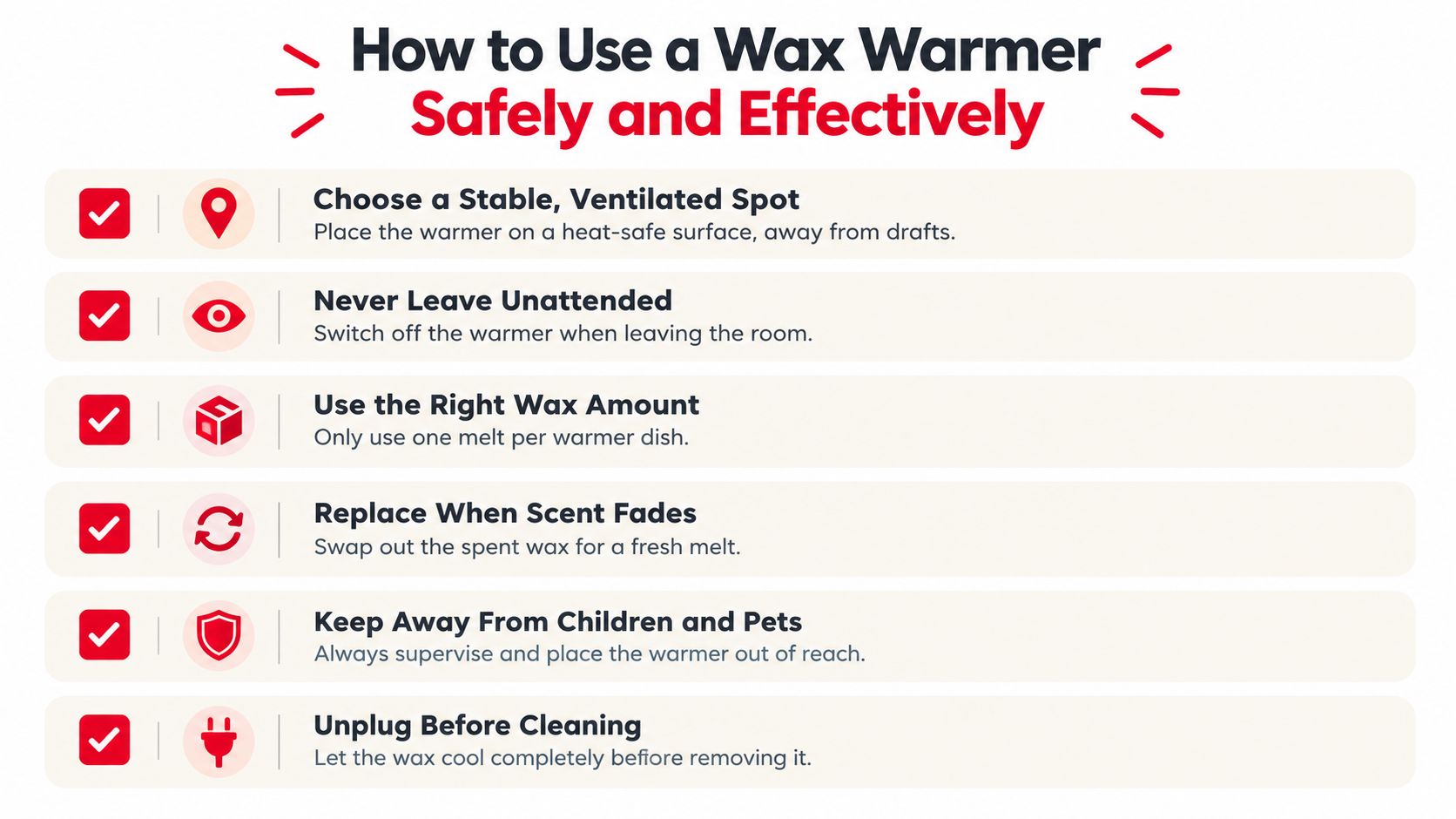
A simple operating routine
- Use the recommended amount: Follow the warmer or melt instructions rather than filling the dish to the top. More wax isn't automatically better, and excess liquid increases the amount of hot material you need to manage.
- Ventilate normally: Use the warmer in a room with ordinary air circulation. Avoid prolonged operation in a small, enclosed space, especially if anyone notices irritation or the fragrance feels overwhelming.
- Stay present: Turn the warmer off when you leave the room or go to sleep. A flameless appliance still contains a heat source, and melted wax can spill if the warmer is bumped.
- Keep hands away while hot: Don't touch or move the dish during use. Let the wax cool and solidify before you remove it, and never lift a hot dish with bare hands.
- Never add water: Water and hot wax can produce rapid vapour formation and splattering. Keep water away from the hot melt.
- Replace faded wax: When the fragrance has noticeably declined, allow the wax to cool and remove it according to the warmer's instructions. Don't keep reheating a spent pool in the hope that the original scent will return.
For a more detailed routine, follow this guide on how to use wax melts. These habits are particularly important in bedrooms, nurseries and homes where children or pets could reach the appliance.
Maintaining Your Warmer and Rotating Scents for Longevity
Fragrance fading is a normal part of evaporation. Once the more volatile components have left the wax, additional heating won't recreate them. Trying to extend a spent melt can leave you with a warm dish that contributes little scent.
Let the wax cool completely before removing it. Clean the dish gently once it's cold, following the warmer maker's care instructions. Avoid scraping aggressively if the dish could chip or crack, and don't pour melted wax into a sink where it may harden in the plumbing.
A small care routine pays off
- Cool before removal: Solidified wax is easier to handle and less likely to burn skin or spill.
- Inspect electrical parts: Look for damaged cords, plugs or visible wear before the next use.
- Protect the warmer's location: Keep the appliance on a stable, heat-resistant surface and away from combustible materials.
- Store unused melts well: A cool, dry storage spot helps preserve the fragrance before use.
- Switch scents thoughtfully: Alternate fresh, floral, woody and warm profiles so one aroma doesn't become background noise.
Rotating scents also helps you notice when a fragrance has fully faded. If you use the same profile continuously, your sense of smell may adapt and register it less strongly even while fragrance remains. A change to a lighter or contrasting scent can make the next experience feel more distinct.
Turn the warmer off when you leave the room or go to sleep. Health Canada's candle-safety guidance reports that Canada-wide candle-fire statistics aren't available, but estimates based on Ontario, Manitoba, Alberta and British Columbia identified nearly 800 candle fires annually on average between 1999 and 2008, with an average of 8 deaths, 115 injuries and $26.2 million in property damage per year. Those are candle figures, not wax-warmer figures, but they show why heat-producing home-fragrance products deserve active supervision. Read the guidance in Health Canada's candle-safety document.
What Canadian Research Reveals About Scented Product Emissions
The melting mechanism explains how fragrance reaches the air, but it doesn't answer whether every fragrance product suits every household. Indoor-air exposure depends on the concentration of emitted compounds and how long people remain exposed. That matters in apartments, nurseries and homes with asthma-sensitive occupants.
Canada's National Research Council, working with Health Canada, has tested emissions from scented products including candles and wax melts in controlled chambers and research houses. The purpose is to measure chemical concentrations that can improve exposure assessments for products used indoors, as described in the NRC information on chemical emissions from household products.
Why labels need careful interpretation
A label such as soy wax, plant-based or phthalate-free fragrance can tell you something about the formulation, but it doesn't prove that a product is emission-free or suitable for every sensitive household. Phthalate-free doesn't mean risk-free, and a plant-based ingredient can still contribute to indoor fragrance emissions.
Health Canada identifies scented products as a source of indoor VOCs and recommends minimizing their use where possible. Its guidance connects potential health effects with both VOC concentration and exposure duration, while recommending lower-emission products, improved ventilation and reduced use of scented products.
A measured approach is more useful than a blanket promise:
- Use a modest amount of wax.
- Keep normal ventilation in the room.
- Avoid running multiple scented products at the same time.
- Don't use a warmer for prolonged periods in a small, closed room.
- Stop using the product if it causes irritation or discomfort.
- Look for clear ingredient and safety information rather than relying on a single marketing phrase.
This is especially relevant when fragrance is part of a larger indoor mix that may include cleaning products, room sprays, candles and diffusers. The question isn't only whether a melt contains soy wax. It's how the complete household environment affects exposure.
Choosing Hand-Poured Soy Wax Melts Made in Ontario
Once you understand the process, shopping becomes more straightforward. Look for a wax melt whose scent profile suits the room, a warmer with clear operating instructions and a product maker willing to explain materials and care. You'll also want to consider how often you plan to use fragrance, how well the room is ventilated and whether anyone in the household is sensitive to scented products.
Shivora Candles offers hand-poured soy candles and soy wax melts made in Ontario, Canada, produced in small batches. Its materials include plant-based soy wax and phthalate-free fragrance oils, but those descriptions shouldn't be treated as proof that a product is emission-free or right for every person. Moderation, ventilation and attention to your own household's response still matter.
For Canadian shoppers comparing formats, hand-poured soy wax melts provide a flameless fragrance option, while soy candles with cotton wicks offer the familiar candle experience. Seasonal scents and giftable options are available through the home fragrance and candle collection. If you use both formats, keep their different heat sources in mind and follow the relevant Candle Care and Safety guidance.
The central idea is simple: a melt releases fragrance because warmth changes solid wax into a liquid reservoir, allowing volatile compounds to evaporate from its surface. Choose products with transparent information, use only the recommended amount, provide ordinary ventilation and switch the warmer off when you leave.
Shipping across Canada starts at $9.99. Free shipping on orders of $79.99 CAD or more. Some conditions apply.
Shivora Candles offers hand-poured soy wax melts and candles made in Ontario for Canadian homes that value thoughtful fragrance and careful use. Visit Shivora Candles to explore scents, choose a format that suits your space and enjoy home fragrance with ventilation and moderation in mind.

