

Soy wax alone doesn't make a candle safe or unsafe for a cat. The wax is the mildest part of the question. What decides the risk is the fragrance formula, the way the scent reaches the cat and whether an open flame sits within reach of a curious animal.
A cat can meet a burning candle three ways: breathing concentrated scent in a closed room, brushing against hot wax or a warm vessel, or licking residue off its fur. Each route has a different fix, which is why a single "pet-safe" claim on a label answers nothing. "Natural" on the jar does the same work as no claim at all.
The audience for this question is large. At least one cat lived in 21% of Canadian households in 2023, according to Statistics Canada, and the Canadian Animal Health Institute's pet population survey put the national cat count at roughly 8.2 million in 2024. So are soy candles safe for cats? The honest answer is conditional, and every condition is something you can check before you light anything.
Table of Contents
- Why Fragrance, Not Soy Wax, Decides Cat Risk
- Reading a Candle Label Before Burning Near a Cat
- Ventilation, Placement and Flame Safety
- Signs of Candle or Fragrance Exposure in Cats
- First Steps and What to Tell Your Vet
- Common Questions and Choosing a Candle for Your Home
Why Fragrance, Not Soy Wax, Decides Cat Risk
Take a soy candle off the shelf and the wax tells you very little about cat safety. Veterinary guidance separates ordinary wax from concentrated essential oils and fragrance exposure, because those are two different problems (Canadian pet-safety guidance on scented products and pets). The soy base rarely decides the outcome. Scent load, flame and what the cat can reach decide it.
Candle factors and their cat-safety relevance
| Factor | Why it matters for cats | What to check |
|---|---|---|
| Soy wax base | Not identified as a feline toxin in the cited veterinary guidance | Confirm the wax type, then keep assessing the rest of the candle |
| Fragrance oils | Can irritate airways and skin, and formulas vary widely | Look for a disclosed fragrance list or choose a lightly scented candle |
| Essential oils and botanical extracts | Cats are especially vulnerable to citrus, cinnamon, eucalyptus, mint, pine, tea tree and wintergreen | Avoid around cats and keep out of reach |
| Open flame | The main documented fire and burn hazard for households | Use a heavy, tip-resistant vessel on a raised, heat-resistant surface |
| Hot wax and wick | Can burn skin and be licked or spilled onto fur | Keep the cat away until the wax has cooled and trim the wick before each burn |
| Ventilation and scent load | Fragrance concentrates in small or closed rooms | Burn briefly with an open window or exhaust fan running |
| Wax melts and warmers | Removes the flame while still dispersing fragrance and leaving hot wax | Keep the warmer, refills and used wax out of reach |
Read the table from the top and the ranking is obvious. Fragrance formulation sits first because disclosure is the one thing a shopper can check before buying. A scent that reads as pleasant to a person can land much harder on a cat, and the jar alone won't warn you.
Why the same scent lands differently on a cat
Cats lack some of the liver enzymes needed to break down certain compounds efficiently, so a fragrance a person clears without thinking can hang around longer in a cat. They also groom constantly. Residue that settles on the coat gets swallowed, which adds an ingestion route on top of whatever the cat breathes in.
Inhalation, skin contact and ingestion are all recognised routes, so a candle in a closed bedroom is a different situation from the same candle beside an open window. The oils flagged by veterinary sources include citrus, cinnamon, eucalyptus, mint, pine, tea tree and wintergreen. Those names are worth remembering when you scan a fragrance description.
Two labels that don't mean what shoppers think
Phthalate-free addresses one ingredient concern. It says nothing about whether the rest of the fragrance is mild, and a phthalate-free scent can still be a poor fit for a particular cat. Natural, botanical and plant-based describe where ingredients come from rather than what they do to a feline nervous system. Both kinds of wording get marketed as safety statements, and neither one carries that meaning on its own.
The screening rule I'd use: if the label won't tell you what's in the fragrance, treat it as a scent you can't assess, whatever the wax happens to be.
If ingredient claims are the part you want to understand properly, the guide to clean-burning candle ingredients that matter walks through wax, wick and fragrance choices one at a time. For the wider air-quality side of the same problem, a VOC air purifier designed to reduce chemical fumes at home works on a different layer than an open window does.
Reading a Candle Label Before Burning Near a Cat
The label settles more of this than the scent name on the front of the jar does.
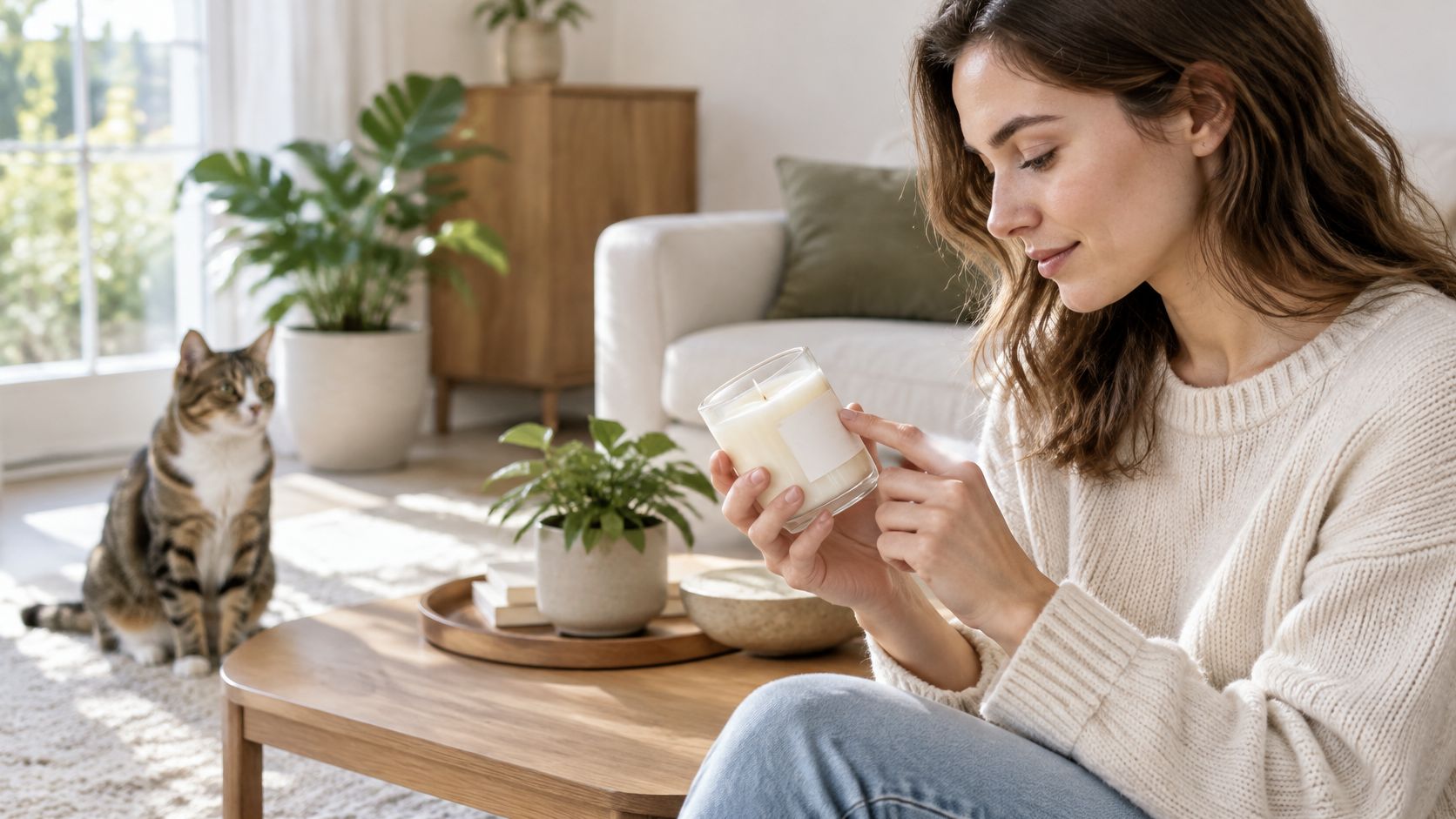
Candle labelling in Canada isn't standardised the way food labelling is, so you're reading for disclosure rather than for a stamp of approval. Work through four checks in this order, and stop at the first one that fails.
- Find the fragrance line. A named fragrance oil or a disclosed blend gives you something to assess. A "signature fragrance" with no list behind it gives you marketing copy.
- Scan for essential oil and botanical extract wording. Look for those exact phrases, and for oil names you don't recognise. A floral name on the front of the jar is not the same thing as an oil on the ingredient list.
- Notice what's missing. A short list that skips fragrance components leaves the key question unanswered. A label carrying no warnings has told you nothing either way.
- Decide before you buy. If the composition is still unclear, skip that candle or ask the maker directly. Asking costs a minute; guessing costs a vet visit.
Where a label can't help you
A cotton or wood wick sets flame behaviour and sound; the fragrance load stays whatever the formula makes it. A lead-free cotton wick or a crackling wood wick changes how the burn looks and how much soot marks the jar rim. Neither one turns a strong fragrance into a mild one.
An unscented candle hits the same wall. Removing fragrance removes one variable, while the flame, the heat and the smoke stay exactly where they were, so placement and supervision still carry the whole load.
Health Canada's position on plant-derived scent ingredients is worth knowing here. The agency warns that essential oils and botanical extracts can create high exposure levels when inhaled, ingested or applied to skin even though they're natural, and advises keeping them out of the reach and sight of children and pets (Health Canada guidance on essential oils and botanical extracts).
When the label runs out of answers, the maker is the next source. Ask whether the blend uses essential oils or botanical extracts, which ones, and whether the fragrance components can be named. A specific answer means the formula is documented; a "proprietary blend" reply is a reason to pick a different jar.
The phthalate question comes up constantly when two candles carry near-identical scent names, and what phthalate-free means in candles is worth ten minutes before you choose between them.
Ventilation, Placement and Flame Safety
Setup carries more weight than wax choice, and it starts with where the jar sits.

A heavy, tip-resistant vessel on a raised, heat-resistant surface survives a curious shoulder check in a way a lightweight tin on a windowsill doesn't. Keep it clear of curtains and loose paper, and off the route your cat uses to reach its favourite perch. Then run the rest as habit.
- Trim the wick to about ¼ inch before every burn. A short wick keeps the flame modest and cuts the soot that settles on fur.
- Let the first burn melt the wax evenly across the top. A full melt pool on day one keeps later burns level and the flame steady.
- Burn in bursts, not all evening. Short sessions in a moving-air room limit how much fragrance accumulates.
- Open a window or run an exhaust fan. Air movement does the work here, not the scent itself.
- Give the cat an exit. A separate unscented room the cat can reach and leave freely turns a trapped feeling into a choice.
- Never leave it burning with nobody in the room. Not for a shower, not for a phone call, not for the walk to the mailbox.
- Keep paws off hot wax and the wick. Wait for the wax to cool fully before you move the jar.
What the fire data shows
A National Research Council Canada study found that candle fires in Ontario rose by more than 12% when the 1995 to 1999 period is compared with 2000 to 2004, that candles in the later period accounted for 7.2% of fire ignitions and 11.8% of fatalities, or 14.4 deaths per 1,000 fires, and that falling asleep was a factor in 12% of home candle fires, with 25% of those fires resulting in fatalities (NRC study on candle fires). Historical, provincial, and still the clearest argument for treating the flame as the first hazard rather than an afterthought.
Wax melts and warmers are not a free pass
Removing the flame cuts burn, fire and tipping hazards, which is real value. The warmer still heats and disperses fragrance, though, and spilled liquid wax can be licked off a paw or transferred to fur (VCA guidance on scented oils around pets). Keep the refills and any used wax discs as far out of reach as the warmer itself.
Ventilation is the other half of the job. Health Canada's Healthy Home Guide identifies candles and incense as sources of indoor particles and other air pollutants, including smoke, soot and aerosol particles, and recommends opening windows or running a kitchen or bathroom exhaust fan to prevent volatile organic compounds from building up (Health Canada Healthy Home Guide). Moving air lowers the fragrance concentration in the room, and a cat that still struggles in a ventilated space is telling you the formula is the problem, not the airflow.
Ventilation changes how much is in the air. It doesn't change what's in the wax.
The full candle safety tips checklist covers burn times, jar care and storage in more detail.
Signs of Candle or Fragrance Exposure in Cats
What you're watching for is a change from your cat's normal behaviour, not a dramatic scene.
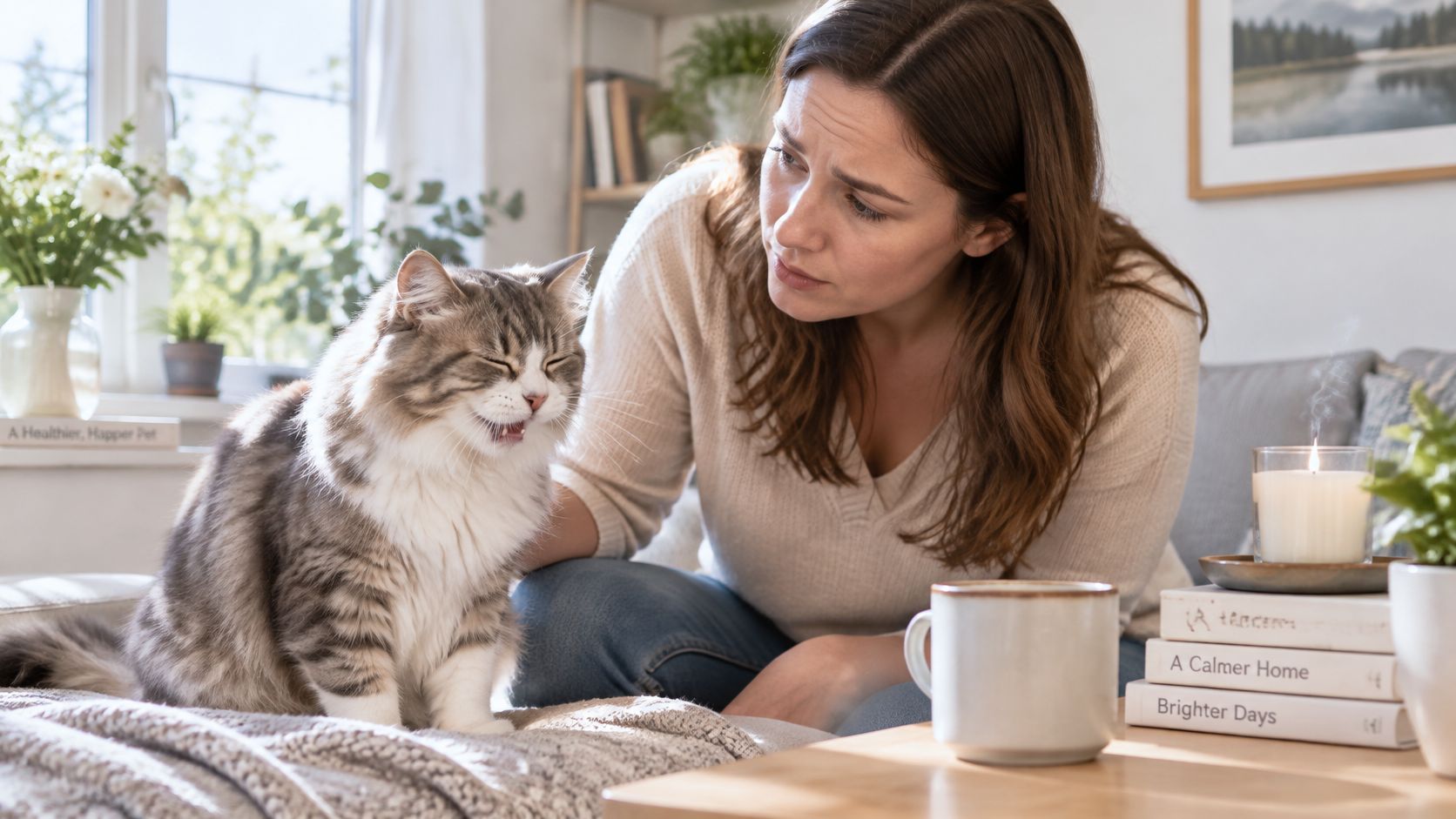
Most reactions owners describe begin during a burn in a closed room, or an hour or two later when the cat grooms scented residue off its coat. Cats mask discomfort well, so a cat that leaves the room and stays away is giving you information rather than being rude.
Exposure symptoms, possible concerns and first action
| Symptom | Possible concern | What to do |
|---|---|---|
| Sneezing or coughing | Airway irritation from fragrance | Move the cat to fresh air, stop burning and watch for persistence |
| Wheezing or breathing difficulty | Serious respiratory distress | Seek emergency veterinary care immediately |
| Drooling or mouth irritation | Possible residue ingestion or contact | Remove from the area, wipe paws gently and call a vet |
| Vomiting or appetite change | Possible ingestion of oil or wax | Contact a vet promptly and bring the product name |
| Weakness, tremors or unsteady gait | Neurological effect possible with essential oils | Seek emergency veterinary care now |
| Skin redness or irritation | Contact with liquid fragrance or melted wax | Rinse gently as a vet advises and call the clinic |
The pattern veterinary toxicology sources describe runs from drooling and weakness to tremors, incoordination, mouth or skin irritation and breathing difficulty (VCA animal hospitals on essential oil poisoning in cats). Signs can build over hours rather than minutes, which is why the timeline you note down matters more than the severity at first glance.
Watch and report versus call now
Two categories, and the line between them is mostly about breathing and coordination. Breathing difficulty, wheezing that doesn't settle, tremors, collapse or an unsteady gait need an emergency clinic now, not a wait-and-see morning.
Mild sneezing that clears once the room airs out is a watch-and-report sign. Write down the time, the candle and the symptom; if it repeats with the same scent, you have your answer about that scent, and it's worth raising at the next vet visit.
Skin redness after contact with liquid fragrance or melted wax gets a gentle rinse and a call to the clinic, because a cat will groom the area afterwards and swallow whatever is left.
The triage logic is similar across species, and a household with both a cat and a dog deals with double the exposure routes; recognising dog poisoning symptoms covers the parallel set of signs and the same principle of calling early rather than searching for a match online.
First Steps and What to Tell Your Vet
Calm action in the first ten minutes does more than any product claim on a label.
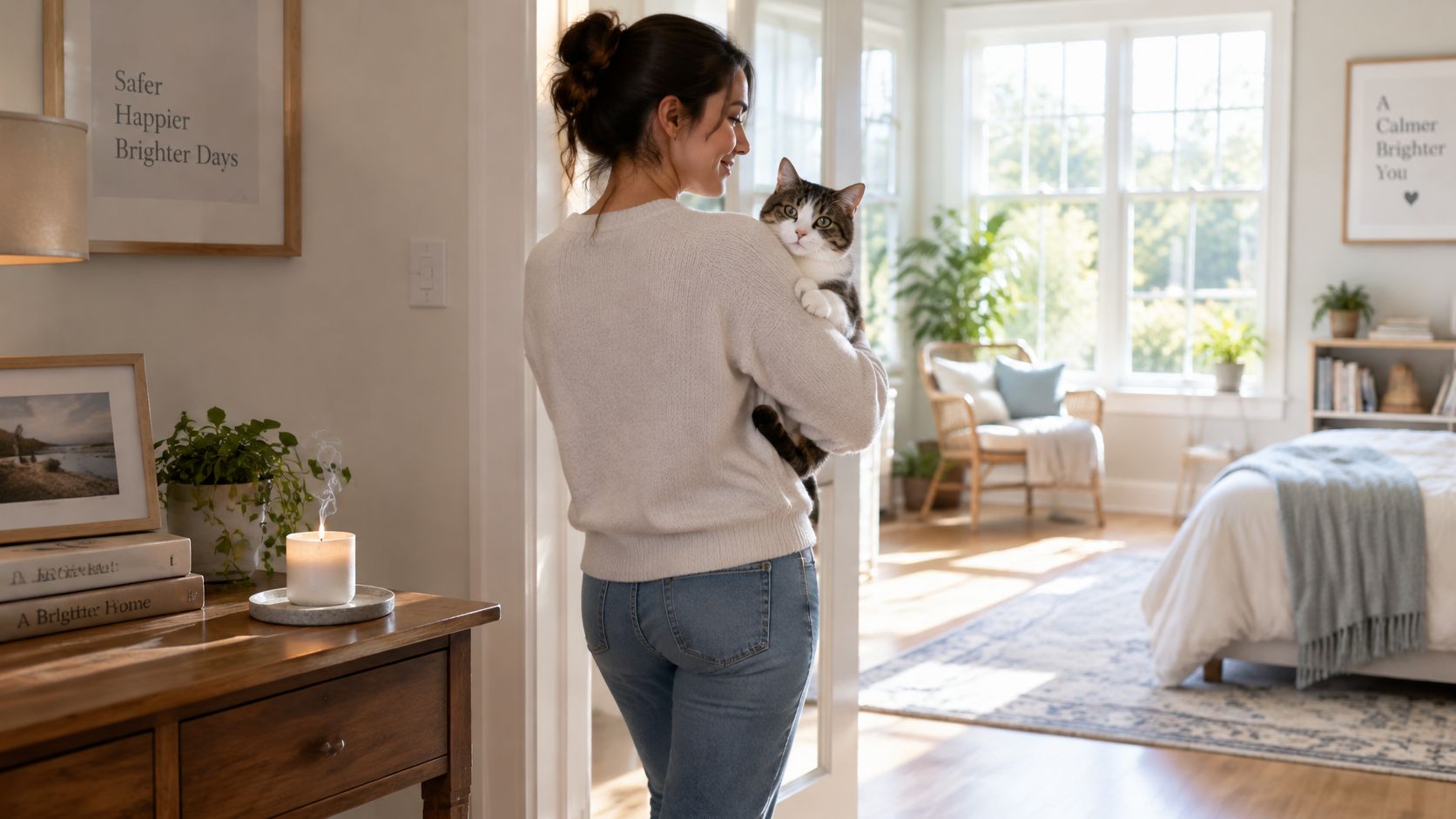
Work through these in order. It's the sequence that gets the cat out of the scent fastest and leaves a clinic with something useful to work from.
- Move the cat to fresh air. A room with no scent, a window that opens, and no diffuser running. Carry the cat rather than chasing it.
- Stop the source. Extinguish the candle or unplug the warmer and let the room air out. Don't relight it later to test whether the scent was the problem.
- Handle contact gently. Wipe paws and fur with a damp cloth if you can do it without a wrestling match. Rinse skin only as a vet advises, since a cat will groom off whatever you leave behind.
- Don't induce vomiting. Not with salt water, not with food, not on the strength of a forum thread. That decision belongs to a vet.
What to say on the phone: the product name, the fragrance if you know it, when the burn started, and the first time you noticed the symptom. A clinic can triage from that in under a minute.
Write those four details down before you dial. Symptoms shift quickly in a small animal, and a timeline taken from memory at the desk is less reliable than one you noted in the moment.
What to bring to the appointment
- The product. Brand name, scent name, and the jar itself or a clear photo of the label.
- The fragrance list. Whatever the maker publishes, including any essential oils or botanical extracts.
- The wax type. Soy, beeswax or a blend, as stated on the packaging.
- The burning details. When it was lit, for how long, how large the room is, and whether a window or fan was running.
- The cat's position. How close the cat was and for how long.
- The timeline. When each symptom started, in the order you noticed them.
The jar matters more than it might seem. A vet can often rule ingredients in or out from a label faster than from a description of how the room smelled, and a photo taken before the bin goes out saves a second trip.
Suspected exposure belongs with a veterinarian or an emergency clinic rather than with a general list of scents on the internet. Canadian veterinary guidance is direct on this point: seek veterinary advice promptly when respiratory distress, drooling, tremors, vomiting or an abnormal gait follows exposure (VCA Canada on essential oil and liquid potpourri poisoning in cats).
For cats with asthma or another respiratory condition, the stricter default covered in the label-reading section applies before any of this. The response steps stay the same, but their margin for fragrance exposure is thinner, which makes prevention the bigger part of the plan.
Common Questions and Choosing a Candle for Your Home
Are Soy Candles Safe for Cats
"Soy" describes the wax, and the wax was never the part in question. The answer sits with the fragrance load and the exposure route, which the first section covers in detail.
Are Wax Melts Safer Than Candles for Cats
For fire risk, yes, because a warmer has no open flame. For fragrance exposure, the answer stays open, since the warmer still heats scent and disperses it into the room. Treat melts as a lower fire risk with the same fragrance questions attached.
Is an Unscented Candle Safe Around a Cat
It removes the fragrance variable, which matters for a cat with a sensitive nose or a known reaction. Smoke, heat and flame remain, so the placement and supervision rules apply in full. I'd call unscented the lowest-fuss option rather than a risk-free one.
When Should I Call a Vet After a Cat Sniffs a Candle
A single curious sniff of cool wax rarely needs a clinic visit. A symptom that persists after the room airs out, or anything involving breathing or coordination, does. When in doubt, the checklist in the previous section tells you exactly what to have ready before you call.
If you'd like to see how a short supervised burn looks in a real room before you set one up at home, this walkthrough is a practical reference.
Households with cats usually want two different things: a gentle scent for the rooms the cat doesn't sleep in, and a careful setup for the rooms it does. For the first job, Jasmine & White Silk Soy Candle Canada – 8 oz Cotton Wick is an 8 oz floral with a lead-free cotton wick and an approximate 40 to 45 hour burn time. Browse the hand-poured soy candle collection for cotton and wood wick options, or the soy wax melts if you'd rather skip the flame entirely. The Candle Guide covers scent selection and burn behaviour, and Candle Care and Safety has the trimming and burn-time basics. Orders ship flat-rate across Canada, with free shipping on orders of $79.99 CAD or more. Some conditions apply.
Shivora Candles makes hand-poured soy candles and soy wax melts in Ontario, in small batches, with 100% natural soy wax, phthalate-free fragrance oils and lead-free cotton or wood wicks. If this changed how you read a label, start with a lighter scent for the rooms your cat doesn't settle in, keep the burn short and supervised, and trim the wick to ¼ inch before you light it. Visit Shivora Candles to browse the current scent list and the care notes that ship with every candle.

