

What if the problem isn't the candle you chose, but how long it burns, where it sits, and whether you can stop the scent quickly? That's the gap in most advice about candles for sensitive noses. A label can describe wax or fragrance oil, yet your comfort often depends on scent intensity, room size, ventilation, and session length, all things you can control at home.
You're not shopping for a guarantee that no candle can make. You're looking for a format you can test briefly, clear easily, and stop without fuss if your nose, head, or breathing tells you it's too much. Treat every first burn as a small, controlled trial rather than an all-evening commitment.
Table of Contents
- Which Candle Formats Suit Sensitive Noses
- What Ingredient Labels Miss in Candles for Sensitive Noses
- Choosing Candles for Small, Shared and Winter Spaces
- How to Trim and Burn a Candle Safely
- How to Test Scent Strength Before Longer Burns
- When to Stop Burning and Who Should Check First
- Choose Your First Candle to Test Carefully
- Frequently Asked Questions About Candles for Sensitive Noses
Which Candle Formats Suit Sensitive Noses
If strong fragrance bothers you, start with one question. Which format lets you keep both scent and flame within reach? The best answer is usually the one you can light or warm for a short time, assess at conversation distance, and end immediately.
No format removes fragrance exposure unless it's unscented, and no scented format suits everyone. Your room matters as much as the product. A milder candle in a large, ventilated living room behaves differently from the same candle beside a sofa in a closed bedroom.
Candle Formats Compared for Scent-Sensitive Homes
| Format | How It Releases Scent | Scent Control | Best Fit | Main Caution |
|---|---|---|---|---|
| Soy candle with cotton wick | Open flame; fragrance released as the wax melts | Choose lighter notes and short sessions | Living rooms and kitchens with a window to open | Combustion emissions still occur, so ventilate |
| Soy candle with wood wick | Open flame with a crackle | Same as cotton wick; the crackle adds sound, not less scent | Relaxed evenings where sound matters | Wood wick changes the flame and sound, not the fragrance |
| Soy wax melt in warmer | No open flame; electric warmer heats the wax | Use the smallest melt quantity that works | Households avoiding any exposed flame | Melts still release fragrance, so ventilate and start small |
| Unscented soy candle | Open flame with no added fragrance oil | Nothing added to adjust for scent | Rooms where any scent is unwelcome | Still a flame and not risk-free for sensitive people |
| Oil diffuser | Continuous release of scented oil | Hard to switch off once running | Few settings where scent can be controlled | Health Canada lists oil diffusers among household indoor-air sources |
A cotton-wick soy candle gives you a familiar, stoppable burn, but the flame still produces combustion emissions. A wood wick adds crackle and atmosphere without reducing fragrance. A wax melt avoids an exposed flame while still releasing scent, so quantity and ventilation remain important. An unscented candle removes added fragrance oil, not the flame itself. A diffuser is the hardest to pause once scent is moving through the room.
Practical rule: Start with one short-session candle or one small wax melt in a single room, not several scented products at once.
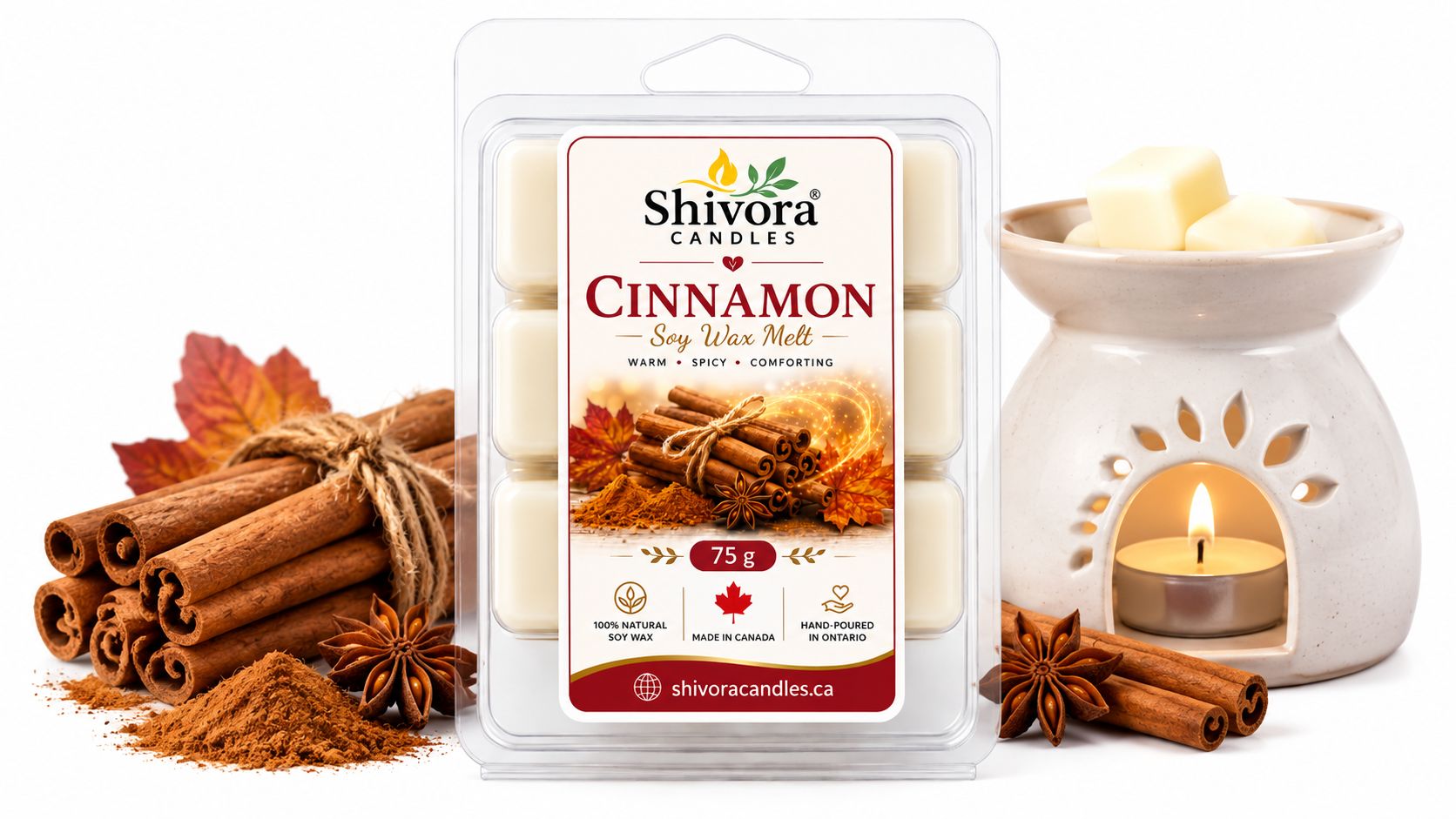
For a flameless example, the Cinnamon Soy Wax Melt Canada – 75g is hand-poured in Ontario, Canada using 100% natural soy wax and phthalate-free fragrance oils, with cinnamon leaf, clove, cedar, and tonka bean notes. It's described as having a strong throw, so a sensitive household should begin with the smallest quantity and a brief test. Our comparison of wax melts and candles explains the format differences in more detail.
What Ingredient Labels Miss in Candles for Sensitive Noses
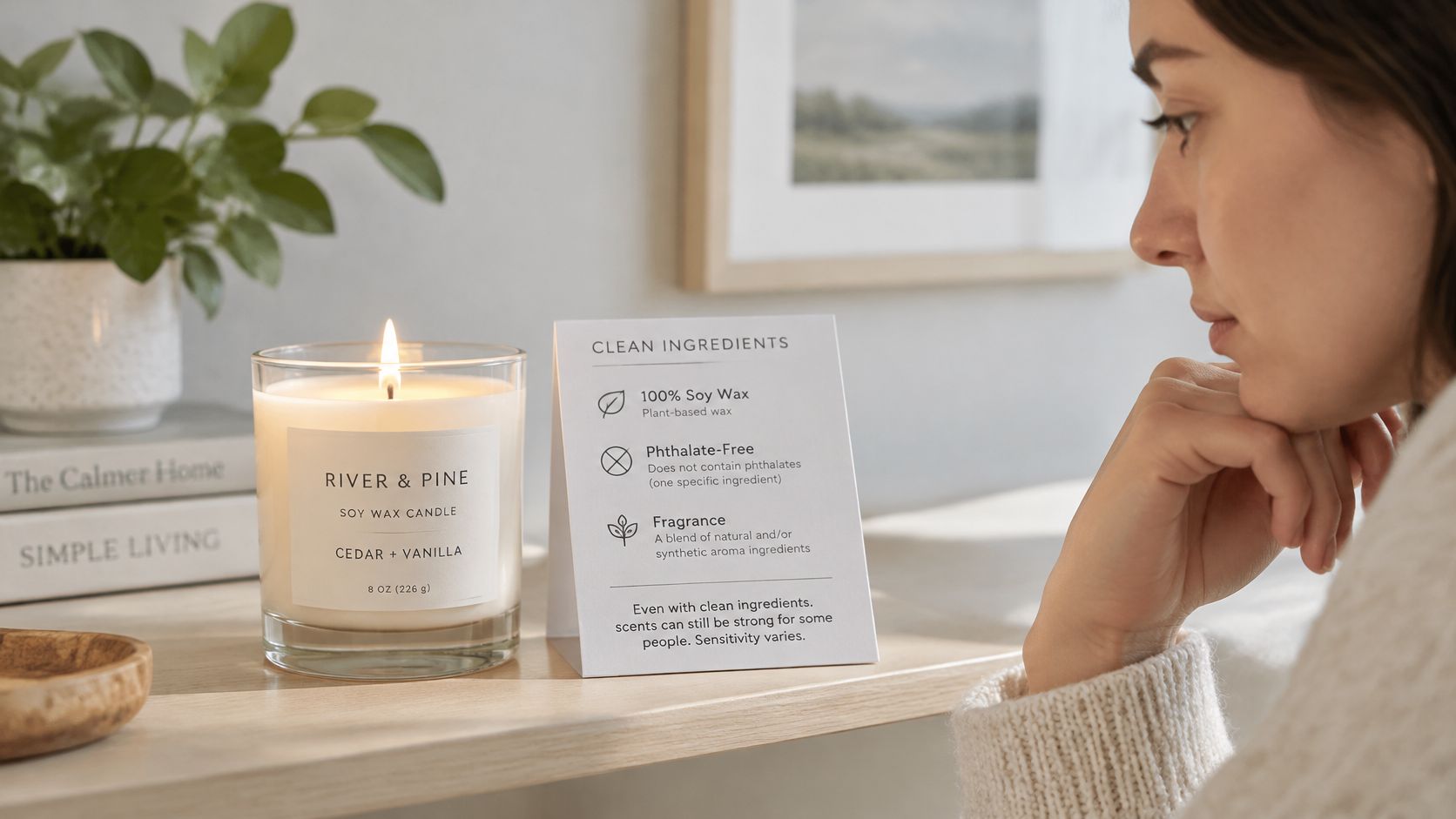
Phthalate-free is the phrase most likely to be read as a promise it can't make. It addresses one ingredient concern. It doesn't tell you how strongly a fragrance will fill your room or whether your body will react to that fragrance.
That distinction matters because sensitivity is individual. A person can dislike or react to a scent even when a product avoids a particular ingredient. Broad words such as natural and clean also have no fixed meaning for tolerance, so they shouldn't replace scent notes, intensity information, or a cautious first test.
What Common Phrases Actually Tell You
- Phthalate-free: The fragrance oils don't include phthalates, but the overall scent may still be strong or unsuitable for you.
- 100% soy wax: This identifies the wax. It doesn't state the scent load or predict how the fragrance will behave in your space.
- Natural or clean: These are general descriptions, not measurements of intensity or individual tolerance.
- Scent notes: Listed top, middle, and base notes help you avoid families you already know bother you, such as heavy spice, sweet gourmand blends, or sharp florals.
Sensitivity isn't a tiny niche in Canada. Preliminary 2025 Canadian Community Health Survey data found that more than 3.1 million Canadian adults, or 9.4%, reported multiple chemical sensitivity (MCS), in a figure published in a 2026 peer-reviewed study. That doesn't mean every one of those adults reacts to candles, but it does show why careful product descriptions matter.
For broader background on how indoor fragrance can affect people differently, Purified Air Duct Cleaning's fragrance guide is a useful companion resource. Our own Canadian buyer's guide to phthalate-free candles explains that label more narrowly.
Why Changing Wax Alone May Not Solve It
A soy candle still has a flame, and that flame produces combustion emissions regardless of wax category. If smoke, heat, or the burning process itself bothers you, switching wax without changing format, session length, or ventilation may not help.
A label can narrow your shortlist. It can't run the room test for you.
Before buying, check four things. Confirm the wax type, note the wick material, look for specific scent notes, and find whether the fragrance is described as light, moderate, or strong. If intensity isn't stated, treat the first burn as unknown and keep it especially short.
Choosing Candles for Small, Shared and Winter Spaces
Exposure rises or falls with four practical factors, burn time, number of candles, room size, and air exchange. Two candles burning for hours in a sealed condo create a very different situation from one candle tested briefly with a door open.
Ventilation dilutes what's in the air, but it doesn't make a sensitive person tolerant of a fragrance. An air purifier can supplement fresh-air exchange, yet it isn't a reason to keep burning through symptoms. When scent is already too much, removing the source comes first.
Candle Choices by Room and Home Setting
| Setting | Suggested Approach | Watch For |
|---|---|---|
| Small bedroom or nursery | Keep candles away from sleeping areas and use short sessions with the door open | Scent lingers after the flame is out |
| Winter apartment with windows closed | Light one candle at a time and ventilate before and after | Pollutants build up when air exchange is low |
| Shared home with guests or a scent-free housemate | Ask before lighting; choose unscented or flameless options | Scent-free requests from housemates or guests |
| Home with an air purifier | Keep the same session limits; the purifier supplements ventilation | A purifier does not replace stopping use |
| Open-plan living room | Use a medium session with a doorway or window open | Scent travelling into other rooms |
Winter, Guests, and Shared Air
Canadian winters complicate ventilation because opening a window wide isn't always comfortable. You can still air the room briefly before lighting, keep an interior door open, and ventilate again after extinguishing. Don't compensate for closed windows by burning longer at a lower perceived intensity.
Shared homes need consent, not guesswork. Ask before lighting a scented candle when guests are visiting or a housemate prefers a scent-free space. An unscented candle may preserve the glow, while no candle at all may be the respectful choice during a meal or overnight stay.
For lingering household smells that make you reach for stronger fragrance, the home deodorizing advice from Canes Cleaners offers source-focused cleaning ideas that can reduce the need to mask odours. That approach suits sensitive households because it lowers the temptation to layer candles, sprays, and melts.
My default for a small or shared space is simple: one candle at a time, a short session, and ventilation before and after. If the scent reaches a bedroom or another person's workspace at an unwelcome level, the test has given you your answer.
How to Trim and Burn a Candle Safely
A steady flame is easier to judge than a tall, smoky one. Good trimming won't make a strong fragrance mild, but it helps the candle burn more predictably and reduces avoidable smoke and disruption while you're assessing scent strength.
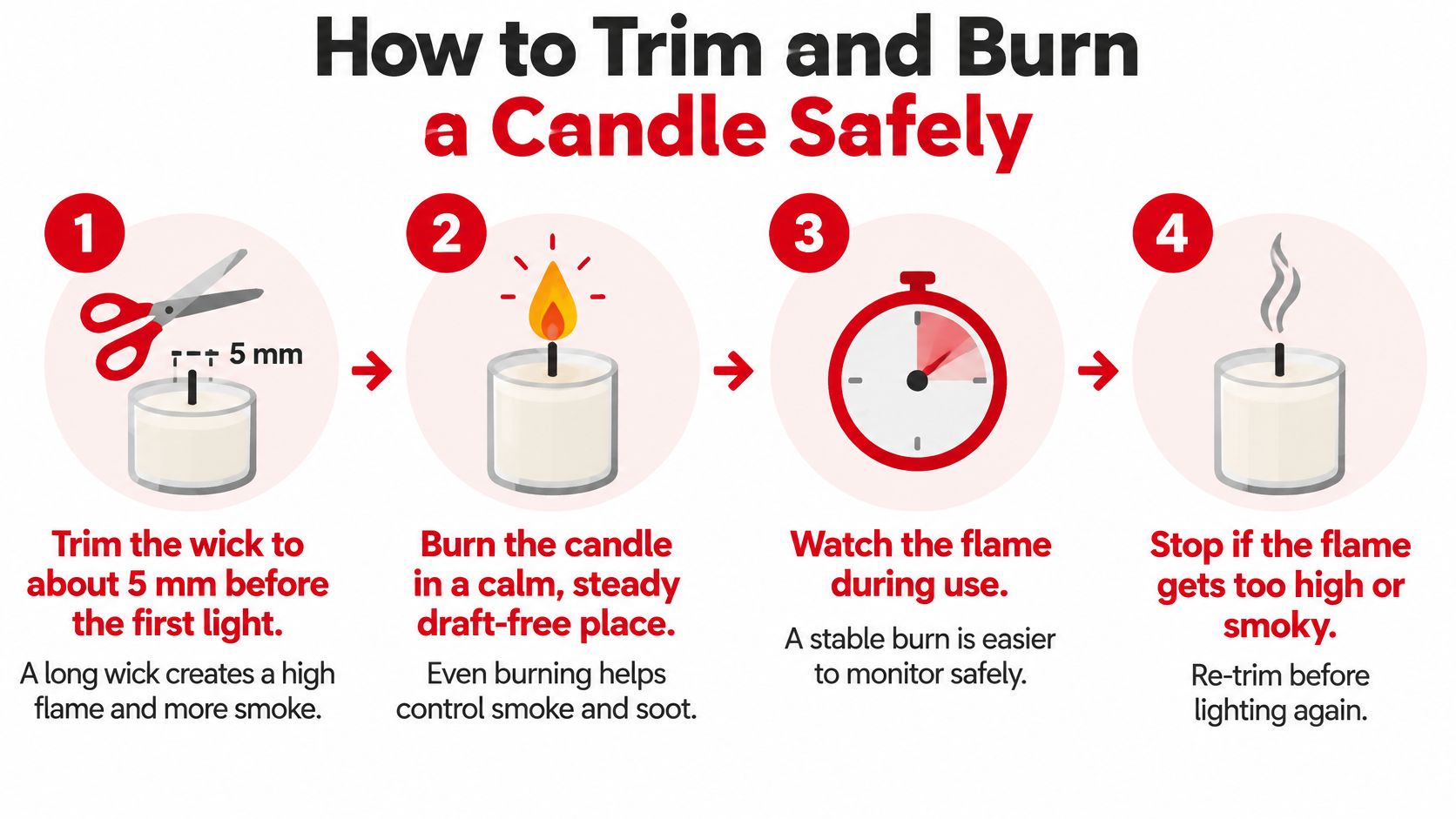
Quebec's public-safety guidance recommends trimming a candle wick to about 5 mm before lighting and again every two to three hours if necessary. It also advises a stable, non-flammable surface more than 30 cm from curtains, tablecloths, and other flammable objects.
A Simple Burn Routine
- Trim before the first light: Cut the wick to about 5 mm, and compare that with the trim length printed on your candle. A long wick can create a high flame and more smoke.
- Set the candle down carefully: Use a stable, heat-resistant, non-flammable surface more than 30 cm from curtains, tablecloths, paper, and other flammable objects. Keep it away from drafts that push the flame sideways.
- Watch and retrim when needed: Check during the burn and again every two to three hours during longer use. If the flame grows tall or smoky, extinguish the candle, let it cool, trim, and only then decide whether to relight.
- Extinguish before you leave: Put the candle out whenever you leave the room or go to bed. Never leave a burning candle unattended, even for a quick errand elsewhere in the home.
- Keep the area clear: Place candles out of reach of children and pets. Don't set one where it can be knocked by a passing sleeve, tail, or cushion.
What a Healthy Burn Looks Like
Look for a steady flame and an even melt pool developing across the surface. Flickering from a draft, a mushroomed wick, black smoke, or a flame that keeps stretching upward are signs to extinguish and correct the setup.
If you can't monitor the flame, you shouldn't keep it lit while testing its scent.
A controlled flame also makes scent release easier to assess because the wax melts consistently instead of overheating in bursts. For brand-specific instructions, follow the Candle Care & Safety page on shivoracandles.ca alongside the directions supplied with your candle. Safety limits come before ambience, especially in bedrooms, nurseries, and homes where someone may fall asleep nearby.
How to Test Scent Strength Before Longer Burns
Scent intensity is the variable you can manage most directly. You control the format, the room, the burn length, and the moment you stop. A staged test turns vague advice such as "try a gentle candle" into evidence from your own home.
A practical starting point is 15 to 30 minutes with the door open. Stand at normal conversation distance rather than leaning over the jar. If the fragrance feels excessive beyond arm's length, or it's already noticeable throughout the home, end the session and ventilate.
Three-Stage Scent Test for a New Candle
| Stage | Duration | What to Check | Stop If |
|---|---|---|---|
| Stage 1: Short open-door test | 15 to 30 minutes | Scent stays comfortable at normal conversation distance | Scent is detectable beyond arm's length or any symptom appears |
| Stage 2: Room-by-room check | 15 to 30 minutes, same candle | Bedroom and seating areas stay at a tolerable level | Scent reaches a sleeping area at a level you find excessive |
| Stage 3: Ongoing evening use | Same session length, one candle | Scent stays moderate across the evening | Any symptom listed in the stop-use section appears |
One Worked Example
Say you light a new candle for 20 minutes in a 12 square metre bedroom with the door open. Leave the room briefly, return, and notice the scent at the doorway before judging it beside the candle. Then check the hallway and pillow area. If the fragrance has settled where you sleep, don't move to a longer evening burn.
That short example tells you three useful things. You'll know how fast the scent builds, how far it travels, and whether it lingers after the flame is out. Repeat the same session length before extending it, because one comfortable evening can reflect an open window or a larger room rather than the candle alone.
Keep the Test Clean
- Use one scented product: Don't run a diffuser, warmer, room spray, or fragranced cleaner at the same time.
- Record the basics: Note the candle, room, session length, ventilation, and any discomfort.
- Change one variable: Adjust time, room, or melt quantity, not all three at once.
- Respect the first warning: A headache or irritated throat isn't a reason to push through to see whether it passes.
Sensitivity varies by person, room size, ventilation, and fragrance composition, so nobody can promise that a candle will suit everyone. Our guide to candle scent strength can help you interpret light, moderate, and strong descriptions before you choose the next one to test.
When to Stop Burning and Who Should Check First
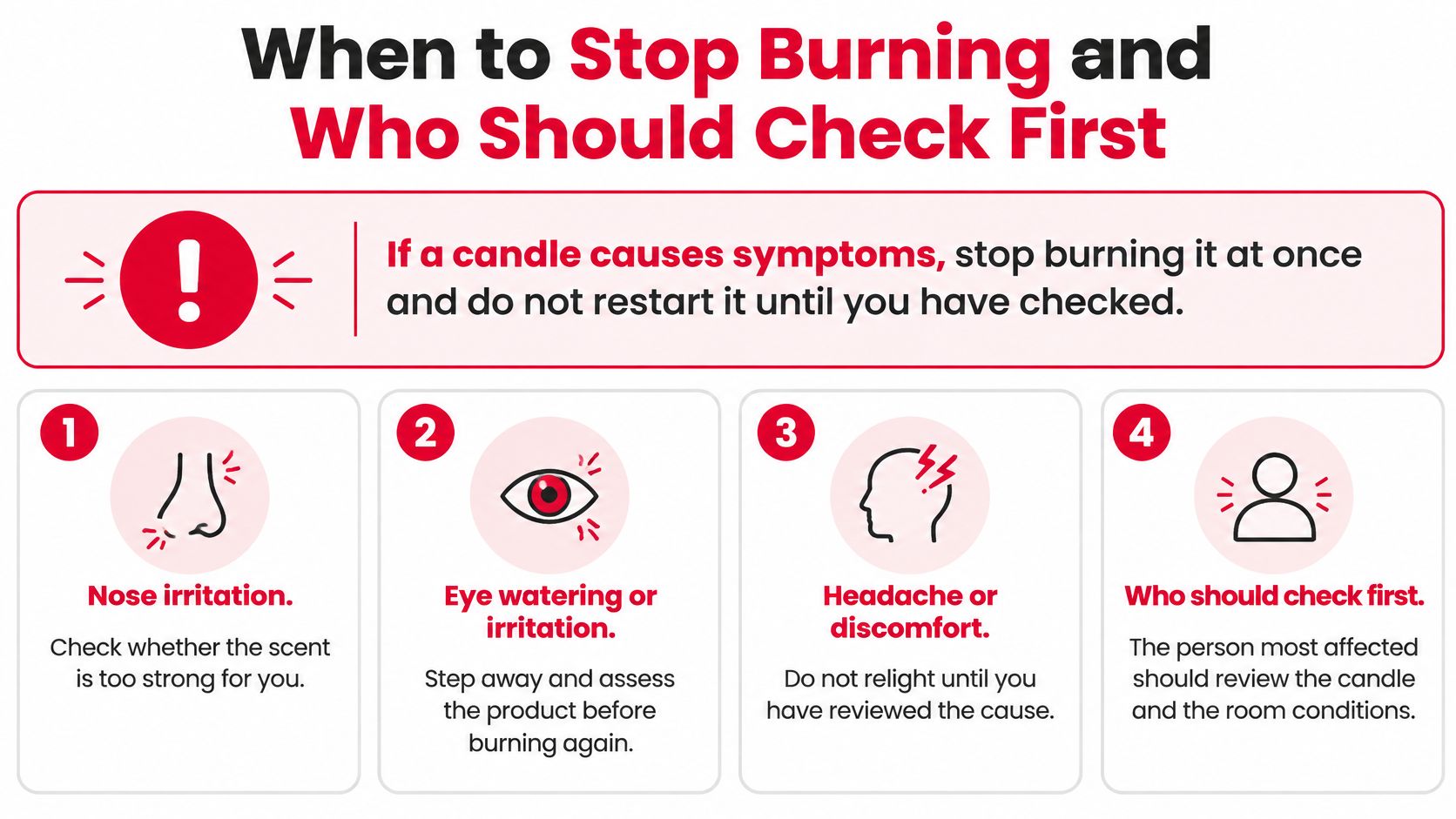
If a candle causes symptoms, stop burning it at once and don't restart it until you've checked. That rule applies whether the product is soy, phthalate-free, lightly scented, unscented, or used in a warmer without a flame.
Symptoms reported around scented products can include headache or migraine, coughing, wheezing, shortness of breath, nausea, and dizziness. Throat irritation, eye watering or irritation, and skin irritation are also reasons to end the session rather than move the candle a little farther away.
What to Do in the Moment
- Extinguish or switch off: Put out the candle or turn off the warmer.
- Get fresh air: Move away from the scent and open windows where practical.
- Write down the details: Note the product, room, ventilation, and how long it had been burning.
- Don't restart yet: Avoid the same product until you've checked with a clinician if symptoms were significant or repeat.
Who Should Check First
People with asthma, migraine, or multiple chemical sensitivity should put avoidance and clinician advice ahead of product claims. A staged test isn't a medical assessment, and a pleasant first few minutes don't prove that longer exposure will be fine.
Urgent rule: Difficulty breathing needs urgent medical care, not a wait-and-see period while the room clears.
Gift buyers should apply the same caution. Don't ask a scent-sensitive recipient to trial a candle during a gathering. Share the full fragrance notes, choose the lightest profile available, and make it easy for them to decline or test it later in a ventilated room.
Choose Your First Candle to Test Carefully
A small candle gives you more control over the first test. Shivora Candles' 4 oz candles suit sampling a new scent, smaller spaces, and Canadian-made gifts. The collection also comes in 8 oz and 10 oz sizes, which may suit scents you have already tried.
Before buying, check the product page for fragrance notes and wick type. Use the scent description to screen for notes you already know you dislike, but don't treat it as a promise about how strong the candle will feel in your room. Fragrance strength depends on the scent and the space where it burns.
A Sensible First Purchase Plan
- Choose a profile that sounds lighter to you: Start with a fragrance description that avoids notes you know can bother you.
- Buy one scent first: Trying several new fragrances close together makes it harder to identify which one affected you.
- Use the staged protocol: Begin with the short, open-door session before considering a longer burn.
- Keep notes: Record the room, ventilation, scent and session length. Consider a larger size only if the same test feels comfortable on more than one occasion.
A gourmand such as Mango Coconut may seem appealing from its notes, but the unlit fragrance description cannot tell you how strong it will feel once warmed. Begin with a brief test in a room where you can control airflow, then decide whether to continue.
Shivora Candles are hand-poured in small batches with 100% natural soy wax and premium fragrance oils. They are vegan, cruelty-free and phthalate-free, with lead-free cotton or crackling wood wicks. If you prefer a flameless format, Shivora's soy wax melts come as cubes for use in a warmer. They still release fragrance, so start with a small amount and pay attention to how it feels in the room.
Free shipping is available on orders of CAD $79.99 or more, subject to conditions.
Frequently Asked Questions About Candles for Sensitive Noses
Are Soy Candles a Good Choice for Sensitive Noses?
Soy wax tells you what the candle is made from, not how strong its fragrance will feel in your room. Compare scent descriptions and choose a format that lets you use less fragrance at a time.
What Should I Look for When Buying an Unscented Candle?
Check the product description to confirm it is labelled unscented, and ask the seller if the fragrance details are unclear. An unscented candle still has a flame and may not suit every sensitive household.
How Can Wick Type Affect the Burn?
Cotton and wood wicks create different experiences. Wood wicks are designed to produce a relaxing crackle; compare the wick options and choose the one that best fits your preferences for sound and ambiance.
Can Wax Melts Replace Candles?
Yes, wax melts offer fragrance without an open flame. Shivora's soy wax melts come as cubes for a warmer, so they may suit households that prefer not to burn a candle. The fragrance is still released into the room.
Should Someone With Asthma Use Candles?
That depends on the person's health and triggers. For advice about whether fragranced products are suitable, ask a healthcare professional.
Shivora Candles makes hand-poured soy candles and wax melts in Ontario. Explore the candle collection and wax melts to compare available formats and scents.


