

You're standing in the kitchen on a cool Ontario morning, coffee nearby and a candle jar in your hand. The label says maple syrup, but you're wondering whether your home will smell like breakfast, a sugar shack, or an overly sweet bakery.
A well-made maple syrup candle should offer more than a flat sugar note. It can suggest reduced sap, toasted wood, buttery caramel, roasted nuts, and the quiet warmth of a Canadian autumn. Maple also carries genuine regional meaning. Canada produced more than 113.4 million kilograms of maple syrup in 2025, and accounted for more than 75% of global production, according to Agriculture and Agri-Food Canada's 2025 maple industry overview.
Table of Contents
- What a Maple Syrup Candle Really Smells Like
- Breaking Down the Maple Fragrance Notes
- Best Seasons and Rooms for a Maple Candle
- Layering and Pairing Maple with Other Scents
- Wick Type, Vessel Size, and Burn Performance
- Candle Care That Keeps the Maple Aroma Strong
- Safety, Sensitivity, and Everyday Use Questions
- Choosing Your Maple Candle and Bringing It Home
What a Maple Syrup Candle Really Smells Like
Think of a Quebec cabin kitchen during sugaring season. A pan of syrup is warming on the stove, the windows are cool to the touch, and the air carries sweetness without smelling like ordinary white sugar. There's a darker quality too, somewhere between toasted wood, butter, and a faint wisp of smoke from the evaporator.
That layered aroma is what a fragrance maker is trying to capture. A maple syrup candle isn't made to smell edible, and it shouldn't smell exactly like pancake batter. Instead, the fragrance usually balances sweetness, caramel, nuttiness, and woodiness so the scent feels comfortable in a room rather than concentrated on a plate.
Ontario has its own connection to that story. Ontario producers harvested 690,000 gallons of maple syrup in 2025, representing 3.7% of national production, while Quebec accounted for 90.0% of Canada's output. The same Canadian maple industry report records Ontario's substantial agricultural and economic role, including a provincial harvest season that produces more than 1.5 million litres of syrup and contributes more than $53 million to Canada's economy.
Why the scent changes as you burn it
When you first open the jar, you're smelling the cold throw, the fragrance released without heat. It may seem buttery, sugary, or softly woody. Once the wick warms the wax, the hot throw develops and the heavier caramelized notes become easier to notice.
That difference can confuse shoppers. A candle that smells subtle in the jar may become rounder and richer once burning, while a candle that smells intensely sweet when cold can feel tiring if its fragrance has no deeper notes.
Maple also benefits from patience. A quick, brief burn may release the first sugary impression without giving the fragrance enough time to fill the room evenly. Let the candle warm gradually, keep the flame steady, and judge its character after the wax has had time to melt across the surface.
For a useful introduction to how scent families work together, explore this guide to candle scent families. It helps place maple beside gourmand, woody, spicy, and fresh fragrances instead of treating it as a single-note category.
Breaking Down the Maple Fragrance Notes
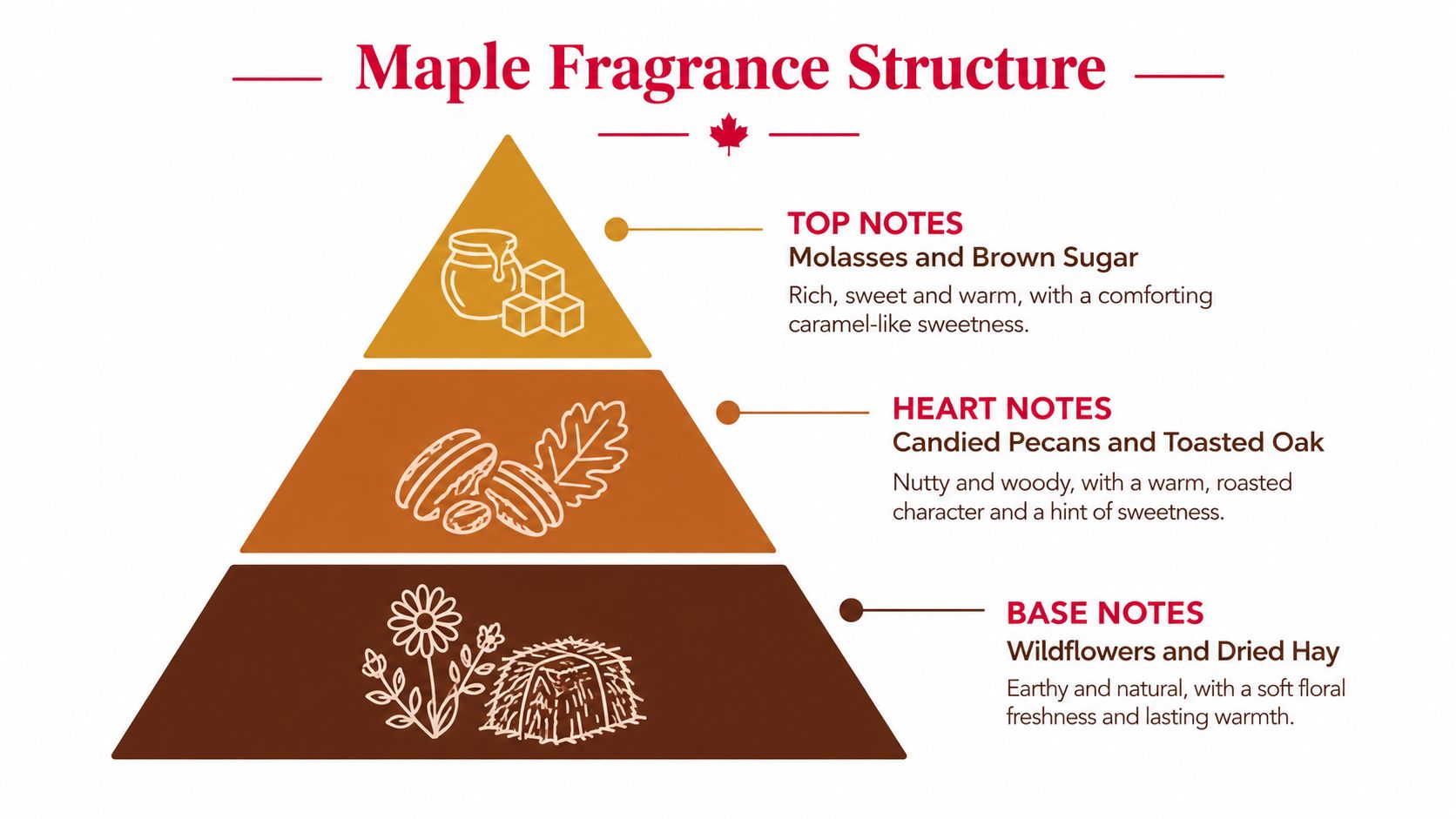
A maple syrup candle can change character as you move from the first sniff to the lasting impression. Perfumers describe that progression as a fragrance pyramid: top notes arrive first, heart notes give the blend its personality, and base notes help it remain present after the brighter opening fades.
The opening impression
The top layer often brings molasses, brown sugar, and sweet butter. These notes identify the candle as maple-forward and create an inviting kitchen or dining-room mood without making the room smell as though someone has just baked.
The heart provides the rounded middle of the accord. Roasted nuts, caramelized sap, and warm vanillin give the fragrance body and connect its sugary opening to a deeper, browned character. Vanillin is associated with vanilla, yet a balanced maple blend does not need to smell like frosting. Used with restraint, it suggests soft warmth and toasted sweetness.
The deeper structure
Base notes remain closer to the room and help the fragrance feel grounded. Toasted wood, cedar-like warmth, tonka, or a gentle bourbon impression can add shadow and dryness, keeping the scent from collapsing into plain sugar.
That caramelized-woody quality has a chemical reason. Canadian maple syrup contains identifiable flavour-active phenolic and aldehydic compounds, including vanillin, syringaldehyde, and coniferaldehyde. Canadian maple syrup chemistry and fragrance-related patent information helps explain why a convincing maple accord can suggest browned wood and cooked sugar rather than sweetness alone.
A candle usually does not use maple syrup itself as its practical fragrance ingredient. Makers build the impression with fragrance materials that suggest vanilla, caramel, toasted sugar, and wood. Vanillin and furaneol-type materials may supply the browned sweetness, while woody base materials create a drier finish. The trade-off is clear: more sugar makes the candle immediately recognizable, while more wood and spice can make it feel natural and less candy-like.
A useful test: If maple smells sweet at first but becomes warmer and more rounded as the candle burns, the fragrance has enough structure to stay interesting.
For shoppers choosing a candle for rest, SouthShore Fine Linens aroma tips offers context on how fragrance character can shape a room's mood. Maple may feel comforting, though its gourmand richness often suits a kitchen, reading nook, or living room better than a quiet sleep space.
Best Seasons and Rooms for a Maple Candle
A maple candle fits most naturally into the in-between parts of the Canadian year. In late autumn, its caramelized warmth suits wool throws, roast dinners, fallen leaves, and evenings that begin earlier. January is another good match. The fragrance can make a room feel welcoming without turning on the oven or starting a baking project. On a cool March morning, maple recalls Ontario sugar shacks and fresh sap season, so it feels connected to place and timing rather than like plain sweetness.
Ontario's harvest record helps explain that connection. Producers harvested 607,000 gallons in 2024, up 20.9% from the previous year. Canadian farmers reached 19.9 million gallons, 91.3% above 2023 and 14.3% above the previous record set in 2022, according to Agriculture and Agri-Food Canada's maple report. Harvests vary, while a candle offers a steady, year-round interpretation of the regional aroma.
Match the room to the mood
An open-concept kitchen or dining area gives maple enough space to breathe. Light it before brunch or while guests arrive, allowing the fragrance to support conversation rather than compete with it. An entryway console is another useful spot. The candle can provide a distinctly Canadian welcome without scenting the entire home.
A reading nook with a wool throw gives maple a quieter job. Let it sit in the background while you read, especially if the fragrance has a restrained sweetness or a dry, wood-like finish. In a finished basement rec room, it can add warmth during a stormy Saturday without competing with cooking aromas upstairs.
Room size changes the experience. In a small, poorly ventilated bathroom, a rich gourmand fragrance may feel concentrated. A south-facing porch in summer can expose wax and fragrance to excessive heat. Humidity may also blur the difference between maple's lighter and darker notes, making its character seem less defined.
For Ontario homes, choose the room first and scent strength second. A smaller candle suits a console or nook, while a larger vessel can serve an open kitchen or dining area. Burn it during the season and activity it supports, then protect the wax from heat between uses. Maple should welcome people into a space, not take over every activity there.
Layering and Pairing Maple with Other Scents
Set a maple candle on the dining table during a cool Ontario brunch, then place coffee near the counter. The fragrances meet across the room like two gentle notes in a song. Maple brings a caramelized, woody sweetness, so pairing works best when another scent supports that character instead of covering it.
Four combinations that work
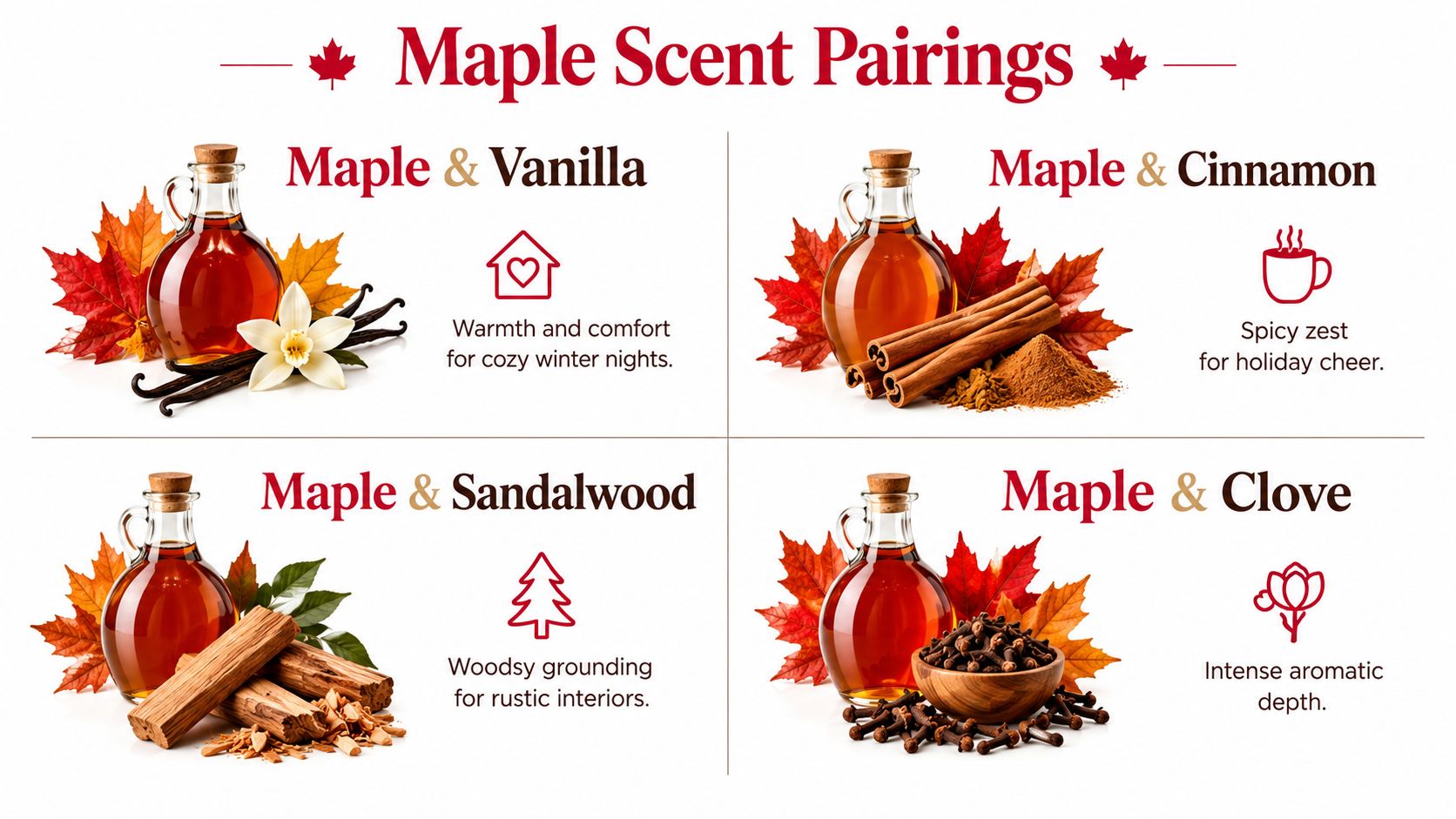
Vanilla or tonka rounds out maple's caramel side and gives the room a dessert-like warmth. Use both in a larger space, with the candles separated so their fragrance blends gradually. This combination fits winter evenings, movie nights, and cosy gift baskets.
Fresh coffee keeps maple at home in a kitchen or breakfast nook. Put maple near the dining table and coffee closer to the counter. These separate zones allow the scents to meet gently, preventing the room from becoming one heavy gourmand blend.
Cedar or pine gives maple a cottage or cabin direction. Place the maple candle in the main seating area and the woodsy candle in an adjoining hallway or reading corner. The dry forest note steadies maple's sweetness, much like a wooden frame gives shape to a warm colour.
Woodsmoke or birch tar creates a darker outdoor mood. Use a lighter amount and leave more space between the candles, since smoky notes can quickly dominate maple's softer caramel character.
Citrus and heavy florals may mute maple's warmth, especially when both candles are strongly scented. For brunch, a maple dessert, or a compact Ontario room, one maple candle often gives the clearest result. Its aroma has space to open, and the regional maple character remains easy to recognize.
For a practical method of combining fragrances at home, follow this candle scent layering guide. Choose one main note, add a supporting scent, and adjust distance before adding more fragrance. Layer for atmosphere, not maximum intensity.
Wick Type, Vessel Size, and Burn Performance
A maple fragrance has a heavier base than a bright citrus scent, so the candle's physical format matters. Wax, wick, and vessel diameter all influence how quickly the wax warms and how evenly the fragrance moves through the room.
Soy wax is often chosen for a softer, measured scent release. A single cotton wick can provide a steady flame, while a wood wick can add a gentle visual and audible character. Paraffin may push the first impression more assertively, but visible soot depends heavily on wick condition, fragrance load, airflow, and burning habits, not wax type alone.
Vessel size changes the experience too. A small travel tin is convenient for a compact space or a short seasonal display. A medium jar generally suits a bedroom, reading nook, or smaller living area. A wider statement vessel can create a broader melt pool, but it may also use fragrance more quickly if the wick and formula are designed to heat a larger surface.
| Format | Scent Throw | Burn Time | Soot Level |
|---|---|---|---|
| Small travel tin | More contained and suited to compact spaces | Shorter overall use | Depends on wick trim and airflow |
| Medium jar | Balanced for everyday rooms | Moderate overall use | Depends on combustion stability |
| Larger statement vessel | Broader potential room presence | Longer overall use when properly formulated | Requires careful wick management |
Canadian listings illustrate the range clearly. A maple travel tin has been listed at about 15 hours, while a 16 oz candle has been listed at about 65 hours in the Seracon maple syrup travel tin listing. Treat those figures as product-specific estimates, not a universal promise. Vessel design, wax blend, wick, fragrance load, and burn routine all change the result.
A maple candle performs best when the melt pool develops evenly and the flame remains controlled. A large jar isn't automatically better value, and a wood wick isn't automatically the right choice for every room. Match the format to the space you'll really use.
Candle Care That Keeps the Maple Aroma Strong
Maple's caramelized and woody notes can become less pleasant when a candle burns with an oversized flame, a smoky wick, or an uneven melt pool. Good care protects both the fragrance and the vessel.
Do these things
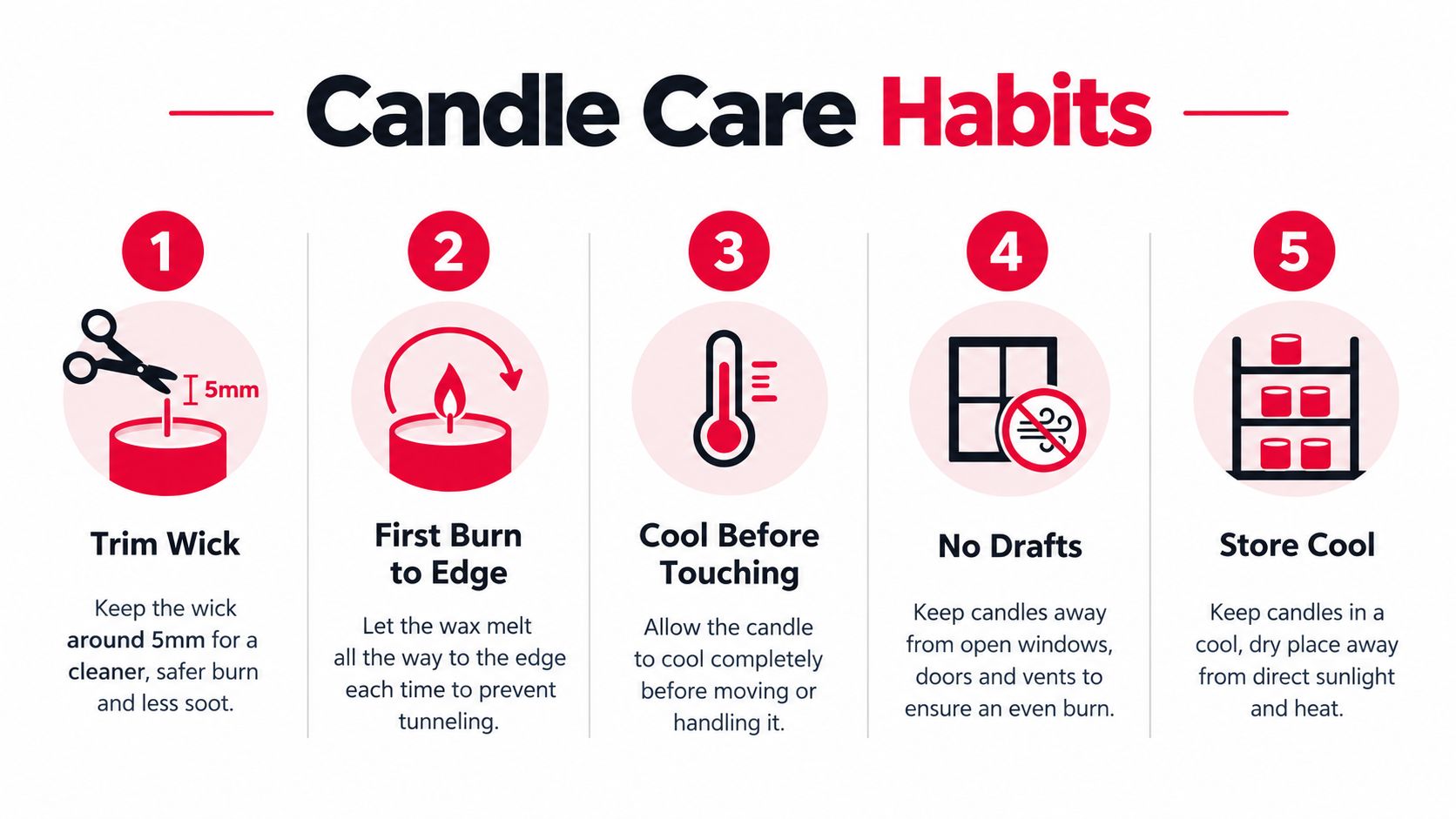
- Trim the wick before lighting. Keep it close to 5 mm, within Health Canada's recommended 5–7 mm range, and remove loose carbon from the tip. A shorter, stable wick helps control the flame and limits unnecessary soot. Health Canada explains the trimming routine in its candle safety guidance.
- Give the first burn enough time to reach the edges. If you extinguish the candle while only the centre has melted, the wax can tunnel around the sides. An even melt pool helps expose the fragrance consistently during later burns.
- Keep each session moderate. Health Canada recommends trimming the wick again every 2–3 hours to help prevent a high flame. Let the candle cool before handling the vessel, and never try to move hot wax.
- Avoid drafts. Windows, furnace vents, and fans can make the flame flicker and create an uneven melt pool. A stable position helps the maple fragrance release in a more balanced way.
- Store it cool and dark. Keep the lid on when possible, away from direct sunlight and heat. For an autumn or winter candle that spends months between uses, protected storage helps preserve its original scent character.
Practical rule: A clean, centred melt pool is more useful than a large flame. More heat doesn't necessarily mean better fragrance.
This guide to fixing weak hot throw in a soy candle covers common reasons a candle may seem quiet while burning.
Safety, Sensitivity, and Everyday Use Questions
A food-inspired candle contains fragrance oils, not edible maple syrup. Don't use the wax, fragrance, or decorative ingredients near food, even when the label evokes pancakes, caramel, or a sugar shack.
Ventilation matters, especially in smaller Canadian apartments or rooms with limited airflow. Independent Canadian guidance notes that scented candles can release aldehydes including formaldehyde, acetaldehyde, and acrolein, while exposure is generally considered low when candles aren't overused. The practical response isn't panic. It's moderation, airflow, and attention to how your own household responds, as discussed by Beneva's guidance on scented candle considerations.
If you're sensitive to fragrance
Start with a shorter session in a larger room and keep a window available. If the aroma causes a headache, throat irritation, nausea, or discomfort, extinguish the candle, move to fresh air, and avoid using that fragrance again until you understand the trigger.
Homes with pets need the same careful approach. No candle should be described as automatically pet-safe. Keep the vessel and flame out of reach, prevent curious animals from knocking it over, and stop using the candle if your pet shows unusual sensitivity to the smell or smoke.
Soy and paraffin behave differently as waxes, but neither removes the need for wick care. A correctly trimmed cotton or wood wick supports steadier combustion, while an overloaded fragrance formula or unstable flame can increase soot and emissions. Canadian guidance has measured total VOC emissions in candle testing at roughly 3–5 micrograms per gram of wax burned across common waxes, which is why balancing fragrance strength with combustion stability matters. The Canada-focused candle material and indoor-air summary also notes that trimming a wick to about 6 mm can substantially reduce black soot.
Follow these everyday rules:
- Stay nearby: Never leave a burning candle unattended.
- Trim regularly: Cut the wick before lighting and again during longer sessions.
- Watch the base: Stop using the candle when about half an inch of wax remains.
- Create distance: Québec guidance recommends placing a candleholder on a stable surface at least 30 cm from flammable objects and out of reach of children and pets. Read the Québec candle safety guidance before lighting.
- Respect multi-wick vessels: Health Canada advises extra caution and recommends avoiding multi-wick candles with wicks positioned close together.
Choosing Your Maple Candle and Bringing It Home
Start with the scent, not the jar. Decide whether you want a breakfast-style maple with butter and brown sugar, a darker profile with toasted wood, or a softer blend rounded with vanilla or tonka. If you're buying for an open-concept kitchen, a fuller fragrance may suit the space. For a reading nook or apartment bedroom, a more restrained profile can feel easier to live with.
Then choose the format. A small tin is convenient for travel, gifting, or a compact room. A medium jar is a flexible everyday option. A larger vessel can suit a living room or open area, but only if you're prepared to follow the wick and burn instructions closely.
Read the label with purpose
Look for:
- Wax information: A clear description of the wax blend, such as soy wax.
- Wick material: Cotton or wood should be identified rather than left vague.
- Fragrance details: Phthalate-free fragrance claims can help shoppers compare products, without implying that any scented candle is risk-free.
- Estimated burn time: Treat the estimate as dependent on wick trimming and session length.
- Care instructions: A responsible maker should explain how to trim, burn, extinguish, and store the candle.
Ontario-made options can be especially appealing when you want a maple profile connected to the place where maple production is part of the agricultural tradition. Shivora Candles offers hand-poured soy candles and wax melts made in Ontario, Canada, with fragrance options and wick choices suited to different home settings.
When your candle arrives, inspect the vessel and wick before lighting. Keep it covered while it settles into its storage spot, then place it on a stable, heat-resistant surface away from drafts. Your first burn should be deliberate rather than rushed, because the way you establish the melt pool affects how consistently the maple aroma returns later.
A maple syrup candle works best when scent, room, vessel, and care all agree. Choose the profile you'll enjoy repeatedly, not merely the one that smells strongest for a few seconds in the shop.
Shivora Candles offers hand-poured soy candles and soy wax melts made in Ontario, Canada, including warm fragrance profiles that suit maple-inspired layering and seasonal gifting. Visit Shivora Candles to explore Canadian-made home fragrance, and remember that shipping across Canada starts at $9.99, with free shipping on orders of $79.99 CAD or more, some conditions apply.

