

You're comparing wholesale candle suppliers late at night, surrounded by sample jars, freight estimates and scent lists that all look similar at first glance. One supplier offers an attractive unit price, another promises Canadian-made production, and a third has the packaging your boutique needs. The difficult part isn't finding candles. It's choosing a supply partner that can protect your margins, meet your restocking needs and fit the story you want your store to tell.
Sourcing wholesale candles in Canada requires more than comparing prices. You need to assess landed cost, production capacity, wax and wick specifications, packaging, lead times, safety information and the role candles will play in your wider home-fragrance assortment.
Table of Contents
- The Challenge of Sourcing Wholesale Candles in Canada
- Understanding Canada Candle Market Dynamics
- Key Considerations When Buying Wholesale Candles
- Private Label versus Stocking Established Brands
- Current Trends Shaping Canadian Candle Demand
- Quality Standards and Safety Requirements for Retail Buyers
- How Shivora Candles Supports Canadian Retail Partners
- Frequently Asked Questions About Wholesale Candles in Canada
The Challenge of Sourcing Wholesale Candles in Canada
A small gift shop in Ontario might start with an imported candle line because the wholesale price looks hard to beat. The first order arrives well enough, but the next replenishment takes longer than expected. A popular scent is unavailable, the vessel colour changes, and emails take days to receive a reply. The original unit price no longer tells the full story.
A boutique in British Columbia may take the opposite route and search only for local producers. The products offer a stronger Canadian story and more direct communication, but a small-batch maker might not have enough capacity when a seasonal display performs well. The retailer then faces a different problem, missed sales while waiting for new stock.

The real cost behind the unit price
Imported candles can suit retailers that prioritise broad availability and competitive pricing. Domestic suppliers can suit shops that need closer communication, traceability and a stronger made-in-Canada story. Neither route is automatically better.
Your decision should account for:
- Landed cost: Include freight, brokerage, packaging changes and any handling costs, not just the supplier's unit price.
- Restocking speed: Ask how quickly a best-selling scent can be reproduced and dispatched.
- Consistency: Confirm whether the same wax, wick, fragrance profile, vessel and label specifications will be used in future batches.
- Communication: A supplier who answers clearly before the first order is more likely to support you when an issue arises.
- Retail positioning: Low-cost imports may suit a value-led shelf, while domestic small-batch candles can support premium, gift and locally made positioning.
Practical rule: Never approve a wholesale candle line from a catalogue image alone. Sample the product, inspect the packaging and ask direct questions about replenishment before committing shelf space.
Retailers comparing larger quantities can also use this guide to buying candles in bulk to organise supplier questions. The strongest buyer knows which compromises are acceptable before negotiating, rather than discovering them after the stock is on the shelf.
Understanding Canada Candle Market Dynamics
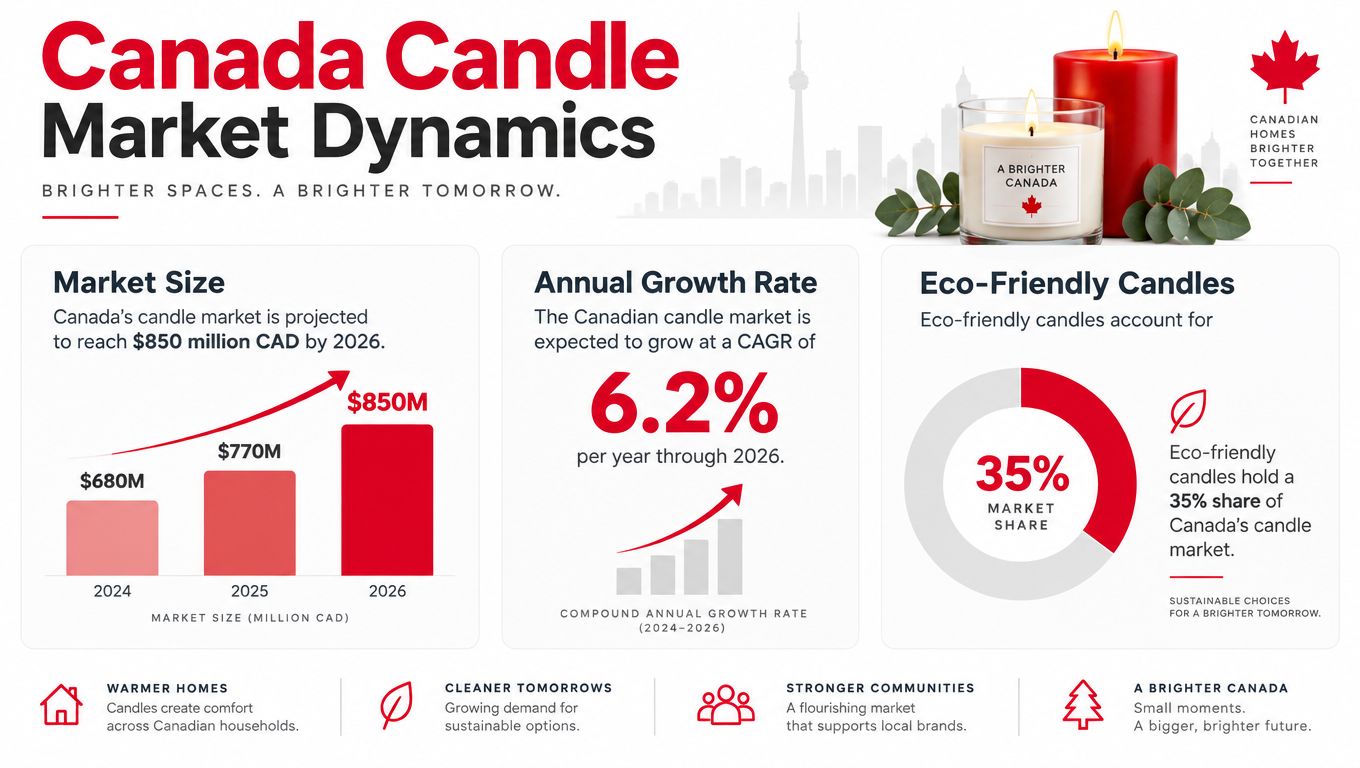
Canada's candle category is large enough to support mass retail, private-label supply and independent makers. The Canadian candle market was estimated at USD 906.8 million in 2025 and is projected to reach USD 1,626.9 million by 2033, representing roughly 79% long-run expansion over that forecast period, according to Canada candle market coverage from Grand View Research.
That scale matters to a boutique owner because candles aren't merely a short-lived seasonal novelty. Long indoor seasons and cold weather support year-round use for ambience, gifting and home fragrance. Retailers can build a dependable replenishment category, provided they choose products that fit their customers rather than treating every candle as interchangeable.
Why local supply deserves serious consideration
Canada remains structurally dependent on imported candles. Estimates indicate that foreign producers supply 70% to 80% of domestic consumption, while domestic production covers approximately 20% to 30% by volume. Another market note places domestic production at roughly 15% to 20%, with imports supplying 70% to 85% and the balance concentrated in premium and artisanal products, as outlined in Canada candle market analysis from IndexBox.
This structure creates a clear role for Canadian makers. Imported volume can serve broad, price-sensitive demand, while domestic producers often compete through small batches, custom lines, premium presentation and closer retailer relationships. Ontario and Quebec are identified as the main domestic production hubs, which gives Ontario-based suppliers a useful position when serving retailers elsewhere in Canada.
A retailer sourcing locally isn't just choosing a flag for the label. Domestic purchasing can make it easier to discuss batch specifications, request packaging changes, plan restocks and explain the product's origin to customers. The right choice depends on your positioning, but local supply deserves evaluation whenever traceability and responsiveness matter as much as unit price.
Key Considerations When Buying Wholesale Candles
Start with the commercial terms, then move into the product details. A supplier should be able to explain the minimum order, price breaks, payment terms, production schedule and freight arrangement without sending you through a maze of vague answers.
Ask for a written quote that separates product cost from shipping. A low wholesale price can lose its advantage if cartons are expensive to move, packaging arrives damaged or you need to hold excessive stock to avoid running out.
A buyer's negotiation checklist
Minimum order quantity: Find out whether the minimum applies per scent, per vessel, per label or across the complete order. A flexible mixed-case arrangement may be more useful to a small boutique than a lower price tied to a large single-scent purchase.
Pricing structure: Ask for wholesale pricing, suggested retail pricing and the margin assumptions behind each. Then test the numbers against your actual shelf price, promotions and markdown policy. A candle that only works at full price may create problems during gifting season.
Freight and shipping: Clarify dispatch location, carrier, carton dimensions, insurance and damage procedures. Wax can be affected by rough handling and temperature changes during transport, so ask how the supplier protects finished candles in transit and what happens when goods arrive compromised.
Supplier reliability: Ask how often core scents are produced, whether components are stocked locally and how the supplier handles a backordered fragrance oil, vessel or wick. A clear answer is more valuable than a broad promise of availability.
Inspect what customers will see
Packaging should survive handling at the shop and still look giftable after repeated browsing. Check label adhesion, scent naming, batch identification, lid fit, vessel finish and whether the safety information is easy to find.
Then test the candle in the way a customer will use it. Note the first-light experience, scent diffusion, wick behaviour and the condition of the vessel as the candle burns. Keep a simple supplier scorecard so you compare products consistently instead of relying on the most attractive sample.
The best wholesale deal is the one that remains profitable after freight, damaged units, staff time and replenishment delays are included.
Private Label versus Stocking Established Brands
Private label and established brands solve different retail problems. Private label gives you control over the product story, label design, scent naming and collection structure. Stocking an existing brand lets you test demand with less development work and gives customers a product line that already has a defined identity.
| Approach | Margin Potential | Brand Control | Lead Time | Best For |
|---|---|---|---|---|
| Private label | Potentially stronger when volume and pricing are well managed | High, from scent selection to packaging | Usually longer because specifications and artwork need approval | Retailers building a distinctive house collection |
| Established brand | More predictable at launch, with direct comparison to other stockists | Limited to merchandising and assortment choices | Often simpler to order, subject to availability | New categories, gift shops and retailers testing demand |
| Canadian small-batch line | Can support premium positioning and local storytelling | Moderate to high, depending on the supplier programme | Depends on production capacity and batch schedule | Boutiques prioritising origin, craftsmanship and direct communication |
Private label requires more than putting your logo on a vessel. You'll need to approve fragrance profiles, vessel dimensions, label copy, warning information, packaging, order quantities and future replenishment terms. If you choose this path, request a production sample that matches the final materials rather than approving a scent in one container and selling it in another.
Established brands reduce the creative workload, but they can create price comparison. Customers may find the same product elsewhere, and other retailers may run promotions that affect your perceived value. Your advantage then comes from curation, display, service and gift presentation.
Use a Canadian wholesale and private-label candle programme as a reference point when preparing supplier questions. Ask whether you're buying a finished product, commissioning a custom product or entering a flexible arrangement between the two. For many independent retailers, a small initial range with the option to customise later is the sensible middle ground.
Current Trends Shaping Canadian Candle Demand
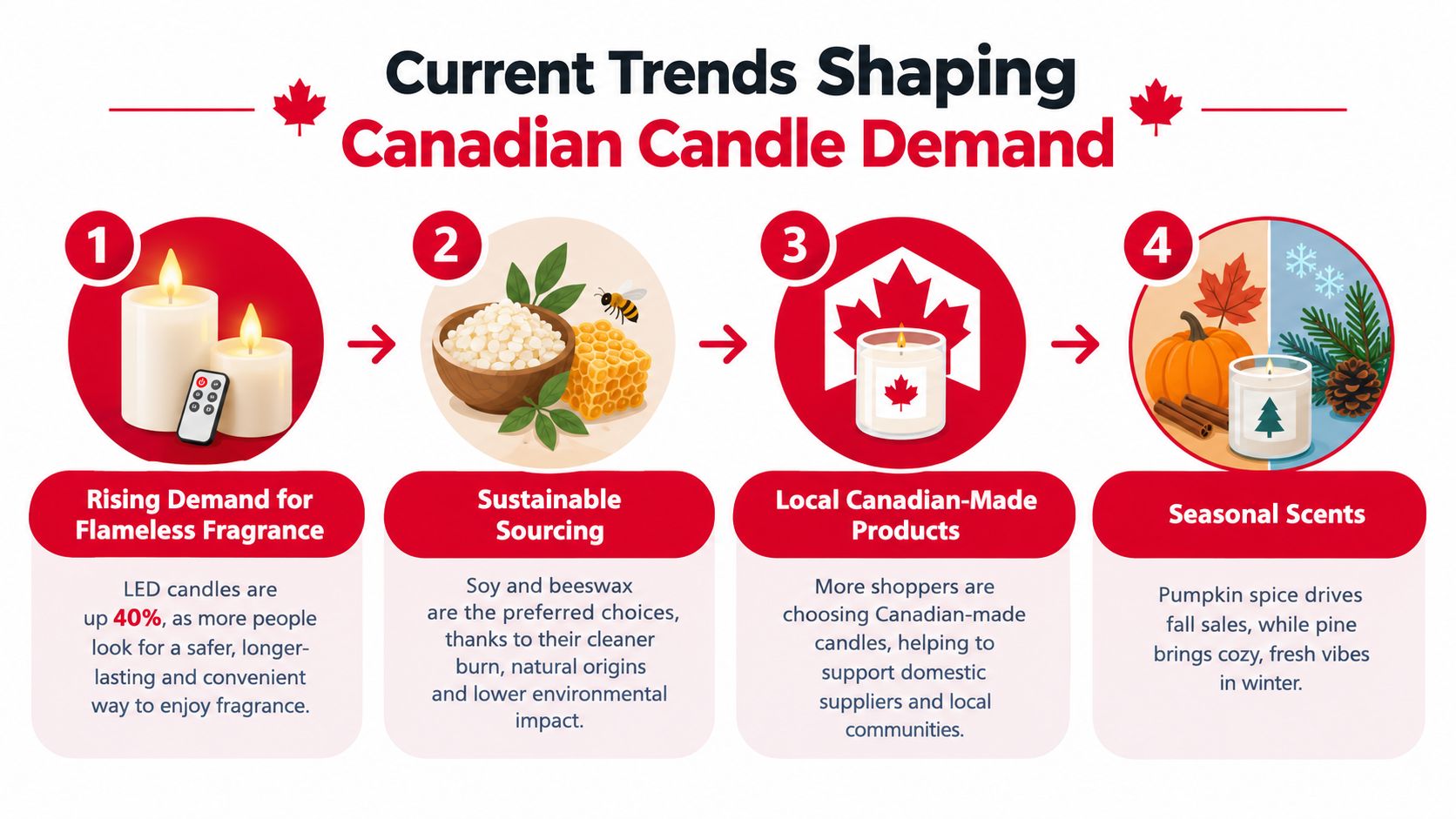
A candle-only assortment can leave useful sales on the table. Canadian home-fragrance demand increasingly reflects wellness routines, nesting, interior design and the desire to fragrance a home without an open flame.
Recent Canada-focused market coverage identifies diffusers, wax melts and electric warmers as the fastest-growing home-fragrance formats, expanding at 6% to 8% annually, while candles retain the largest share of category revenue, as reported in IndexBox's Canada candles and home scents analysis. The practical conclusion is straightforward: keep candles at the centre of the assortment, but give shoppers credible alternatives.
Build an assortment around use cases
Apartment and condo residents may want fragrance without a visible flame. Pet-owning households may ask for formats that let them scent a room while the product remains inside an electric warmer. Safety-conscious shoppers may prefer wax melts or diffusers for everyday use and reserve candles for supervised evening rituals.
Merchandise by occasion rather than by format alone:
- Quiet evening: Pair a candle with a soft, familiar scent profile and a care card.
- Flameless fragrance: Group wax melts with compatible warmers and clear usage instructions.
- Host gifts: Create a small home-fragrance arrangement with complementary scent families.
- Seasonal refresh: Rotate limited seasonal profiles while keeping dependable everyday scents available.
Retailers should also think beyond scent names. A customer buying for a dinner, wedding or hosted gathering may be looking for perfect candles for events, where presentation and coordinated styling matter as much as fragrance.
The strongest wholesale programme gives customers a choice without making the shelf confusing. Keep a core candle collection, add a focused wax-melt selection and use signage to explain when each format works best. For further assortment planning, review these home-fragrance trends for 2026.
This short video can also help retailers think about how candle presentation contributes to the shopping experience:
Quality Standards and Safety Requirements for Retail Buyers
Quality control starts before the candle reaches the shelf. Ask suppliers to explain the wax type, wick material, fragrance specifications, vessel suitability and testing process. You don't need to run a laboratory, but you do need enough information to identify inconsistent products before customers do.
A sample should be assessed across more than one burn session. Look for a stable flame, suitable melt-pool development, manageable soot and a vessel that remains appropriate for its intended use. Compare the same scent across batches when possible, because fragrance perception can change with wax, wick, vessel diameter and fragrance load.
Make wick information part of the purchase decision
Health Canada guidance recommends trimming the wick to 5 to 7 mm, about 1/4 inch, before lighting and again every 2 to 3 hours. An overly long wick can increase flame height and soot formation. The same Canadian candle safety guidance warns against lead-core wicks because they can emit harmful lead vapours and dust when burned.
Ask suppliers whether their wicks are cotton or wood, how they specify wick size and what care instructions appear on the packaging. A retailer shouldn't have to improvise basic guidance after the product is already in customers' homes.
Give shoppers clear safety information
Health Canada consumer guidance says candles should sit on a stable, heat-resistant surface, away from flammable objects, and should never be left unattended while burning. It also advises keeping candles out of reach of children and pets, as set out in this Canadian candle care and safety guidance.
Use shelf cards, product inserts or staff training to reinforce those points. Avoid unsupported claims such as “completely safe,” “soot-free” or “pet-safe.” Responsible use depends on placement, supervision, wick care and the conditions in the home.
A supplier that treats safety copy as an afterthought creates unnecessary risk for your store. Choose products with legible instructions, consistent labelling and a clear process for handling customer concerns.
How Shivora Candles Supports Canadian Retail Partners
The most useful domestic supplier relationship begins with a practical conversation, not a sales script. A retailer should be able to describe the shop's customer, shelf space, price positioning, preferred scent families and expected replenishment pattern. The supplier can then explain which formats and ordering arrangements make sense.
For an Ontario boutique, a nearby small-batch producer may offer a more direct route to product questions and restocking conversations. For a retailer in another province, the key questions remain the same: Where is production located? Which products are regularly available? How are wholesale orders packed? How much notice is needed for repeat orders?
A Canadian manufacturer example shows that hand-poured soy candles made in Newmarket, Ontario can be offered through a dedicated wholesale programme for retailers and partners, providing a concrete example of how domestic small-batch production and wholesale distribution can work together. The Ontario wholesale candle example also illustrates why retailers should evaluate maker capacity, not just product appeal.
Questions to ask before opening an account
- Which products are core lines? Start with scents and formats the supplier expects to keep available, rather than building the entire range around temporary items.
- How are batches documented? Ask how the maker tracks wax, wick, fragrance and vessel specifications.
- What can be customised? Confirm whether labels, scent names, packaging or vessel choices can change without creating an unmanageable order.
- How are issues resolved? Get the process for damaged cartons, inconsistent products and backordered components in writing.
- What does a repeat order look like? A supplier should explain whether reorders follow the same terms as the opening order.
For retailers, the value of a domestic partner isn't limited to shipping distance. It includes clearer product storytelling, direct communication and the ability to build an assortment with a maker instead of just selecting from a catalogue. The right programme should still meet your commercial requirements, including workable pricing, dependable quality and an order process your team can manage.
Frequently Asked Questions About Wholesale Candles in Canada
Can I request samples before placing a wholesale order?
Yes, ask for samples before approving a full range. Test scent appeal, packaging, wick behaviour and how the product looks on your shelf. If you're considering several vessels or wick styles, sample each meaningful variation rather than assuming one test represents the entire collection.
Which wax type works best in the Canadian climate?
There isn't one universal answer. Soy wax, beeswax and blended waxes can all suit different products, provided the supplier has matched the wax to the vessel, wick and fragrance. Ask for burn-testing information and evaluate the finished candle in the conditions your customers are likely to use it.
How long will a wholesale delivery take?
Delivery depends on whether the supplier is shipping ready-made inventory or producing your order after approval. Request both the normal production timeline and the realistic timeline during busy seasonal periods. Put the expected dispatch window on your purchase documents.
How can I test scent strength before buying in quantity?
Smell the candle cold, then burn a sample in a suitable room and record how the fragrance develops over time. Compare scent strength at different distances, and ask the supplier whether the fragrance profile is intended for a smaller room, an open living area or flameless use.
Shivora Candles offers hand-poured soy candles and soy wax melts made in Ontario, Canada, with wholesale and private-label options for retailers seeking a thoughtful domestic assortment. Visit Shivora Candles to explore Canadian-made home fragrance and start a supplier conversation that fits your boutique's needs. Shipping across Canada starts at $9.99. Free shipping on orders of $79.99 CAD or more. Some conditions apply.

