

You've sorted the venue, started chasing RSVPs, and finally found a table setting you love. Then someone asks about favours, and suddenly you're comparing candle jars, seed packets, sweets, and personalised keepsakes. Choosing wedding favours in Canada shouldn't become another expensive project. Start with what your guests can use, what you can afford, and what you can realistically organise.
Table of Contents
- Choosing Wedding Favours That Feel Meaningful
- What Canadian Wedding Budgets Really Allow
- Candle Favours Versus Popular Alternatives
- Bulk Ordering and Customization Essentials
- Timelines for Ordering and Shipping Across Canada
- Understanding GST and HST on Favours
- Choosing Favours Guests Will Actually Use
- Your Final Favour Planning Checklist
Choosing Wedding Favours That Feel Meaningful
A favour can look lovely beside a place card and still be an awkward gift. Your cousin has a long flight home, your friend avoids fragrance, and your grandparents don't need another ornament with someone else's wedding date on it.
My recommendation is straightforward: choose the everyday use first, then add the wedding detail. A useful gift with a thoughtful tag feels personal without asking guests to permanently display your initials.
Choose something that fits your story
If weekend breakfasts are your thing, maple syrup makes more sense than a decorative trinket. Saporia's organic grade A maple syrup is a starting point for exploring that idea, although you'll still need to check the format, packaging, and suitability for a bulk favour order.
If you and your partner love quiet evenings at home, a candle might feel more natural. If gardening is part of your relationship, seeds could be meaningful, provided your guests have somewhere to plant them.
Personal doesn't have to mean heavily personalised. A removable tag lets the gift belong to the guest after the celebration. Keep permanent wedding branding subtle unless the item's purpose is specifically commemorative.
Ask these questions before browsing
- Who receives a favour? Decide whether you're giving individual gifts or a clearly planned household gift.
- How will guests take it home? Consider luggage space, breakable containers, and awkward packaging.
- What does using it require? A warmer, garden, particular diet, or willingness to use an open flame can limit usefulness.
- Does it create work for you? Include assembly, storage, transport, and distribution in your decision.
Don't choose an item because it matches your invitation colours. Choose it because you can explain, in ordinary language, why your guests might enjoy having it.
Practical rule: If the favour only makes sense on the reception table, reconsider it.
A meaningful favour is a small expression of hospitality. It doesn't need to become the centrepiece of your wedding budget.
What Canadian Wedding Budgets Really Allow
Set the complete favour budget before choosing the product. Otherwise, a reasonable-looking unit price can become an uncomfortable total once you add presentation and delivery.
RBC's Canadian wedding-budget guidance allocates approximately 2.5% to gifts and favours; applying that benchmark gives the scenarios below, while its historical poll context contrasts a CAD $8,937 realistic wedding-price estimate in 2017 with reported spending of CAD $30,717 in an earlier 2015 poll.
Favour Budget Benchmarks for Canadian Weddings
| Wedding Budget | Favour Allocation | Per Guest at 100 Guests |
|---|---|---|
| CAD $30,000 | Approximately CAD $750 | CAD $7.50 |
| CAD $40,000 | Approximately CAD $1,000 | CAD $10 |
These are planning calculations using the RBC benchmark, not supplier quotes. Make sure the category includes gifts and favours, so do not automatically reserve the entire allocation for guest favours if wedding-party gifts are coming from the same pot.
The historical poll comparison isn't a current wedding-price estimate or a like-for-like spending trend. Its useful lesson is simpler: expectations and actual expenditure can be far apart. Put favours on the spreadsheet rather than assuming you'll find spare money near the wedding date.
Budget for the finished gift
Your spending ceiling needs to cover more than the candle, biscuit, or seed packet.
- The item itself: Compare the actual format you'll receive, not a starting price for a different size.
- Presentation: Include tags, labels, boxes, wrapping, and any paid assembly.
- Delivered cost: Allow for applicable taxes, transport, and protective packaging.
- Contingency: Keep room for the additional units you decide are necessary.
A modest, locally made gift can fit a sensible allocation, but no benchmark guarantees that a particular candle size or customised package will fit. Ask for an itemised quote before getting attached to a design.
For separate thank-you gifts, the Canadian gifts-under-$50 guide can help you distinguish individual gift shopping from bulk favour planning.
If the finished quote exceeds your ceiling, simplify the presentation or change the format. Don't protect an elaborate favour at the expense of something you value more.
Candle Favours Versus Popular Alternatives
Candle favours suit guests who enjoy home fragrance, not every guest automatically. They offer an experience beyond the wedding day, but the container, care requirements, and transport deserve as much attention as the scent.
A Canadian wedding-planning industry profile reports an average guest count of approximately 120 people, a useful historical scale for thinking about bulk orders rather than a prediction of your attendance.
At that scale, every product decision becomes a packing decision too. A candle vessel needs protection; an edible favour needs suitable storage; a decorative keepsake needs enough practical appeal to justify bringing it home.
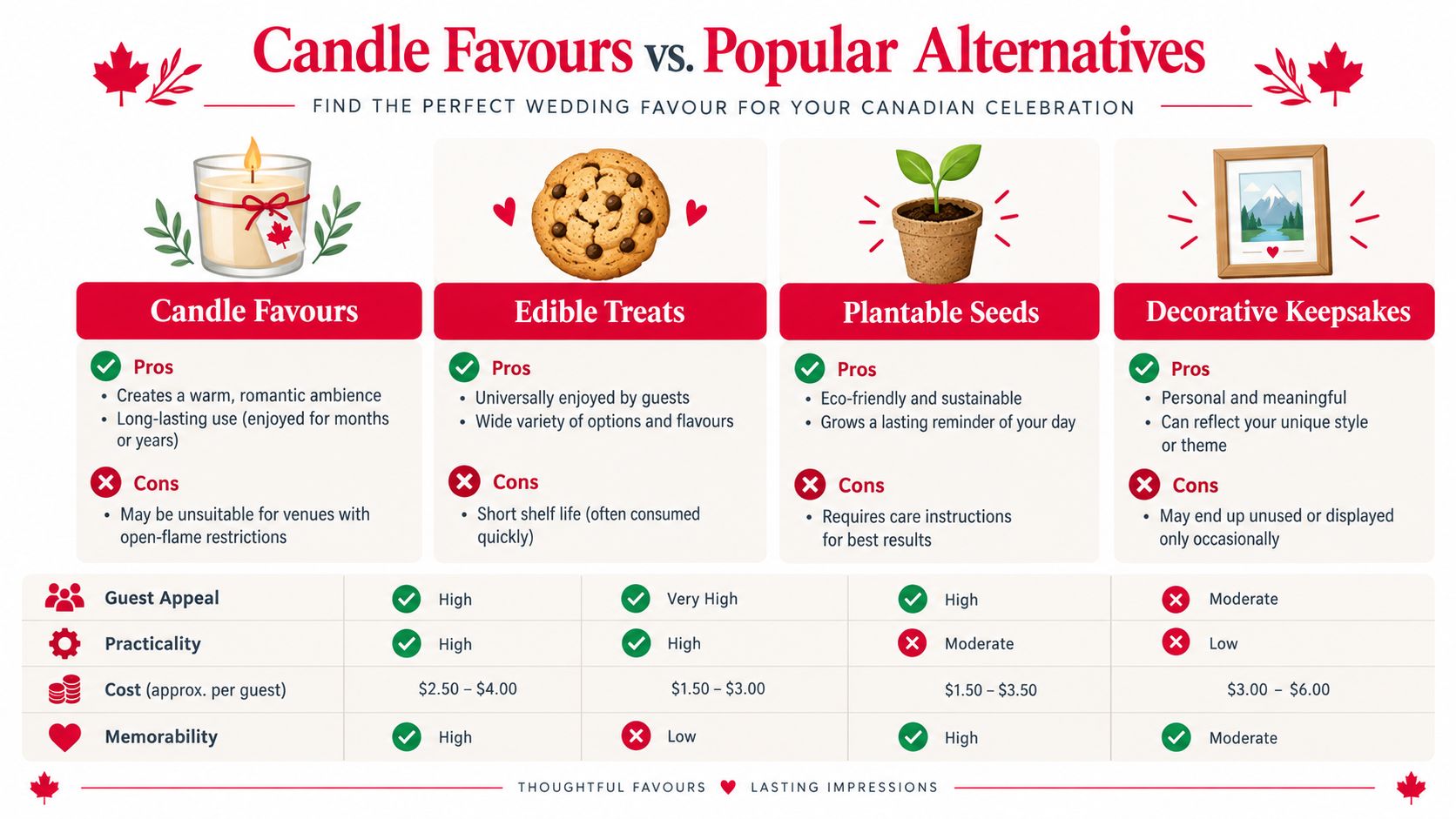
Candle Favours vs Common Alternatives
| Favour Type | Best For | Watch Out For |
|---|---|---|
| Candles | Guests who enjoy ambience and a take-home home-fragrance gift | Breakable vessels, fragrance preferences, and open-flame restrictions |
| Wax melts | Guests who already use an electric warmer | Equipment requirements and continued fragrance exposure |
| Edible treats | A gift guests can consume rather than store | Ingredients, dietary restrictions, freshness, and packaging |
| Plantable seeds | Guests with an interest in growing plants | Suitable growing space, seed selection, and care instructions |
| Decorative keepsakes | A deliberately commemorative gift | Personal taste, luggage space, and the possibility of remaining unused |
Match the format to the job
An 8 oz candle with a stated 40–45-hour burn time, as described in the wedding candle guide, is better treated as a substantial keepsake than a tiny token. Confirm the selected product's specification and care requirements rather than assuming every candle offers the same use.
A larger vessel also means more to carry and protect. Fragrance selection, wick testing, and protective packing belong in the purchasing conversation, especially if you're comparing candles with lighter wax-melt packages.
Wax melts are a reasonable alternative when guests prefer not to light candles, provided they use an electric warmer. They aren't a scent-free alternative, and a guest without a suitable warmer may not use them.
Edible treats avoid permanent clutter, but they aren't universally suitable. Seeds can be charming without being useful to someone who doesn't garden.
Keep your scent choices restrained. A small approved palette is easier to review and label than a different fragrance for every table, and guests don't need a complicated scent-selection experience at the reception.
Bulk Ordering and Customization Essentials
Before requesting a bulk quote, write a short specification you could hand to someone else without explaining it verbally. Include the favour type, planned quantity, delivery location, presentation requirements, and the date you need everything ready.
Ask what's available before designing around it. Custom vessels, special labels, and particular wick options are supplier-specific, not automatic features of a bulk order.
Turn your guest list into an order
Confirm your distribution method first. An individual place-setting gift needs a different quantity from a household gift handed out at departure.
Then add a modest contingency based on your actual risks: unresolved RSVPs, transport arrangements, and fragile packaging. Using the guest-count benchmark already discussed, a 3% overage rounds up to four additional units, giving approximately 124 favours. That's a planning example, not a universal minimum.
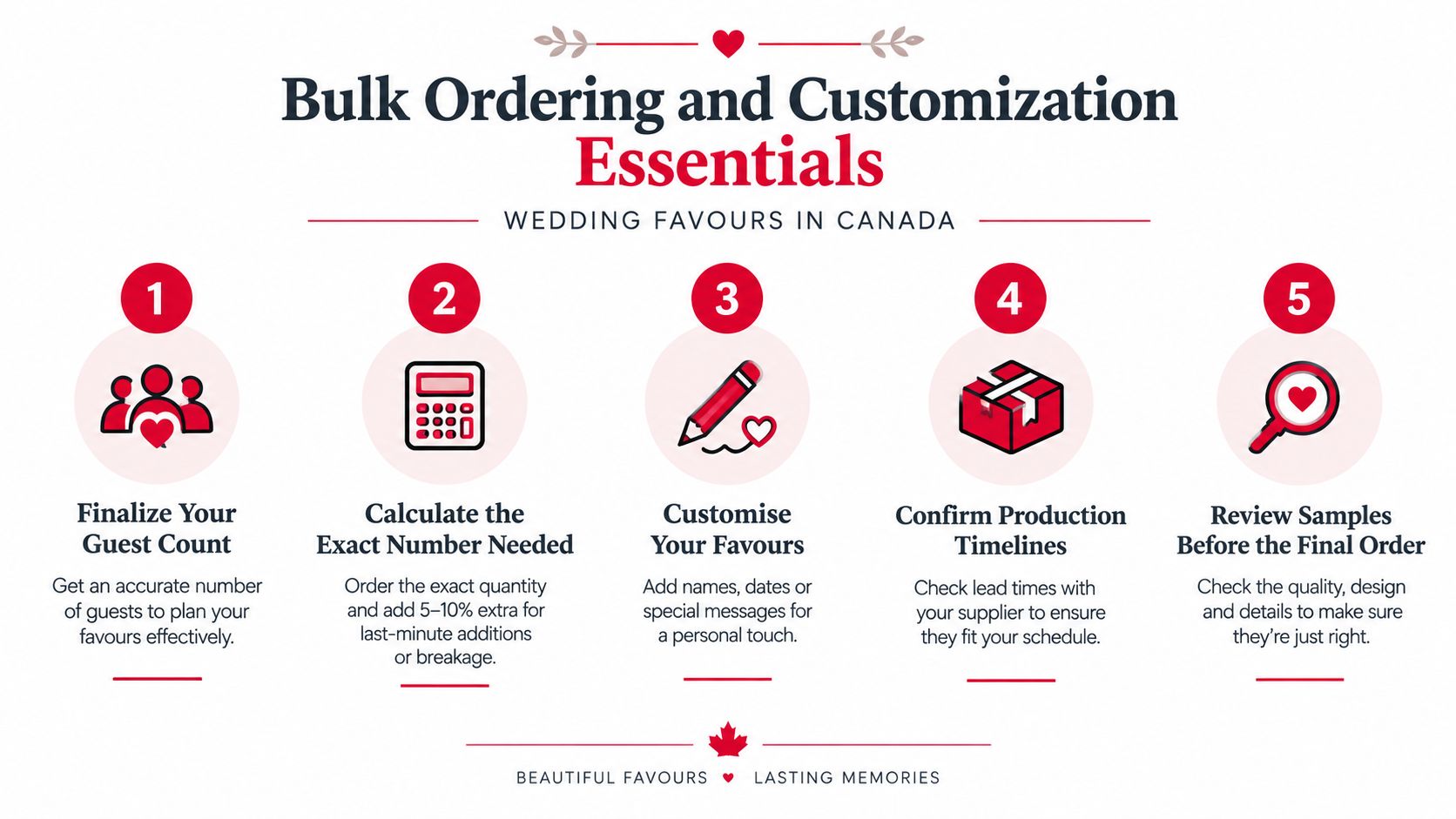
Treat the visual checklist as an organising aid. Your supplier's confirmed quantities and production terms should determine the final order, rather than a generic extra-stock recommendation.
Get the important details in writing
- Product specification: Confirm container size, wax type, fragrance, and cotton or wood-wick availability.
- Customisation limits: Ask which label elements can change and whether a new vessel requires additional testing.
- Approval process: Request a sample or proof, and establish when changes stop being possible.
- Commercial terms: Confirm minimum quantities, payment arrangements, packaging charges, and the process for damaged arrivals.
- Production commitment: Get an agreed completion date and understand what happens if you approve artwork late.
The wholesale candle ordering guide for Canada offers a useful starting point for supplier conversations. Don't assume wholesale purchasing and wedding-specific customisation have identical terms.
For comparison, Simply Merchandise's page explaining how to find volume discounts on merch can prompt questions about quantity-based pricing. It isn't a Canadian candle quote, so confirm your own currency, tax, and delivery terms separately.
A bulk discount isn't a saving if it persuades you to order gifts you don't need.
Keep names and dates easy to proofread. A beautifully packaged order with a spelling mistake still creates last-minute work.
Timelines for Ordering and Shipping Across Canada
The date you need favours ready is more useful than the wedding date. You need time to receive the order, inspect it, resolve problems, and complete any assembly before it goes to the venue.
For hand-poured candles, ask the maker to account for production, curing, label application, and packing. The carrier's delivery estimate comes after those stages, not instead of them.
Work backwards from a ready-to-place deadline
Choose a date when your favours must be fully packed and ready for whoever is setting up the reception. Then ask the supplier to propose an order and approval schedule that supports that deadline.
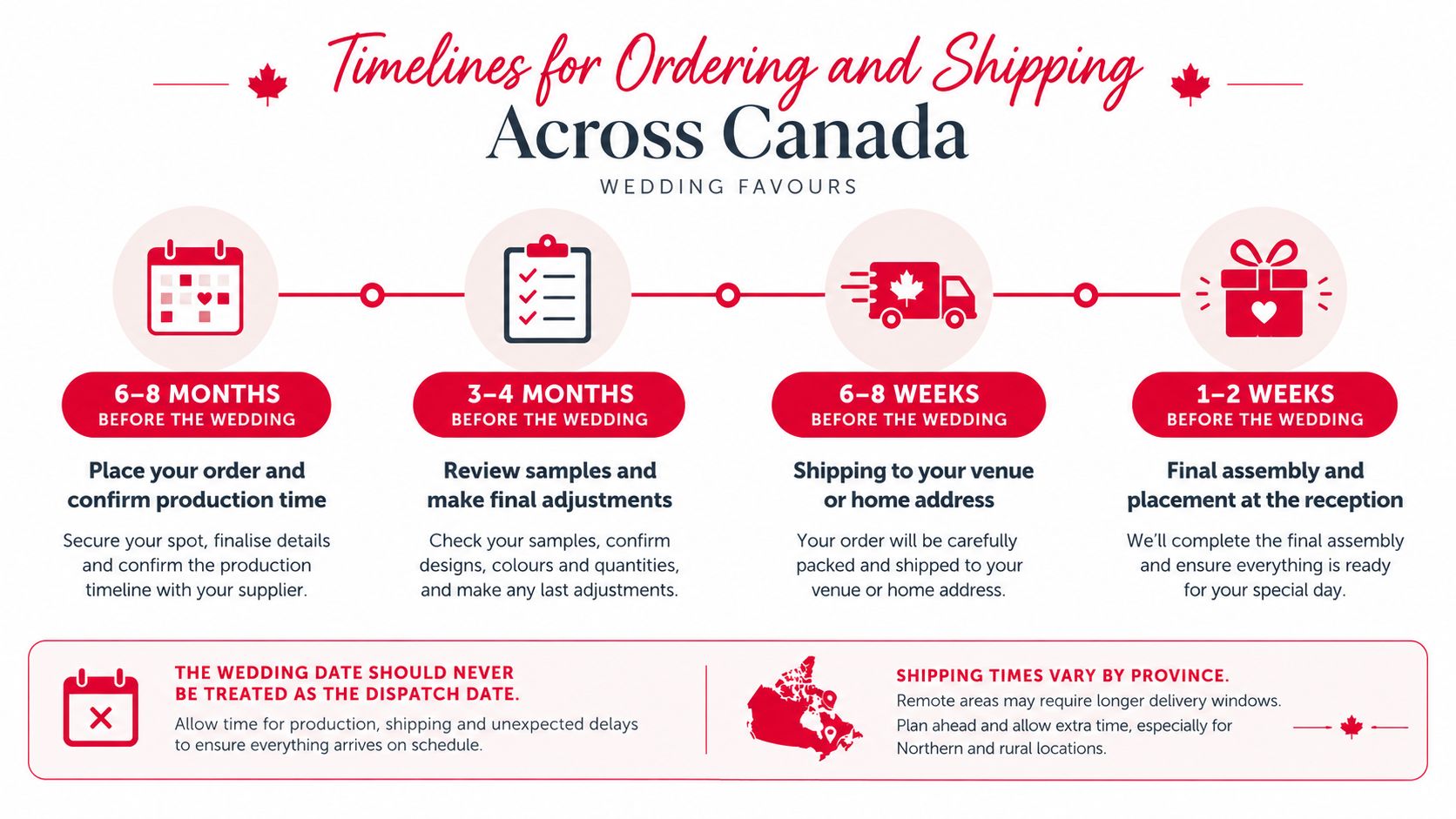
Use the timeline as a planning framework, not a promised lead time. Actual scheduling depends on the selected product, customisation, approval speed, supplier capacity, and destination.
Your written schedule should distinguish the milestones clearly:
- Order acceptance: The supplier has the specifications and information needed to proceed.
- Approval deadline: You've signed off on scent choices, artwork, and other agreed details.
- Production completion: The favours are finished and ready for packing.
- Dispatch and receipt: The order leaves the supplier, then reaches the agreed address.
- Inspection and assembly: You check quantities and condition before adding final presentation details.
Choose the delivery address carefully
Delivering to your home can make inspection easier, but it also makes you responsible for moving the favours to the venue. Delivering directly to the venue removes that journey only if staff have agreed to receive, store, and identify the boxes.
If you're mailing favours to guests, prepare a checked address list and ask for a quote that reflects separate parcels. Don't assume the cost or handling arrangements will match a single bulk delivery.
Scheduling advice: Leave room to fix a problem, not merely enough time for the parcel to arrive.
Ask about the process for guest-list changes before ordering. Once production or personalised labelling has started, changes may be less straightforward than editing your seating plan.
Understanding GST and HST on Favours
Compare delivered totals, not just product prices. A supplier quote can look cheaper until you discover that packaging, freight, and applicable tax weren't included in the displayed amount.
The Canada Revenue Agency's guidance on freight transportation explains that courier and other freight services generally remain subject to GST/HST unless a specific zero-rating rule applies. Don't assume shipping is tax-free.
Read the quote line by line
Ask the supplier to show merchandise, customisation, packaging, delivery, and tax distinctly enough that you can understand the final amount. You don't need to become a tax specialist; you need to know what you'll pay.
Use this comparison method:
- Confirm the scope: Make sure each quote covers the same quantity and presentation.
- Check exclusions: Look for charges that will be added after approval or at checkout.
- Use the delivered total: Divide the complete payable amount by the number of favours you'll receive.
- Check the destination: Ask the seller to confirm the tax treatment for your delivery address, especially when comparing orders going to different provinces.
Separate guest shipments deserve their own calculation. A price based on a bulk parcel won't necessarily represent the cost of mailing individual gifts.
Gift certificates work differently
The CRA's gift-certificate guidance states that GST/HST is generally not collected when a gift certificate is purchased, including online certificates. Applicable tax is calculated when it's redeemed for taxable goods or services, with the certificate deducted as though it were cash.
That distinction matters if you're considering digital vouchers instead of physical favours. The certificate purchase and the guest's eventual product purchase are separate transactions.
A voucher offers choice, but it also asks the guest to take another step. Before selecting one, check redemption conditions, whether the guest might need to pay a remaining balance, and how delivery charges would be handled.
Explain redemption clearly. A thank-you gift shouldn't leave someone guessing whether they need to spend more to enjoy it.
Choosing Favours Guests Will Actually Use
A coordinated table doesn't require identical gifts for every household. You can keep the presentation consistent while offering a fragrance-free, non-food, or flameless alternative.
Canadian favour-planning coverage from Bargainmoose reports that approximately 35% of Canadian weddings in 2025 included a cultural or religious tradition beyond a Western Christian template. Don't translate that into assumptions about individual guests; use it as a reminder to ask rather than guess.
Use a guest-usability checklist
- Food suitability: Can guests identify ingredients and assess dietary, cultural, or religious restrictions?
- Fragrance choice: Is there a fragrance-free option for people who avoid scent?
- Equipment: Does using the gift require something the guest already owns?
- Travel practicality: Can it fit comfortably in luggage, and should guests check carrier requirements?
- Household safety: Are the instructions clear about heat, flames, storage, children, and pets?
- Post-wedding usefulness: Would the guest choose to use it without the wedding connection?
For food inspiration, Smokey Rebel's gift guide can help you think beyond standard sweets. Treat a themed gift guide as inspiration, not evidence that every flavour suits your guest list.
Make candle care part of the gift
A candle favour should arrive with its container size, stated burn-time expectations, wick-care instructions, and fire-safety guidance. Use instructions appropriate to the selected wick and vessel rather than copying care advice from an unrelated product.
Guests should know to keep burning candles attended and away from combustible materials, children, and pets. Put essential instructions with the item instead of relying solely on a web page guests may never open.
Lightly scented isn't the same as unscented. Likewise, wax melts address open-flame preferences only when used with a suitable electric warmer; they don't resolve fragrance sensitivity.
Offer alternatives discreetly, without asking guests to explain personal health or religious choices at the reception. A thoughtful host makes the gift easy to accept, exchange, or decline.
Your Final Favour Planning Checklist
The strongest favour plan is one you can hand to your partner, planner, or setup team without a long explanation. Everyone should know what was ordered, where it's arriving, and how guests will receive it.
A favour is a thank-you, not a financial exchange. CBC's Canadian wedding-gift etiquette reporting stresses that guests shouldn't feel pressured to give beyond their means. Apply the same generosity to your own decision: choose what fits your budget, not what seems to repay a guest's gift.
Check the decisions that matter
- Budget approved: You've compared the complete payable cost with your allocation.
- Guest fit considered: The gift and any alternatives suit the people attending.
- Quantity settled: Your distribution method and contingency are clearly recorded.
- Specification approved: Product details and personalised artwork have been checked.
- Timing confirmed: Production, dispatch, receipt, and assembly have separate deadlines.
- Handover organised: Someone is responsible for inspection, storage, and placement.
Do we have to give wedding favours?
My advice is to skip them if they stretch your budget or add stress without meaning. A warm welcome and sincere thanks matter more than an item chosen out of obligation.
Should we give individual or household favours?
Choose the approach that suits the gift, then apply it consistently. Household gifts need a clear distribution plan so guests aren't left wondering whether something was missed.
Are candles or wax melts more practical?
Choose candles for guests comfortable with candle care and open flames. Choose melts for people who already use electric warmers, while keeping a fragrance-free alternative available where needed.
Can we personalise favours without making them hard to reuse?
Yes. Keep the wedding message on removable packaging and let the object remain useful on its own.
For your delivery budget, the current offer is: Shipping across Canada starts at $9.99. Free shipping on orders of $79.99 CAD or more. Some conditions apply.
Shivora Candles offers hand-poured soy candles and wax melts made in Ontario, Canada, giving you home-fragrance options to consider alongside edible and other practical favours. Visit Shivora Candles to explore the range, then ask about suitable formats, quantities, and timing before committing to your wedding order.

