

Would you burn a candle differently if it held jewellery inside? A ring or pendant set in wax changes how the melt pool moves, when to stop the burn, and what may touch your skin afterward. A surprise reveal is not proof that the candle is safe.
Candles with rings are a niche gift format, rather than a standard candle type. Canadian buyers considering one need to assess both the burn and the jewellery: check the format, the stop point, the named alloy, and the aftercare. Treating it only as home fragrance leaves out the metal and the moment of recovery.
Shivora Candles doesn't make hidden-ring candles. The Ontario maker hand-pours soy candles and wax melts in small batches for people who want fragrance without a buried object. If you choose a reveal candle, consider the candle and the jewellery as two connected parts of the purchase.
Table of Contents
- What Candles with Rings Usually Mean
- Metal Claims and Honest Packaging
- How a Ring Is Set into the Wax
- Safety Checks Before the First Burn
- After the Ring Appears
- Gift Paths That Skip the Hidden Ring
- Pick a Candle Gift You Can Name
What Candles with Rings Usually Mean
Most gift listings mean a hidden jewellery candle: a ring or pendant set in the wax, often low in a small cup. Search results also use the same words for three other things. A candle ring or wreath is greenery or decor around a separate candle. A ring-shaped candle is wax sculpted into a circle. A ring holder is a metal loop that only supports a taper or votive. Only the first one is a reveal. The object is not ordinary home fragrance, because it changes how wax can move.
| Format | What you see | How it is used | Main risk |
|---|---|---|---|
| Hidden jewellery candle | Ring or pendant set in the wax, often in a small cup | Burn only until the piece can be recovered | Blocked melt pool, hot metal, or flame near the object |
| Candle ring or wreath | Greenery or decor around a separate candle | Centrepiece with the flame kept clear of the ring | Dried material too close to the flame |
| Ring-shaped candle | The wax itself is shaped like a ring | Decorative display or a carefully watched burn | Centre opening changes the melt pool |
| Ring holder | Metal ring supporting a taper or votive | Table styling | Unstable holder or nearby items that can catch fire |
What to check before you add it to a cart
Look for a photo of the actual ring, not a stock sparkle. Look for the metal name, the wax type, and a clear line that says when to stop burning. If the listing only says "surprise ring inside," you don't yet know whether you are buying jewellery, table decor, or a shaped pillar.
A hidden jewellery candle is burned only until the piece can be recovered safely. A wreath stays table decor and must stay clear of flame, especially with dried botanicals. A sculpted ring can be display or a watched burn, and the centre opening can leave the surface melting unevenly. A holder never becomes part of the fuel. It only has to stand steady.
Practical rule: If the photo doesn't show the ring, the metal, and a stop point, you are guessing about both the burn and the jewellery.
An IndexBox Canada candles market analysis places household use at roughly 6 to 9 candle units a year across all price tiers. That is the neighbourhood this novelty sits in. No Canada-wide sales figure exists for ring candles alone, so don't treat a viral listing as a measured share of the market. Seasonal gifting is when these formats get attention. The useful question is still whether this candle's only job is scent, or whether you have also accepted a metal object in the wax.
Shivora doesn't pour rings into wax. Later on, the simpler gifts are ordinary scented candles and melts whose job stops at fragrance.
Metal Claims and Honest Packaging
A candle with a hidden ring has two things to assess: the burn and the jewellery. For the jewellery, start with the named alloy, then check whether the candle's packaging describes the product and the business clearly.
Hypoallergenic has no legal definition or mandatory test in Canada, according to Canadian jewellery guidance from Vanhess. The alloy name gives you more useful information than that label. A ring uncovered in warm wax may be hot and carry fragrance residue. Nickel and worn plating can trigger contact dermatitis in people sensitive to metals. Alberta Health Services identifies nickel as the most common metal allergen and lists stainless steel, higher-karat gold, niobium, titanium, and platinum as materials less likely to cause trouble. Lower-risk metals can still cause reactions in some people.
| Listing language | What it really tells you | Better question |
|---|---|---|
| Hypoallergenic | No legal definition or mandatory test in Canada | What alloy is the ring? |
| Stainless steel, titanium, niobium, platinum, or stated-karat gold | A named metal that may be less likely to bother sensitive users | Is the whole ring that alloy, or only a coating? |
| Plated or gold-tone | A finish that can wear and expose the base metal | What metal is underneath, and how thick is the plate? |
| Undisclosed metal | No basis for a skin-contact decision | Can the seller name the alloy before purchase? |
| Made for children under 15 | Extra lead and cadmium care may apply | Does it meet the cited children's jewellery limits? |
Children's jewellery is a different product
For a ring listed for children under 15, the guidance gives limits of 90 mg/kg lead and 130 mg/kg cadmium for children's jewellery: see the Canadian jewellery guidance from Vanhess. An ordinary gift candle is not a substitute for children's jewellery. Avoid describing any alloy as medical-grade or safe for everyone. Once the ring is safely recovered, let it cool fully, wash it before wearing, and stop wearing it if itching, swelling, or pain occurs. Aftercare is part of the purchase decision, not a promise made by a label.
The three lines a candle box still needs
For prepackaged non-food products, the Competition Bureau's packaging and labelling guide identifies three mandatory declarations, including for boxes of candles:
- Product identity: The common name or function, in English and French, so the product is clearly identified as a candle.
- Net quantity: A clear, accurate statement of how much is in the box.
- Dealer identity: The responsible business and its principal place of business.
Decorative branding cannot stand in for these required details. A useful listing also names the wax and wick types, and avoids unsupported claims such as “chemical-free” or “completely safe.” Shivora's guide to candle ingredients explains soy wax and wicks in plain language, without a hidden ring to assess.
If a seller ships the ring separately, check that its packaging protects the metal from scratches and residue. The sustainable packaging for rings discussion can help you assess the wrap after recovery; attractive packaging still does not identify the alloy. Choose a different gift if the seller cannot name the metal or identify the business responsible for the candle.
How a Ring Is Set into the Wax
Think of the candle as a fuel cup. The ring is a passenger. It should not steer the flame.
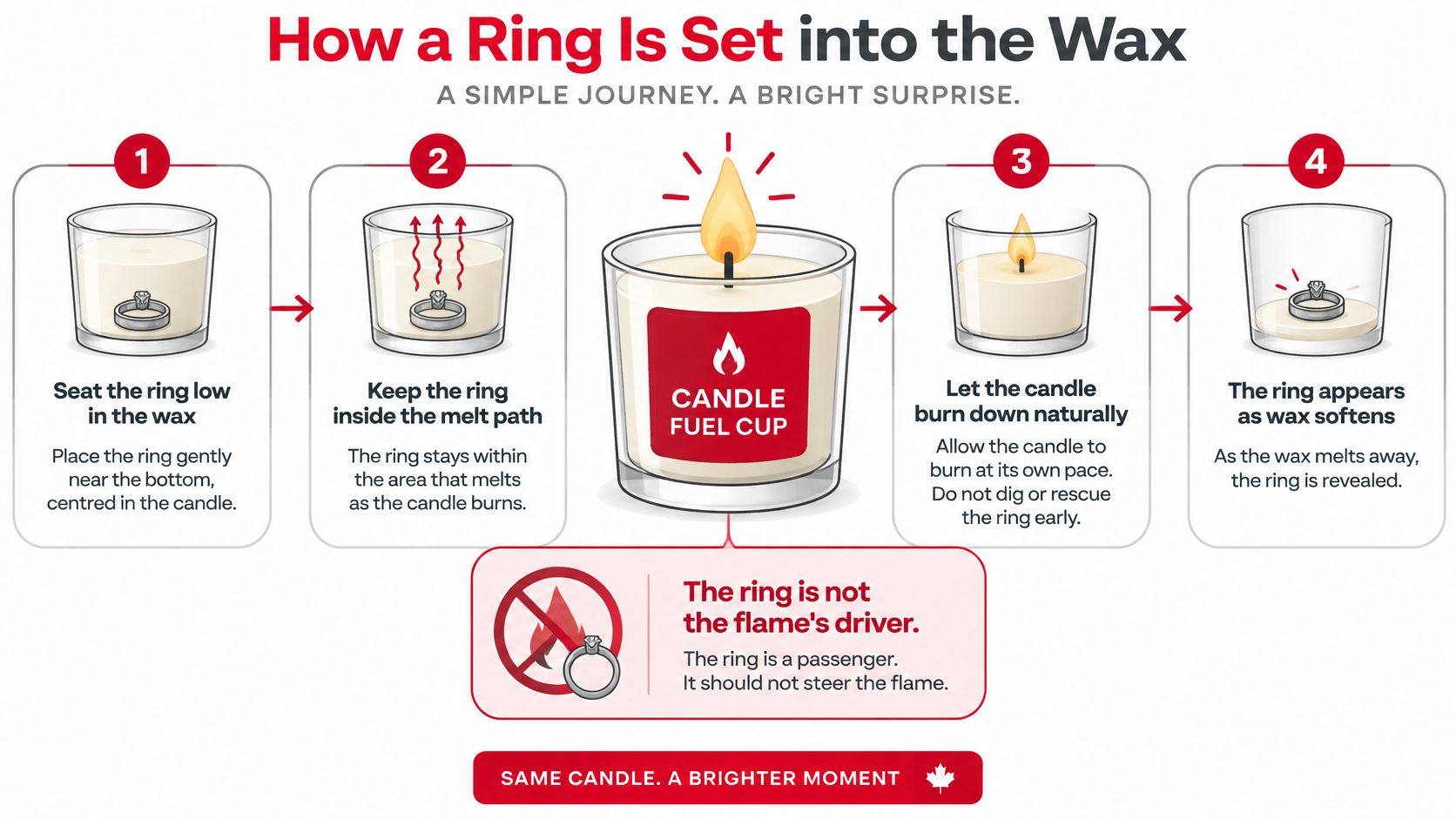
A typical build, in order
Say the maker is pouring a small cup for a birthday gift. The sequence is usually simple, and the order is what matters.
- Seat the ring low. It sits near the bottom of the vessel, often inside a small metal or foil capsule so wax doesn't coat every surface of the band.
- Pour around it. Wax goes in around that capsule. The wick is set above that zone, not through the ring.
- Early burns look ordinary. On the first sessions you see a melt pool and smell the fragrance. The passenger is still covered.
- The level falls. As wax drops, the cup can block circulation, leave unmelted shelves at the edge, or let the ring appear while wax and metal are still hot.
That is the whole trick. Nothing in the build makes the ring part of the fuel system. It only occupies space the melt pool used to own.
The burn shape you should expect
Burn only while the pool can still melt evenly across the surface. Keep the wick trimmed to about 6 mm before you light. Stop as soon as the capsule or the ring becomes visible. You are not trying to finish the jar. You are trying to reach a safe recovery point and then quit.
The ring is not the flame's driver. Once you can see it, the planned burn is over.
A short look at a careful reveal helps if you want the sequence in motion, then go back to the listing's own stop instruction.
Decorative candles live in home decor and gifting, not in emergency lighting. A Grand View Research outlook for the Canadian candle market reported that votive candles were the largest product segment in 2025, at 27.9% of revenue, with tapers the fastest-growing segment. Ring-style gifts sit beside votives, tapers, pillars, and table pieces. That source doesn't isolate ring-candle sales, so there is no Canada-specific unit count to quote.
Judge the finished candle, not the ring and the wax as two separate objects. The capsule, the fragrance load, the wick, and the vessel are one configuration.
Safety Checks Before the First Burn
What changes when a candle contains a hidden metal cup? The flame, wax, vessel, and jewellery now work as one burning setup, so check the instructions and the candle's surroundings before lighting it.
A buried cup may interrupt the melt pool, sit close to the glass, or become exposed as the wax level drops. That can create uneven heating and leave hot wax or metal to handle. Health Canada's candle safety guidance reports that candles caused nearly 800 fires a year in Canada during 1999–2008, with an average of 8 deaths, 115 injuries, and $26.2 million in property damage. Those figures cover candles generally, not ring candles. They show why a changed burn deserves careful attention.
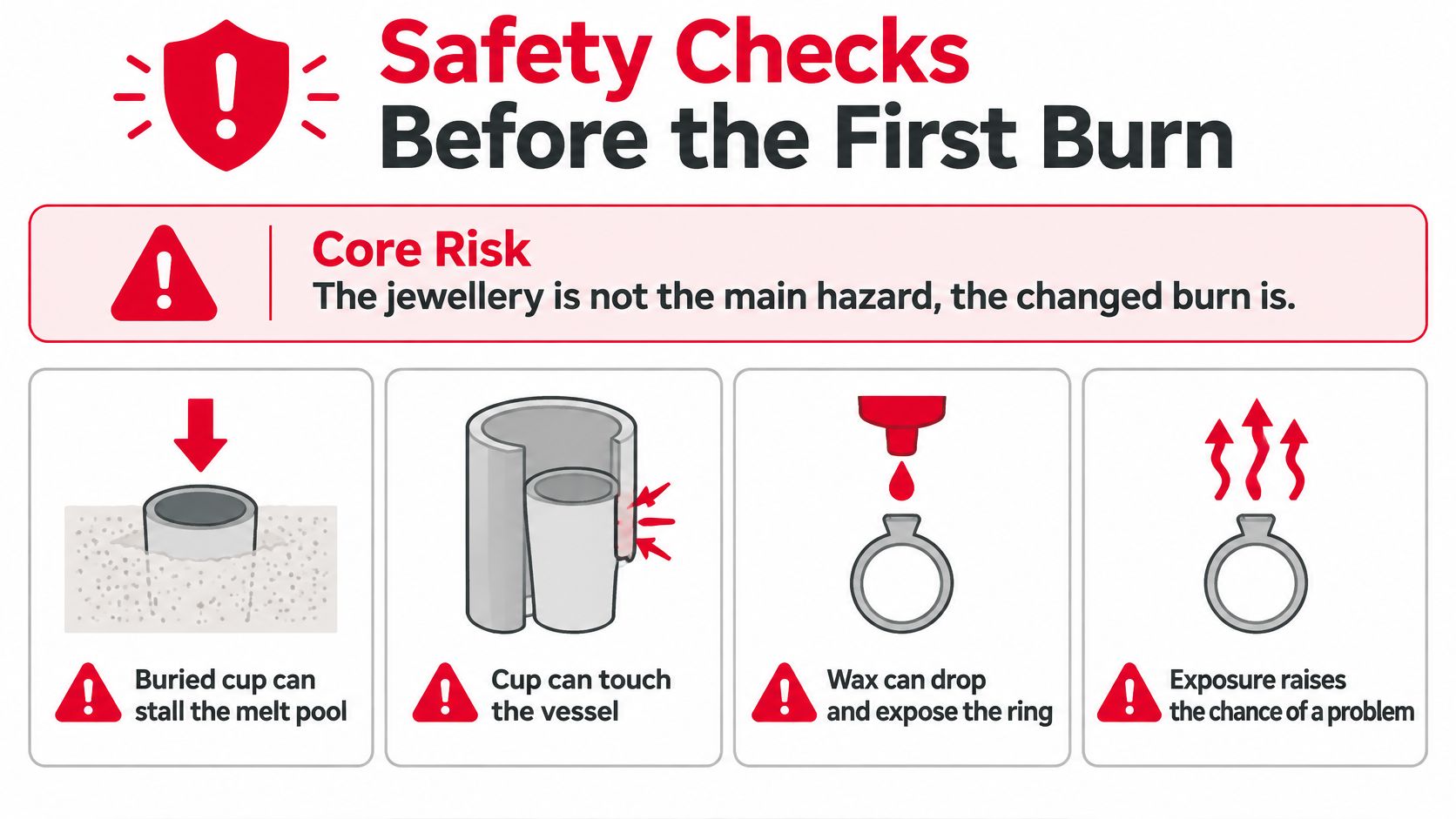
When the flame should already be out
| Situation | What changes | What to do |
|---|---|---|
| Metal is covered but the pool stalls | Wax is not melting evenly | Extinguish the candle; do not dig into hot wax |
| Ring or cup becomes visible | Less wax separates the flame from the object | Extinguish the candle and let the wax and metal cool |
| You need to leave or sleep | The flame would be unattended | Put it out before leaving or going to sleep, as Health Canada advises |
| Anything combustible is nearby | Decor, paper, or a wreath could catch fire | Move the candle or do not light it |
| Wax remains after the reveal | The wax may still be hot | Let it cool before handling the piece |
A ring, glitter finish, or gift description does not establish whether a candle has been tested or how it should be burned. The Canada Consumer Product Safety Act guide says packaging and labelling must not give an erroneous impression that a product is safe, or make false or misleading claims about safety compliance or certification. The Act also prohibits making, importing, advertising, or selling consumer products that do not comply with applicable regulations, including the Candles Regulations.
The listing should explain the candle's stop point, whether it requires continuous attention, and how to keep it clear of combustible materials. Those details help you assess the burn-plus-jewellery setup before buying. A product photo alone cannot show how the finished candle behaves as the wax melts.
For candles without a buried cup, ordinary care includes trimming the wick and allowing a full first melt pool. See Shivora Candles' candle care and safety guidance for those basic habits. Embedded-jewellery candles need their own clear instructions, since routine candle care does not answer how the hidden metal changes the burn.
Only light a reveal candle when you can stay nearby and follow its instructions. If you cannot supervise it, choose another candle.
After the Ring Appears
Once the ring is out, the remaining job is cleanup. Handle the metal, leftover wax and vessel as separate parts of the gift.
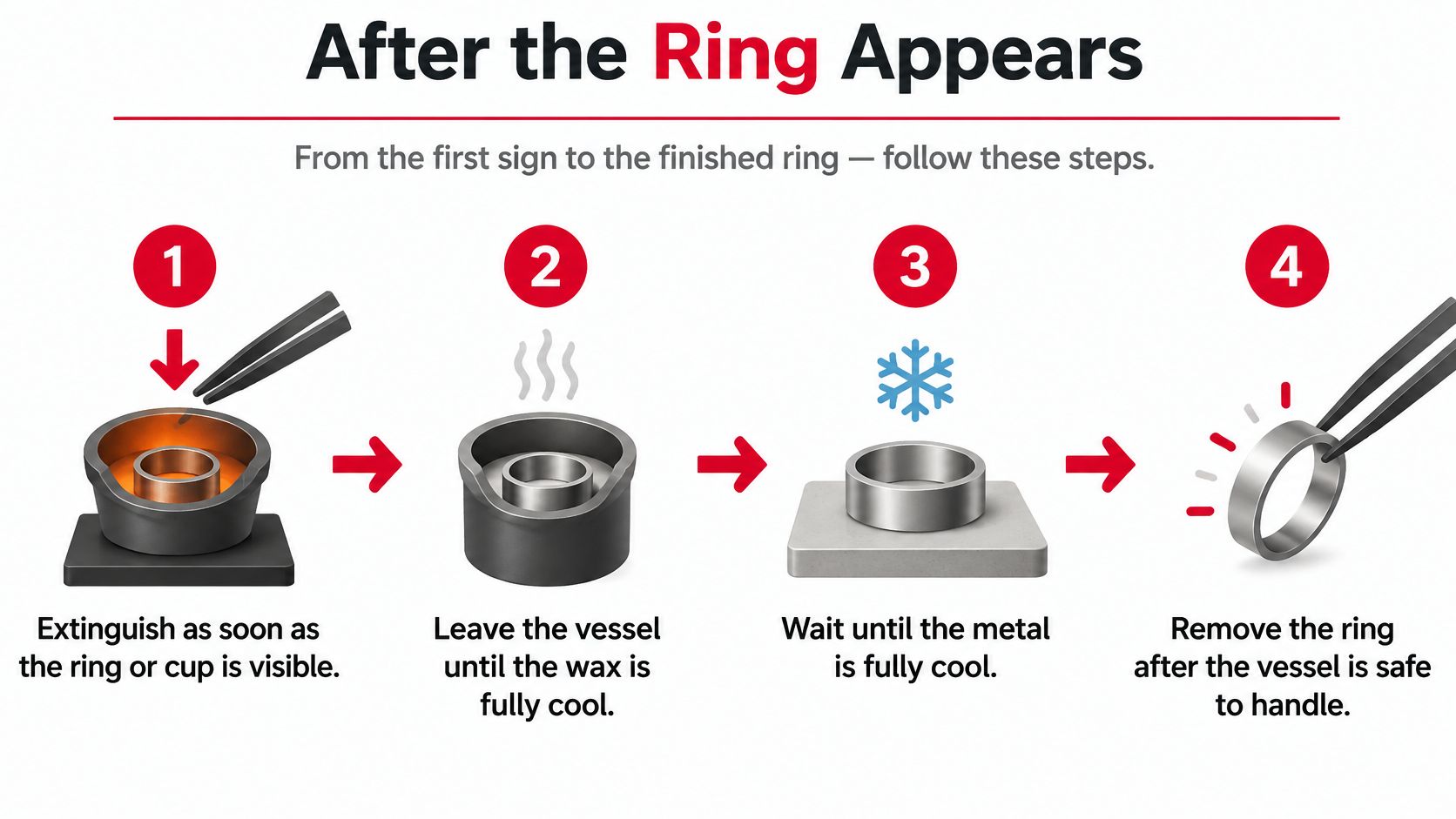
- Lift the piece only when it is fully cool. If wax still smears onto your skin, wait longer. Don't pry with a knife while the cup or ring is warm.
- Wipe away loose wax, then wash the ring. Mild soap and water remove residue before anyone wears it. Fragrance left on the metal is not a finish.
- Keep leftover wax out of the sink. A soy or “natural” label doesn't make drain disposal suitable. Wax can remain in the vessel or be discarded according to local guidance.
- Check your municipality's disposal rules. Calgary's waste guidance directs unusable wax products to the black cart as garbage. For other locations, check the local rules rather than assuming the same system applies.
- Clean the vessel before checking whether it can be recycled. Remove the wax first. Whether a glass or aluminium container is accepted depends on local collection rules.
- Stop wearing the ring if your skin reacts. Itching, swelling or pain calls for taking it off. A metal description is not a medical claim.
Why the city on the label matters
Recycling rules are municipal, not universal. A national shortcut or a product photo cannot tell you what your local service accepts. If local guidance says to bin the leftover wax, package it as garbage, clean the jar and then check the rules for the container.
The aftercare has two tracks: jewellery care and waste sorting. Washing the ring prepares it for wear; removing wax from the vessel lets you check its local disposal route. Keeping those steps separate avoids treating one material's instructions as the rule for everything else.
Gift Paths That Skip the Hidden Ring
What kind of gift suits the moment if the candle should not contain jewellery? For Canadian buyers, the choice is a burn-plus-jewellery decision: select the format, know when to stop burning, and keep any jewellery separate from the flame.
Soy wax melts suit a flameless gift, provided the recipient has a compatible warmer. With no wick or hidden object, they can work for an office or a home where an open flame is not suitable. Shivora Candles sells premium soy wax melts.
One hand-poured soy candle keeps the focus on scent and the vessel. Check the size, wick, fragrance, and intended room before choosing. A scent for a kitchen may not suit a bedroom. Shivora Candles makes candles in small batches using 100% natural soy wax, premium fragrance oils, and lead-free cotton or crackling wood wicks.
A candle paired with separate, non-flammable decor suits a gift where styling matters more than a reveal. Keep dried greenery well away from the flame; decorative material near a candle can become a fire hazard.
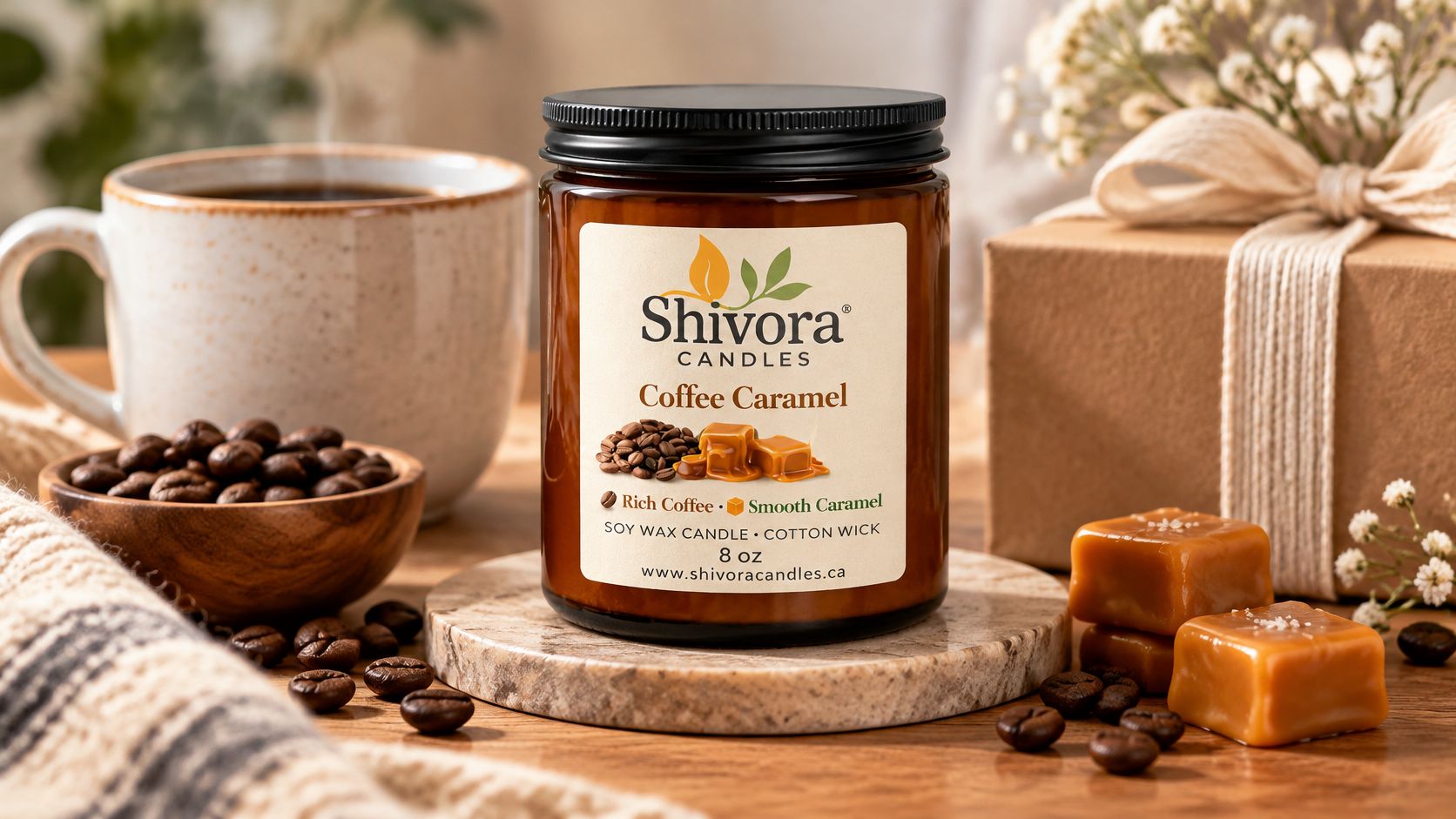
For a ring-free candle example, the Coffee Caramel Soy Candle Canada – 8 oz Cotton Wick is an Ontario-made soy candle with a lead-free cotton wick. Its listing identifies the size and wick, giving the buyer concrete details to share without estimating jewellery value. Choose decor separately, and the candle's purpose stays clear: fragrance, not a hidden ring.
If the recipient's tastes matter more than a surprise, this guide to choosing giftable candles can help match scent and room. Choose melts when a flameless format fits, a soy candle when the candle itself is the gift, or separate decor when appearance matters most.
Pick a Candle Gift You Can Name
A hidden-ring candle combines two gifts, a burnable product and jewellery. Before buying one, look for the ring's named alloy, a clear image of the actual piece, instructions on when to stop burning, and the seller's identity. Without those details, choose a candle for its scent and give jewellery separately. That way, you can describe both gifts without guessing what the metal is or how close the flame should get.
For a Canadian gift, Shivora Candles offers hand-poured soy candles and wax melts made in small batches in Ontario. The candles are vegan, cruelty-free, and phthalate-free. Coffee Caramel can suit a kitchen gift, while Blue Cedar & Lavender offers a floral and woody scent for an evening at home. Wax melts provide a flameless fragrance option. Shipping across Canada is available at a flat rate, with free shipping on orders of $79.99 CAD or more, subject to conditions.
A bridal gift list may bring candles together with jewellery and keepsakes. The Get Spliced bridal gift guide shows that mix. Give the candle and ring as separate items, so the jewellery reveal does not depend on burning the candle.
Does a low price prove a ring's quality?
Price alone cannot establish what a ring is made from. A 2025 Etsy Canada listing priced rose-scented candles at CA$18.00 for one candle, CA$35.00 for two, CA$50.00 for three, and CA$59.00 for four. Those are candle prices, not a jewellery appraisal. They do not identify the alloy, plate thickness, or whether the piece is suitable for skin contact.
Will Shivora hide a ring in a custom candle?
No jewellery is set into Shivora candles. Custom choices are scent, size, and wick: choose a fragrance for the room, a 4 oz, 8 oz, or 10 oz candle, and a cotton or wood wick. The jar contains a candle, not a surprise ring.
Is a ring candle suitable for a child's room?
A lit candle should be kept out of children's reach, and it should not burn in a room where a child sleeps. Any ring intended for someone under 15 also raises a separate jewellery-safety question. Neither consideration makes a burning candle suitable for a child's room.
Shivora Candles makes hand-poured soy candles and wax melts in Ontario for Canadian homes. Choose a scent and wick you can name, and keep jewellery in its own box. Browse the collection at Shivora Candles.
