

You light a taper for dinner, step back, and notice a thin bead of wax starting to run where you wanted a clean line of candlelight. That moment is why dripless taper candles confuse so many first-time buyers, because the label sounds absolute, but the burn at your table depends on the wax, the wick, the holder, and the air in the room. In Canadian homes, that matters even more when heating vents, winter drafts, or a slightly loose holder turn a neat setup into a messy one.
The useful way to think about dripless tapers is simple, they're performance candles. They're made to resist runoff under suitable conditions, not to ignore gravity, airflow, or basic candle care. If you want a cleaner burn, start with what the candle is made to do, then control the small habits that decide whether it stays tidy on your table.
Table of Contents
- What Dripless Taper Candles Actually Promise
- How Dripless Tapers Are Built and Why They Resist Dripping
- Wax Materials Compared for Dripless Performance
- Room Conditions That Decide Whether a Taper Drips
- Setting Up a Taper for a Clean Burn
- Why Dripless Does Not Mean Zero Maintenance
- Choosing and Enjoying Dripless Tapers at Home
- Common Questions About Dripless Tapers
What Dripless Taper Candles Actually Promise
The first disappointment usually starts with the word itself. A candle marked dripless can still leave wax behind if the flame leans, the candle tilts, or the wick burns too hot for the room around it. That doesn't mean the candle failed, it means the conditions changed.
A label, not a magic shield
Canadian fire-safety guidance treats candles as open flames whether they're tidy or not, because wax can still get hot enough to ignite and flame can still reach nearby materials. Health Canada also notes that airflow and wick length affect how evenly a taper burns, so the term dripless belongs to burn behaviour, not to a promise of zero wax runoff. The practical takeaway is that two candles with the same label can act very differently on the same dining table if one is exposed to a vent and the other isn't.
Practical rule: If a taper drips, check the room before you blame the wax.
That framing helps when you're choosing candles for a dinner party, a wedding table, or a quiet night at home. A taper that stays neat in still air may behave differently near a ceiling fan, an open window, or a warm register. If you've ever wondered why one candle looked polished in the package and messy on the table, the answer is usually in the setup.
What you should expect instead
A better expectation is drip resistance under suitable conditions. That means less mess, a steadier flame, and a lower chance of wax sliding down the shaft when the candle is upright and cared for correctly. It does not mean you can ignore the holder, the wick, or the distance between candles.
The rest of the guide is about those variables, because that's where the difference shows up. Once you understand them, the label becomes useful again, not misleading.
How Dripless Tapers Are Built and Why They Resist Dripping
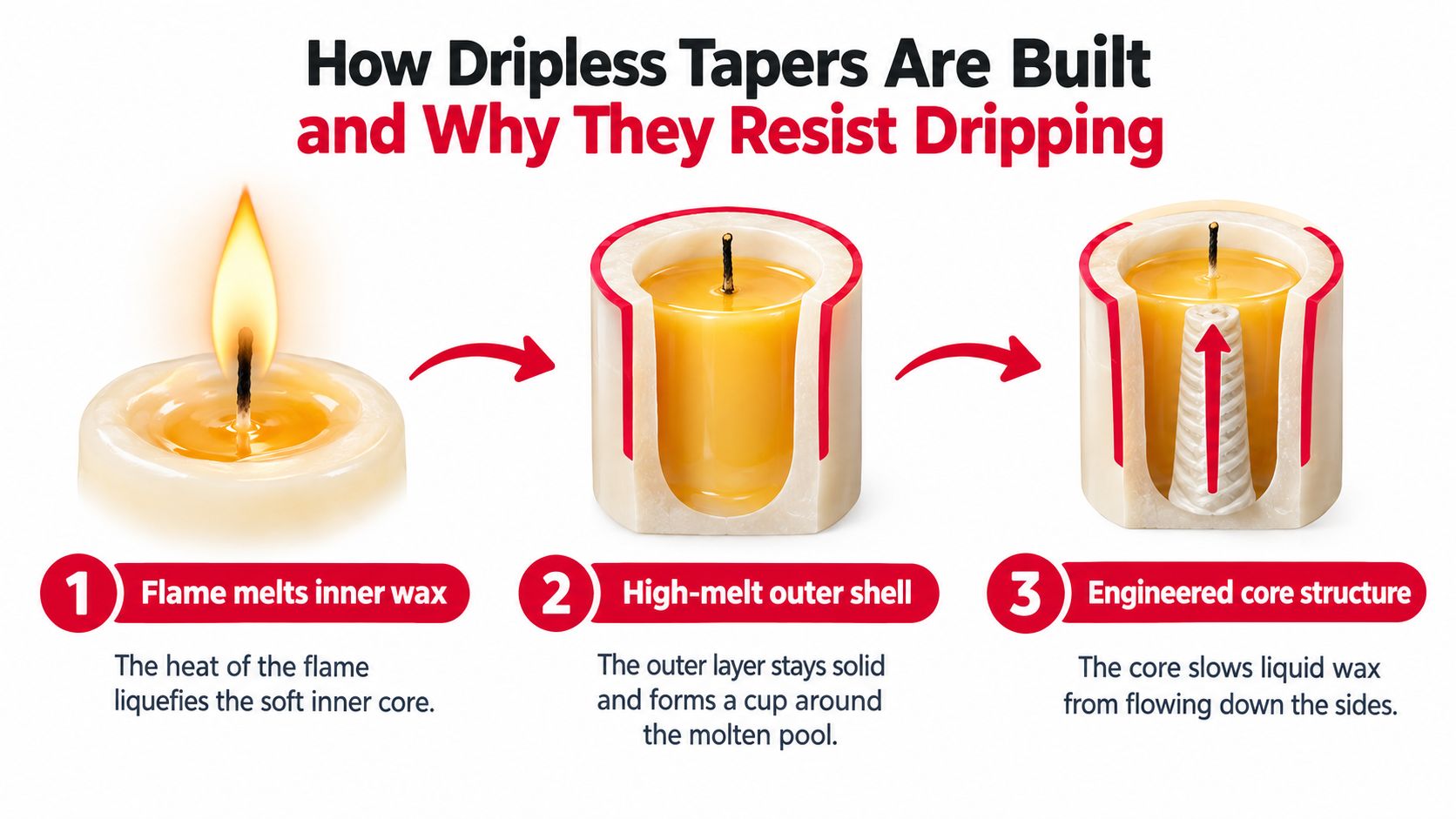
A taper drips when liquid wax forms faster than the candle can hold it in place. The flame melts the top, the melt pool widens, and if that heat spreads unevenly, wax starts travelling down one side. Drip resistance comes from shaping that melt in a controlled way.
The construction idea behind the label
A useful example appears in a patent history trail that documented drip reduction through specialised wax compositions. Earlier non-drip candle concepts were patented in the United States in 1955 and 1963, and a later patent titled “Dripless candle” was filed on January 25, 1982, then published on March 26, 1985. Its Canadian counterpart, CA1195135A, was filed on December 30, 1982, which shows that dripless-candle technology entered the Canadian patent record in the early 1980s. That patent described a three-layer structure, a low-melting-point internal core, a thin outer layer made from higher-melt wax, and an intermediate bonding layer. The document also specified paraffin combined with approximately equal quantities of double-pressed stearic acid and high-purity tallow acid, with the latter described in a range of 0.5% to 60% by weight and a preferred range of 5% to 10%. Those details show that “dripless” started as an engineering term for thermal behaviour, not just a decorative label. US4507077A patent record
Why layers matter in plain language
Think of the outer layer as the candle's shape keeper. A higher-melt shell helps the taper stay firm around the edges while the centre softens near the wick. That makes the melt pool more contained, so liquid wax is less likely to spill over the side.
The internal core does the opposite job in a controlled way. It feeds the flame while the structure around it keeps the wax from collapsing all at once. The bonding layer matters too, because the shell and core have to work together instead of separating under heat.
A taper doesn't stay clean because it never melts. It stays cleaner because it melts in a more disciplined pattern.
That's why some candles look hotter at the rim while others hold a tighter pool around the wick. The goal isn't to stop melting. The goal is to manage where that melting goes.
Wax Materials Compared for Dripless Performance
Material choice shapes how a taper behaves, but it doesn't work alone. Paraffin with stearic modification is the classic drip-resistant approach, because the added structure helps the candle hold form better as it burns. Pure paraffin can still make a nice taper, though it usually relies more heavily on wick control and room conditions.
What each wax tends to do
Beeswax often gets praised for a steady, elegant burn, especially when it's upright and away from drafts. Soy works beautifully in many home-fragrance formats, but taper candles ask more of the wax than jar candles do, so soy tapers can be more sensitive to wick size, holder fit, and room airflow. In a Canadian home, that sensitivity matters in winter, when forced-air heating can disturb the flame even if the room feels calm.
A practical way to think about the four common taper materials is to ask what problem you're trying to solve. If you want the most classic drip-resistant taper profile, the engineered paraffin-and-stearic route is the closest match. If you want a more natural wax look or a different burn feel, beeswax and soy may appeal for other reasons, but they still need the same setup discipline.
| Material | Typical Drip Behaviour | Burn Temperature Feel | Scent Behaviour | Notes for Canadian Homes |
|---|---|---|---|---|
| Paraffin with stearic modification | Designed for stronger drip resistance | Feels stable when the flame is controlled | Can carry scent well, depending on formulation | Good fit when you want a classic taper with more structure |
| Pure paraffin | Can burn neatly, but setup matters | Can run hotter if the flame is too large | Often used for clean fragrance release | Watch wick length and drafts closely |
| Beeswax | Often steady in still air | Usually feels firm and controlled | Naturally distinct scent profile | Upright placement and holder fit matter a lot |
| Soy | Better known in containers than tall tapers | Can be more sensitive to heat conditions | Works well in scented home fragrance formats | Best when the room is still and the holder fits snugly |
For a broader wax primer, the guide to candle wax types gives a helpful starting point if you're comparing formats beyond tapers.
The main lesson is simple. Wax matters, but it isn't the whole story. A well-made taper can still drip if the room beats the design.
Room Conditions That Decide Whether a Taper Drips
A candle that behaves perfectly in a showroom can misbehave at the dining table by the time the roast is carved. The reason usually isn't mysterious. It's a small set of physical conditions that push the flame off centre or let the candle lean.
The variables you can actually control
Health Canada recommends trimming the wick to 5 to 7 mm before lighting and again every 2 to 3 hours to keep the flame from getting too tall. Quebec guidance also points to about 5 mm before lighting. A shorter, stable flame sends less heat into the sidewall, which helps the taper keep its shape. If the wick is long, the flame gets larger, the melt pool spreads faster, and wax starts to run where you don't want it. Health Canada candle safety guidance
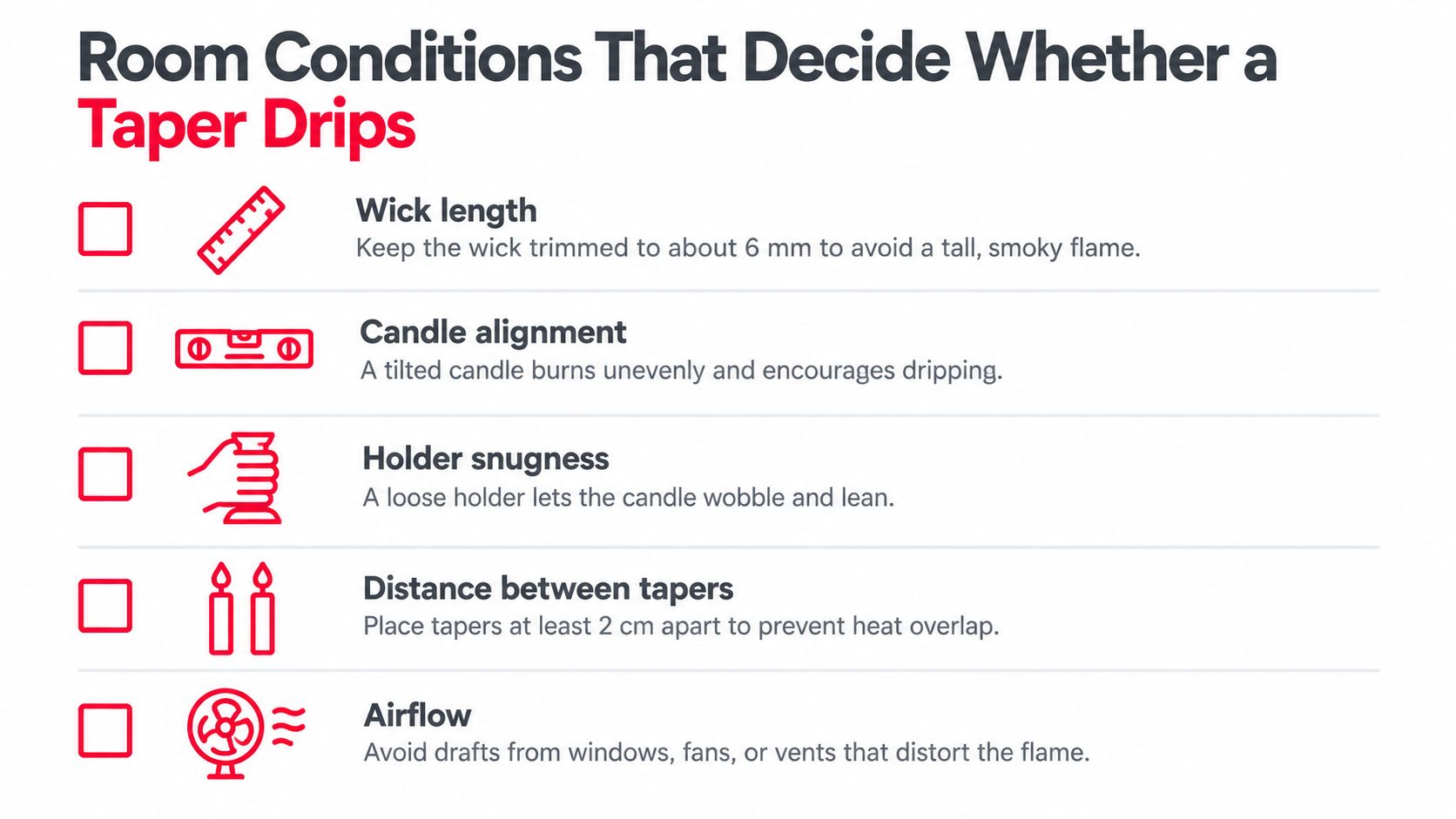
Airflow is the other big culprit. Drafts from fans, vents, open windows, or people moving nearby can tilt the flame to one side, so one wall of the candle melts faster than the other. A taper that leans even slightly in its holder will do something similar, because gravity encourages the wax to follow the low side.
Why Canadian rooms are a special case
Canadian homes often create exactly the conditions that challenge a taper. Winter heating moves warm air around a room. Summer cross-breezes can tug at a flame. Dining tables often sit near vents, windows, or walkways, which means the candle looks fine until the room starts moving around it.
Practical rule: Test a taper in the room where you'll actually burn it, not only where it looked good on the shelf.
That's the troubleshooting lens. If a taper dripped in your home, don't jump straight to the wax formula. Check the wick, the holder, the angle, the spacing, and the airflow. Those are the levers that decide whether the candle performs like a drip-resistant taper or like a regular one.
Canadian candle safety tips are especially useful here if you want a room-by-room habit instead of a one-time fix.
Setting Up a Taper for a Clean Burn
A clean taper burn starts before the match. Most messes happen because someone lights the candle first and checks the setup later. That order gives the flame a head start on every mistake.
The five-second routine
Choose a snug, sturdy, heat-resistant holder first. A loose holder lets the candle wobble, and wobble turns into uneven melting quickly. The taper should stand perfectly upright, not almost upright.
Trim the wick to roughly 6 mm before lighting. That small cut keeps the flame from growing too tall and sending heat sideways. If you're lighting more than one taper, leave enough space between them so one flame doesn't warm the next.
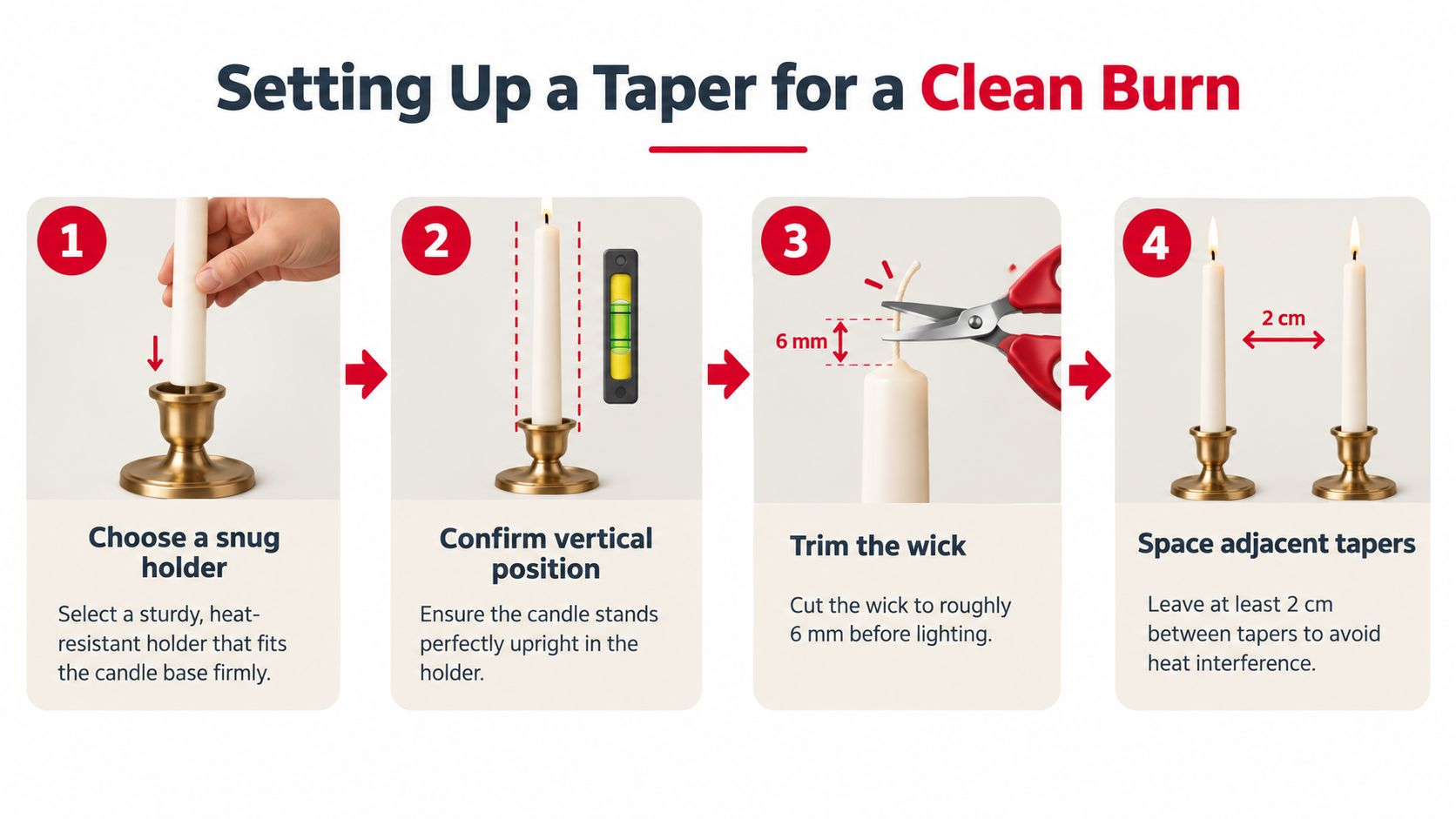
A table set for a long dinner, for example, needs more care than a single candle on a sideboard. If several tapers sit too close together, they warm each other and the melt pools can merge in ways that invite dripping. That's why spacing matters just as much as wax choice.
Holders, tables, and real-life placement
The holder should fit the candle's base securely, without forcing it so hard that the wax cracks. Standard taper holders often accommodate roughly 0.75 to 0.87 inches at the base, so a loose fit can create lean and an overly tight fit can cause problems too. For décor ideas that respect spacing and stability, advent candle holder styling ideas offer a useful visual reference, especially if you're arranging several candles together.
This is the habit that separates a tidy taper from a fussy one. Straight base, trimmed wick, stable holder, enough room around it. That's the whole system.
Why Dripless Does Not Mean Zero Maintenance
A drip-resistant taper still asks for attention. The label can reduce mess, but it can't replace wick care, safe placement, or common sense around open flame. If you treat it like a decorative object that never needs checking, it'll remind you that wax still obeys physics.
A long dinner is where the difference shows up most clearly. As the burn goes on, the melt pool changes shape, and a small problem at the start can become a bigger one later. A slightly tilted candle, a holder that's a touch too loose, or a flame left too tall can undo a neat setup even if the wax itself is well made.
Canadian fire-safety guidance still applies in full. Health Canada advises using sturdy, well-ventilated holders, keeping candles away from flammable materials, and never leaving them unattended. The Ontario Association of Fire Chiefs and the Canada Safety Council advise extinguishing taper and pillar candles when about 5 cm remains above the holder or decorative material, because the final burn stage can overheat the holder or surface. Ontario fire safety guidance
What tidy burns still require
- Trim before each use. A short wick gives you a calmer flame and fewer side-wall issues.
- Check the holder again. Movement during handling can shift a taper out of true.
- Watch grouped centrepieces. Several candles close together can influence each other's heat.
- Stay with the room. If you leave, extinguish the flame before you go.
The phrasing matters here. Dripless means cleaner under suitable conditions, not maintenance-free in every setting. That distinction helps when you're planning a wedding table, a holiday meal, or a gift someone will use at home.
For wick care habits that support a steadier burn, how to trim candle wicks is worth keeping nearby before the first light.
Choosing and Enjoying Dripless Tapers at Home
The best taper choice depends on the room, the holder, and how long you want the candle to burn. For a short dinner, a well-fitted taper in still air can work beautifully. For a longer gathering, the safer choice is the one you can keep upright, trimmed, and away from moving air for the whole event.
A simple buying lens
Start with material, then match the candle to the setting. If you want a classic drip-resistant profile, look for a taper built with structure in mind. If you're using the candle near pets, children, or a crowded table, make the holder fit and room placement part of the decision, not an afterthought. If you're planning a gift, a candle that behaves predictably in normal home conditions is usually more appreciated than one that sounds perfect on the label.
For a softer alternative in rooms where an open flame isn't the right call, hand-poured soy candles and wax melts can give you fragrance without a taper flame. A balanced home-fragrance option like the hand-selected Harmony Candle is a good example of how shoppers often pair atmosphere with practicality.
Shivora Candles offers hand-poured soy candles and wax melts made in Ontario, Canada, which gives Canadian shoppers a local option for home fragrance alongside taper candle care knowledge. If you're building a table setting or choosing a gift, that mix of product and guidance matters more than a one-word label.
Shipping across Canada starts at $9.99. Free shipping on orders of $79.99 CAD or more. Some conditions apply.
Common Questions About Dripless Tapers
Can I burn a dripless taper through a long dinner?
Yes, but only if the setup stays stable for the whole burn. A long dinner makes small problems more visible, especially if the wick grows too long or the room gets warmer near the table. If you're planning extended use, check the candle before guests arrive and again before the main course lands.
A taper can look fine for the first part of the evening and still start to drip later if the melt pool grows too large. That's why the room matters as much as the wax. A candle under still air in a snug holder usually has a better chance of staying neat than one near a vent or a walking path.
How tight should the holder fit be?
The candle should sit securely without wobbling. Standard taper holders often work around the 0.75 to 0.87-inch base range, so a loose fit can let the candle lean and an overly tight fit can damage the base. You want a firm seat, not a forced one.
If you're choosing décor for a long table, a stable base matters more than a decorative holder that looks elegant but lets the candle shift. That's one reason a dining table with the right proportions, such as a well-scaled pedestal table like the tulip dining table guide, can make candle placement easier to manage. The surface itself affects how confident the setup feels.
Are tapers a good idea in homes with pets?
They can be, but only with careful placement and supervision. A taper's open flame and hot wax are still a hazard if a pet jumps, brushes the table, or knocks the holder. Keep the candle out of reach, on a stable surface, and away from tails, paws, and busy walkways.
If pets move freely through the room, a flameless fragrance option may make more sense for some occasions. The safest choice is the one that matches your household, not the one that looks best in the centre of the table.
When should I extinguish a taper?
Extinguish it before you leave the room or go to sleep, and don't let it burn down to the point where the holder or surface gets too close. Canadian guidance also sets a practical end point at about 5 cm of wax remaining above the holder or decorative material. That final margin helps reduce heat stress on the holder and nearby décor.
If the candle has started to lean, if the flame is getting too tall, or if the room conditions have changed, extinguish it sooner. A drip-resistant candle still needs a careful finish.
If you want Canadian-made candle options that fit real homes, not just perfect display tables, explore Shivora Candles for hand-poured soy candles and wax melts made in Ontario. You'll find thoughtful home-fragrance choices that pair well with the candle care habits covered here, along with Canada-wide shipping and guidance for everyday use.

