

You've been selling other people's candles for two seasons and they move. Then a regular customer asks whether she can buy one with your shop's name on the jar, and a supplier replies within the hour: private label, no minimum, six units to start.
That reply is either the cheapest product test you'll ever run or the start of an expensive detour, and the difference isn't the price per jar. It's whether you understand what a small order does and doesn't cover: the bilingual declarations, the burn record, the freight that lands on eleven units instead of twelve.
Private label candles wholesale no minimum is the phrase Canadian boutiques search for, and it hides a useful trap. No minimum changes the quantity. It changes nothing about the label, the safety file or the landed cost per unit.
Table of Contents
- What Private Label Candles Wholesale No Minimum Means
- Minimum Order Quantities Across Supplier Models
- Who Carries Compliance Risk on a Small Order
- Bilingual Label Content and How to Proof It
- Landed Cost and Replenishment Math for Small Orders
- Frequently Asked Questions
- Ten Questions to Confirm Before a Pilot Order
What Private Label Candles Wholesale No Minimum Means
Think of two cafés. One buys ready-made loaves and adds its own sticker. The other commissions its own recipe from a bakery down the road. Both sell bread under their own name, but only one owns the formula, and only one waits weeks for a first sample.
Candle supply splits the same way, with three models worth knowing in order.
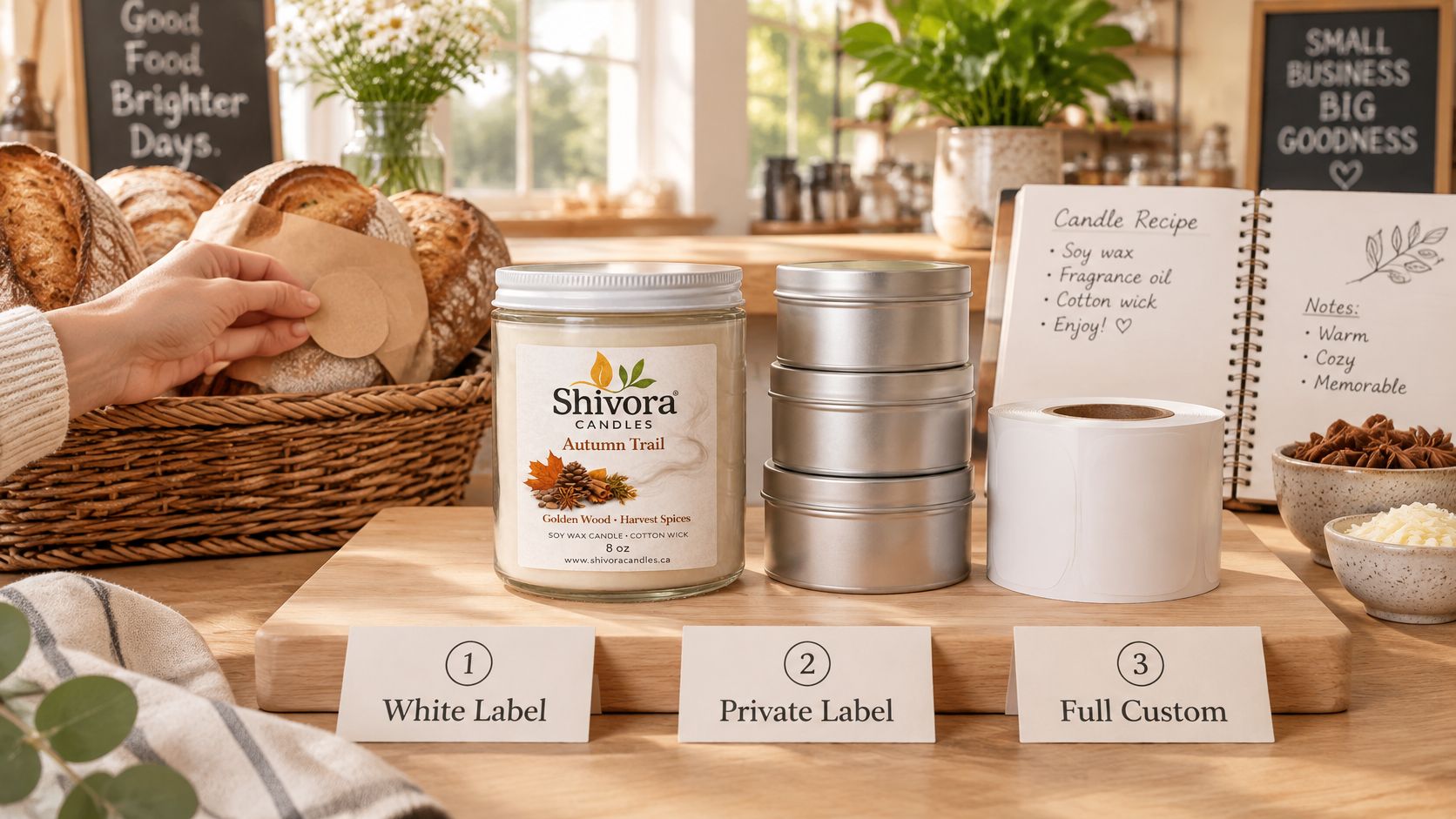
White label means the maker's existing scent, vessel and wick, sold under your name with only the label changing. It's fast and non-exclusive, so two boutiques can stock the identical vanilla jar with different stickers.
Private label means you own the brand and the artwork, and usually choose a scent and vessel from the maker's existing range. Custom-blended private label adds a new fragrance, a new container, or both, and takes longest to set up because formulation and sampling come first.
Then the phrase itself. No minimum means the supplier accepts a small pilot quantity, such as 6, 12 or 24 units, instead of a standard production run.
Definition that matters: no minimum means flexible quantity, not lower standards.
What it doesn't mean is free artwork, no setup charges or looser product standards. Pilot units are usually priced higher each, sample fees often apply, and a twelve-jar order carries exactly the same labelling and safety duties as a pallet. You're buying flexibility, and flexibility has a price per unit.
Here's the first question I'd put to any maker: does the no-minimum offer cover stock formulas only, or custom blends and labels too? Plenty of suppliers will run a small test on a formula they already produce and quote a separate minimum for anything new. The answer tells you whether you're testing a product or commissioning one.
If your fragrance family is still undecided, work through this guide to private label versus white label candles before you price anything. And when you're mapping how a whole line will look together on a shelf, how cosmetics brands stay visually consistent shows how tightly controlled packaging systems hold their identity across dozens of products, which matters more when each SKU is printed in a tiny run.
Minimum Order Quantities Across Supplier Models
| Order model | Quantity pattern | Customization | Main trade-off |
|---|---|---|---|
| Stock-line white label | Supplier's standard run | Name and label only | Lowest setup, least control over scent and vessel |
| Private label, stock scent | Standard run, or pilot quantity where offered | Scent and vessel from supplier range, custom label | Higher unit cost on small runs, label proofing required |
| Custom-blended private label | Set by blend, vessel and label run | New fragrance or container, bespoke label | Longest lead time, sample and setup costs |
| No-minimum test order | 6 to 24 units, confirmed in writing | Usually limited to approved formulas and vessels | Cheapest test, highest cost per unit |
Read that table by column, not by row. The number a supplier will accept depends on the blend, the vessel and the label run as much as on the candle itself, so the same maker can quote twelve units on a stock scent and two hundred on a new fragrance.
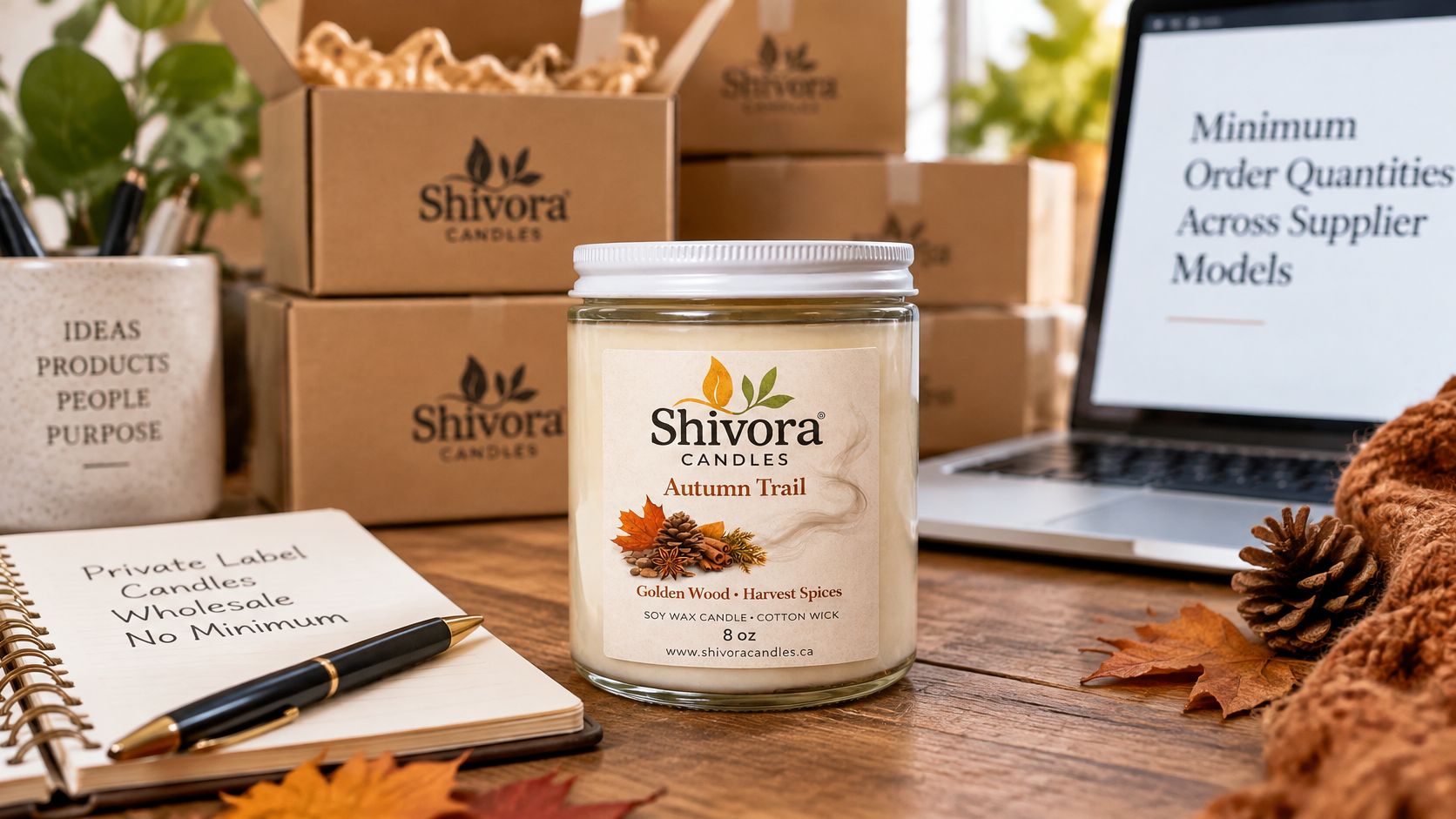
Two buyers, two very different quotes
A boutique wants a 12-unit seasonal scent pulled from the maker's stock formulas. The wick, jar and wax are already documented, so the only new variable is the label. That's the fastest, cheapest pilot in this business, and it's the right first order for most shops.
A gift shop asks for a custom vessel on a 24-unit run. Now the maker has to source glass, re-test the burn with a different vessel diameter, and produce a specification for a combination that didn't exist last month. Fewer makers will say yes, the price per unit climbs, and the schedule stretches.
Ontario is where much of that supply sits. The province's wholesale trade sector employed about 281,000 people in 2023 and contributed CAD $56.1 billion to provincial GDP, according to the Ontario wholesale trade sector profile, which makes a domestic maker a realistic option for coast-to-coast shipping rather than a local-only choice.
When a pilot earns its higher unit price
Pay more per unit, deliberately, in three situations.
- Validating a new scent family: one sku, one answer. You learn whether your customers want smoky or floral before you commit capital to a run.
- Testing a seasonal launch: a single 8 oz soy candle like Autumn Trail Soy Candle Canada – 8 oz Cotton Wick tells you whether a woody-spicy autumn profile sells in your market, and it's one SKU to photograph, list and reorder or drop.
- Checking sell-through speed: a 12-unit pilot that sells out in three weeks is a signal. One that sits for four months is also a signal, and a cheaper one than a pallet.
Small is not unusual, either. Of 1.10 million employer businesses in Canada in December 2024, 1.08 million were small businesses, or 98.2% of the total, according to Innovation, Science and Economic Development Canada.
Read any quote against three things: the quantity in writing, exactly what that quantity covers, and whether the pilot rate resets to a standard rate on reorder. Costing boxes and mailers separately is its own exercise, and it helps to compare wholesale packaging supply costs before you decide a small run is viable.
For the broader picture on Canadian supplier terms, this overview of wholesale candles in Canada covers how programs are usually structured.
Rule of thumb: the smaller your first order, the more the scent and label decisions have to be right before the press starts.
Who Carries Compliance Risk on a Small Order
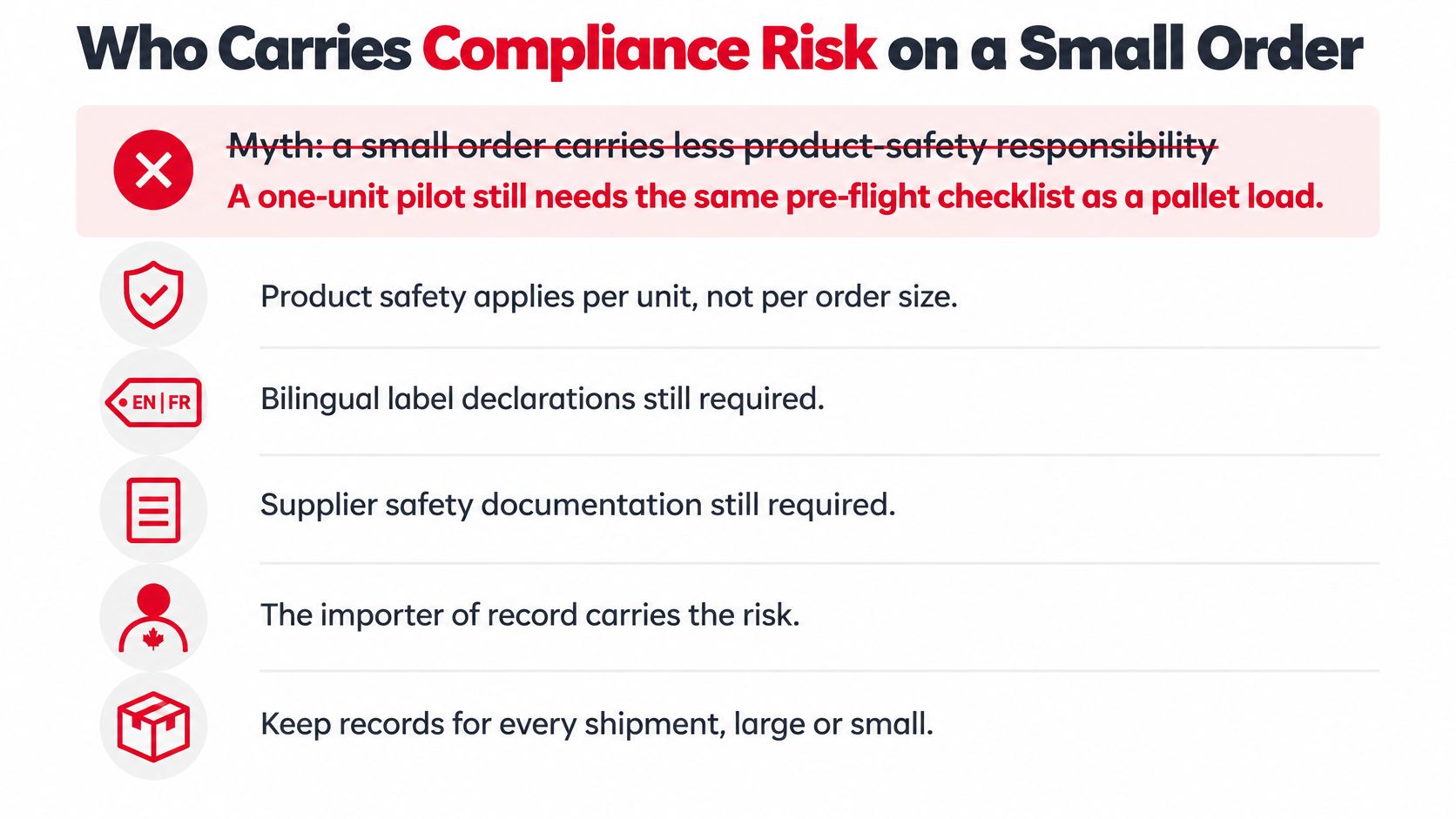
The most expensive assumption in small-run private label is that a small order carries less product-safety responsibility. It doesn't. A one-unit pilot needs the same pre-flight checklist as a pallet load, because the obligations attach to the product, not to the size of the purchase order.
Canada's Candles Regulations apply to candles that are imported, advertised or sold, and require that a candle must not spontaneously reignite after extinction, as set out in the Candles Regulations. That one performance requirement is why each combination of wick, wax, fragrance load and vessel needs its own evidence instead of being assumed across a scent family or a jar swap.
The records to hold for every SKU
Ask for these before production, not after, and keep them per private-label combination rather than per order.
- Wick specification: type, material and supplier declaration, since cotton and wood wicks behave differently and customers do ask.
- Formulation record: wax blend, fragrance load and batch code, so a reorder can be matched to what you sold.
- Vessel geometry: supplier, dimensions and glass type, which governs heat behaviour and breakage in transit.
- Extinguishing and burn-test results: the evidence behind the reignition rule, run on the finished assembly.
- Bilingual cautionary-use text: the exact approved wording, with a record of who wrote and translated it.
- Approval sample and retained specification: a signed-off unit plus the written spec it was approved against.
Where the responsibility splits
In practice the maker holds formula, batch and burn-test records. You, as the brand on the jar, own the claims you make and the words on your listing. Write that split down in the order paperwork, because verbal arrangements evaporate when a scent is reformulated or a jar is discontinued.
Health Canada tells consumers to follow the instructions printed on the label and to ask retailers whether candle wicks contain lead, according to Health Canada's candle safety guidance. That puts a simple duty on you: be able to answer the wick question with a document, not a marketing phrase.
Compliance travels with the product, not with the purchase order.
Avoid unqualified claims such as clean, non-toxic or safe. Documented specifications do the selling better anyway, and our Candle Care & Safety guidance is a workable model for the burn directions you hand to a customer.
Bilingual Label Content and How to Proof It
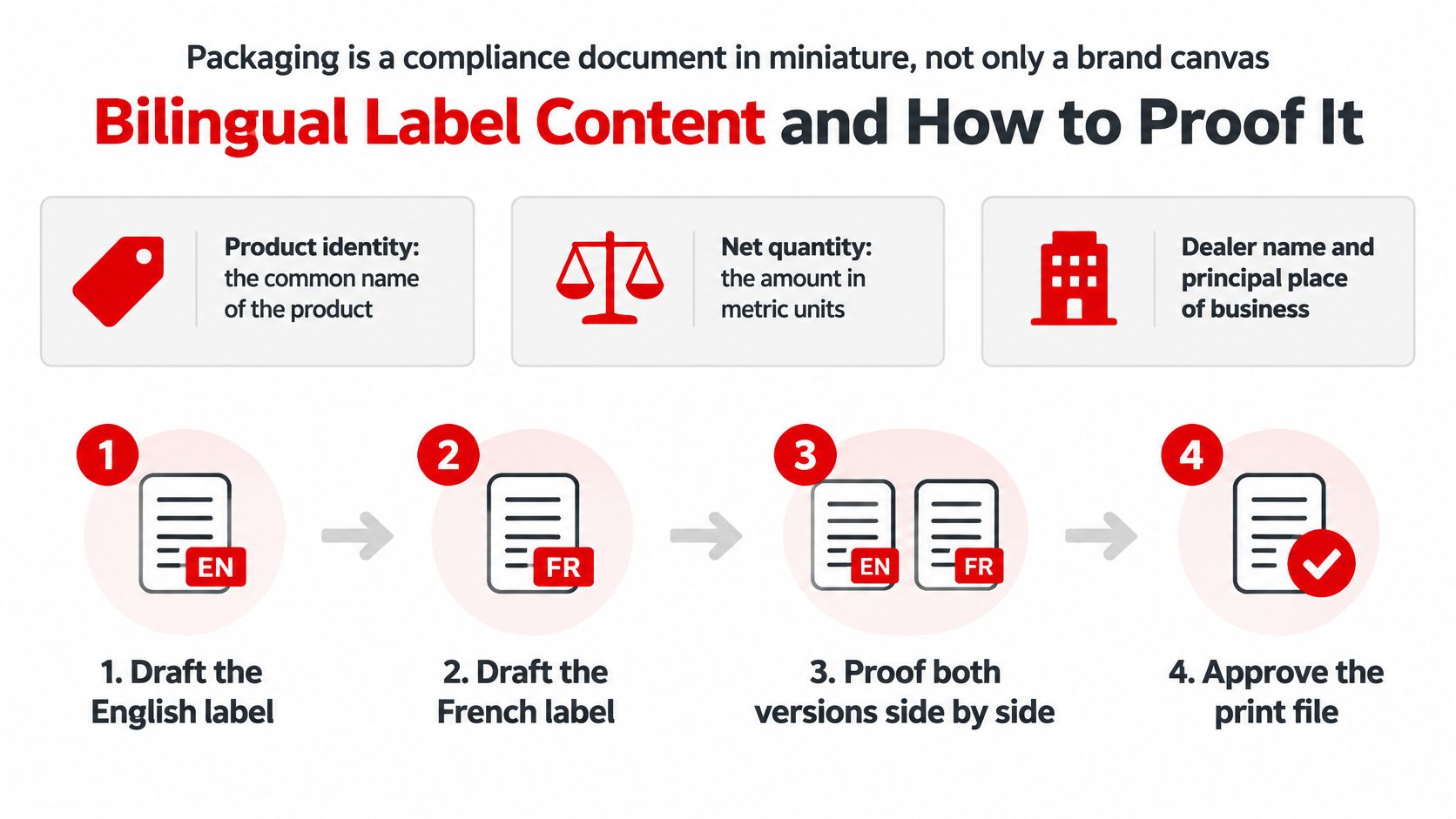
A candle package is a compliance document in miniature. Treat it purely as a brand canvas and the omission a buyer finds is nearly always the same one: a product identity printed in English only.
Canadian packaging must carry three core declarations, according to the Competition Bureau's labelling guidance: a product-identity declaration, a net-quantity declaration, and the dealer's name and place of business. The identity must use the product's common name or function, the quantity must accurately state the contents, and the identity must appear in both English and French. Candles sold by count can state an item count, while anything sold by weight needs the applicable metric measurement.
That bilingual requirement isn't a Quebec-only consideration. It applies to a national launch whether you sell in one province or ten.
Build a permanent warning panel
Federal guidance on candle packaging identifies warning-label requirements and points to risks such as unattended burning, proximity to combustible materials and access by children, per this federal candle packaging guidance. Reserve a fixed panel for English and French safety instructions, keep contrast and type size legible after any varnish or laminate, and keep mandatory text away from where a barcode, price sticker or shrink-wrap will sit.
Marketplace and trade guidance for Canada treats bilingual safety warnings and directions as part of what a compliant listing carries, according to the Canada labelling and marking requirements, so allocate panel space for directions rather than branding every flat surface.
Six steps from artwork to print approval
- Draft the artwork with the common product name and an accurate quantity in place before any branding.
- Check the dealer information and confirm how the maker's business details appear beside your brand.
- Confirm warning and care text in English and French, with one named owner for the final wording.
- Verify declarations and claims such as wick material against the approved formula, not the previous label.
- Approve a printed sample, not a screen proof, because finish and print shift colour and size.
- Release the run only once that sample passes, and file it with the SKU records.
If the vessel is still undecided, this guide to candle jar bulk buying covers how container choice affects what you can print and where the label panel sits.
Small runs change artwork often, and each revision needs its own check rather than a quick yes on email. A label reprint after a 12-unit run can wipe out the entire saving from ordering small, so the proof stage is where a pilot is won.
Landed Cost and Replenishment Math for Small Orders
Every supplier page quotes a unit price. Almost none answers the question that decides your reorder: is the pilot still profitable once the box is open on your counter?
Landed cost per unit is the unit price, plus your share of freight, plus packaging and mailers, plus the label setup spread across the run, plus a breakage allowance, plus sample fees, minus the markdowns you expect at resale. Run that calculation before you celebrate a low headline price.
- Freight share: one small parcel has fixed handling costs, so per-unit freight on 6 units is far higher than on 60.
- Label setup: a one-time cost that gets ugly when divided by twelve jars.
- Breakage allowance: glass in a small carton has fewer neighbours to cushion it.
- Sample fees: a paid approval sample is normal and should be quoted up front.
Order bands and the costs that change the decision
| Order band | Units | Costs to add to unit price | Decision signal |
|---|---|---|---|
| Demand test | 6 | Freight, sample fee, label setup spread over few units | Reorder only if sell-through holds |
| Seasonal pilot | 12 | Freight share, label setup, breakage allowance | Compare with the next consolidated order |
| Replenishment order | 24 | Freight share, breakage allowance, label setup already paid | Consolidated order usually wins when demand is steady |
| Ontario versus other provinces | Same units, quoted by destination | Freight rate to the destination province | Quote per province before comparing |
A 12-unit order with one broken jar
Say a 12-unit order arrives with one vessel cracked at the rim. You've lost a unit, paid freight on it, and now need a replacement shipped separately unless the maker builds a damage allowance into the pilot terms. The replacement cost and its freight land on the eleven jars you can sell, which can turn a comfortable resale margin into a thin one. Ask who pays for breakage before the carton leaves, and get the answer in writing.
Distance matters too. A shipment from Ontario to a Quebec or Ontario address usually travels the shortest domestic lane, while a run to Alberta or British Columbia may carry higher per-unit freight on small parcels, so quote each destination before comparing two suppliers.
When the pilot stops saving money
The pilot model has stopped working the moment two small reorders cost more in freight, labels and handling than one consolidated order would. Watch for that point rather than defending the flexibility out of habit, and treat a no-minimum order as validation, not as your permanent replenishment method.
Delivery and returns expectations now shape shopper decisions as much as wholesale price. Canadian online retail represented 6.1% of total retail sales in December 2024, and a 2025 Canadian shopper study reported that 82% of shoppers may abandon a basket without preferred delivery options and 78% may do so without preferred returns options, according to market intelligence on Canadian e-commerce. Retail e-commerce revenue in Canada reached CAD $73.7 billion in 2024, up 9.0% on the previous year, per Statistics Canada.
If you carry several scents at once, setting safety stock buffers in an ERP planner keeps pilot purchases from turning into dead inventory.
Frequently Asked Questions
Is “no minimum” the same as no paperwork?
No. A 12-unit pilot carries the same basic duties as a larger run: a defined SKU, an approved label, an order record, and a way to trace which wax, wick, vessel and fragrance went into that batch. Keep those records from unit one.
Can I order one unit to test a scent?
Sometimes. The useful version is a documented single unit sold through the same process as a pilot, with fragrance, wick and vessel named in writing. A loose tester without those identifiers only checks whether you like the cold throw.
What if the jar, wick or fragrance is discontinued after my pilot?
Get the substitute in writing before you accept it. A change in vessel diameter, wick series or fragrance batch can alter burn behaviour and label details, so approve the replacement as a new configuration and retire the old SKU code instead of letting inventory mix.
Does a no-minimum pilot suit a seasonal launch?
Yes, if the scent uses a stock formula and components already in production. A custom blend, new vessel or special packaging turns the launch into a quoted project, so order early enough to approve one finished candle before the selling window opens.
Ten Questions to Confirm Before a Pilot Order
Send these in writing, get answers in writing, and use the replies to score two or three suppliers side by side. A verbal yes on a phone call is not an answer you can rely on when a jar arrives unlabelled.
- Does the no-minimum quantity cover stock formulas only, or custom blends, vessels and labels as well?
- Who supplies the bilingual product identity, net quantity and dealer name, and who approves the final artwork?
- Who writes and translates the warning and care text?
- Which wick and which vessel does each SKU use, and can both be named in writing?
- Is a burn-test or batch record supplied for each private-label combination?
- What does an approval sample cost, and how long does it take to arrive?
- What does a label change after the first run cost?
- Who pays freight and replacement on units that arrive broken?
- What are the shipping cost and lead time to my province?
- Does the pilot unit price reset on reorder, and to what?
A 12-unit pilot carries the same duties as a pallet: bilingual identity and net quantity, named wick and vessel, warning and care text, artwork approval, batch or burn records, freight responsibility and reorder price. If a supplier treats those as extras, the saving stops at the invoice.
Questions four and five decide whether the record matches the jar. Shivora Candles uses lead-free cotton wicks or crackling wood wicks, and wick choice changes burn behaviour, so the specification has to travel with each SKU rather than being assumed from one scent to the next.
Buy one retail candle and judge it like a receiving inspector: scent strength in the room, jar finish, label placement, packaging and how the wick behaves over a full burn. Retail orders use flat-rate shipping, with free shipping on orders of CAD $79.99 or higher, conditions apply; wholesale freight and breakage terms are quoted separately. Bring those notes and the written answers to the Wholesale & Private Label conversation, and ask for quantities, bilingual label details and the records that ship with each SKU.
Shivora Candles hand-pours soy candles and wax melts in small batches in Ontario, Canada, with lead-free cotton or crackling wood wicks and phthalate-free fragrance oils. If a 12-unit private-label run is your next move, ask Shivora Candles for quantity tiers, label responsibilities and landed-cost terms before you approve artwork.

