

The familiar advice that soy wax melts at one fixed temperature is too simple to be useful. Soy wax melting point depends on the wax grade, its formulation and how someone measured it. A supplier's melting figure, a candle maker's pouring temperature and the warmth of a burning candle describe different things.
For Canadian home fragrance lovers, that distinction matters when choosing candles, using wax warmers or deciding where to store a favourite scent. Think of the temperature on a wax data sheet as a starting point for understanding the product, not a complete set of instructions.
Table of Contents
- What Soy Wax Melting Point Really Measures
- Reading Supplier Data Sheets Across Soy Wax Grades
- How Melting Range Shapes Pour Temperature and Throw
- Why Heat Matters for Wax Melts and Warmers
- Storage and Summer Temperatures in Canadian Homes
- Why Melting Point Is Not a Safety Rating
- Choosing Soy Candles and Wax Melts for Your Space
What Soy Wax Melting Point Really Measures
Soy wax behaves more like butter on a warm counter than an ice cube with a neat melting boundary. It can soften, lose its shape and become progressively more liquid. The moment someone records a temperature depends on what they're watching for and which test they're using.
That's why two published figures can differ without either being wrong. Before comparing them, check whether they describe melting, flowing, setting or a manufacturing decision.
Different measurements answer different questions
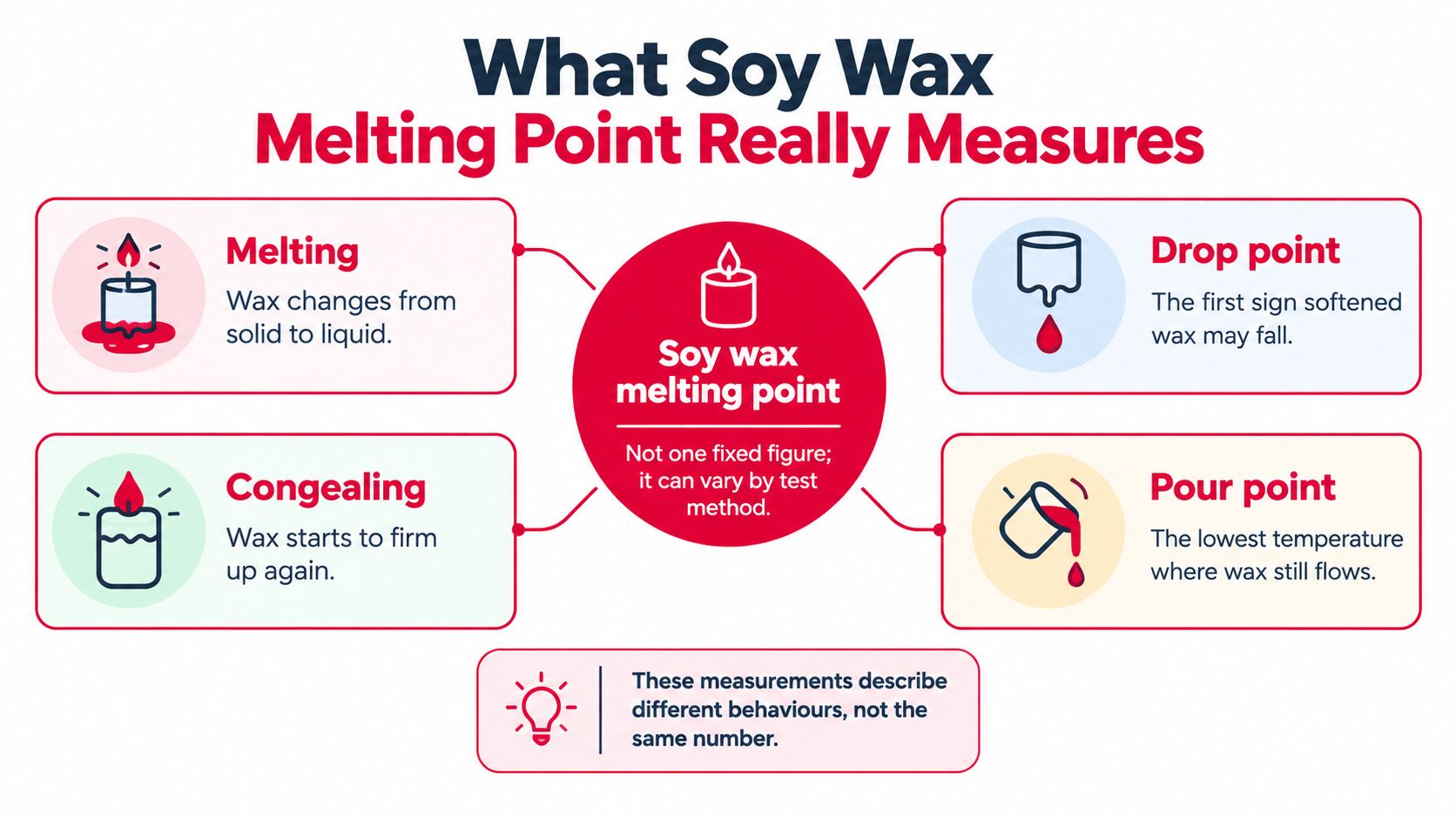
- Melting temperature describes the transition from solid wax towards liquid, often reported as a range.
- Drop point identifies when a standardised sample begins to flow or drop under specified test conditions.
- Congealing temperature describes wax firming up during cooling.
- Pouring temperature is a production setting chosen for transferring prepared wax into a vessel or mould.
The visual below separates these behaviours. One wording distinction matters: a measured pour point, meaning a low-temperature flow limit, isn't the same as the pouring temperature a candle maker chooses.
Why cooling isn't melting in reverse
Differential scanning calorimetry, usually shortened to DSC, measures heat absorbed or released as a sample changes temperature. It gives researchers a more detailed picture than watching wax in a melting pot.
A published soy-wax comparison reports melting at 43.92°C, solidification at 38.49°C, and latent heats of 117.59 J/g during melting and 122.18 J/g during solidification. Those energy measurements describe heat absorbed and released during the transitions, not recommended candle-making settings.
The approximately 5.4°C difference between melting and solidification in that comparison is called thermal hysteresis. In everyday language, wax doesn't necessarily firm up at the same temperature at which it melted.
Workbench insight: Ask what the temperature describes before asking whether it's the right number.
For a finished candle or melt, that gives you a useful mental model: softening, becoming fully liquid and setting again aren't interchangeable events. A wax can look firm while already feeling softer, and its appearance alone won't tell you its complete thermal behaviour.
Reading Supplier Data Sheets Across Soy Wax Grades
Open several soy-wax documents and you'll find figures that don't line up neatly. The useful response isn't to average them. It's to identify the product, measurement and intended application.
A safety data sheet helps communicate material hazards and handling information. A technical data sheet is generally the more useful place to look for grade-specific processing guidance. Keep both with your batch records rather than relying on a temperature copied from a general candle-making tutorial.
Reported Soy Wax Temperature Figures by Product Reference
| Wax reference | Reported figure | What it measures |
|---|---|---|
| Canadian supplier's soy container wax | 51.1–54.4°C | Listed melting range for that container-wax reference |
| EcoSoya Q230 technical sheet | 43.9°C Mettler drop point and 39.4°C congealing point; a second reported analysis gives 46.1°C and 42.8°C, respectively | Separate flow and cooling measurements; the sheet also recommends processing between 68.3°C and 85°C |
| KeraSoy Container 4130 references | Approximately 39°C in a Canadian supplier listing, alongside reported family technical figures of 45.5°C typical melting and a 42–48°C specification range | Product-specific figures that need their measurement context |
| EcoSoya container blend SDS | 43.3–79.4°C | A broad reported melting/freezing range, not a pouring recommendation |
The KeraSoy figures deserve particular care. A retail listing and a family-level technical specification shouldn't be treated as identical measurements of your own batch. If documents disagree, ask the supplier which current specification applies to the product you've purchased.
The EcoSoya processing recommendation also illustrates an important distinction: a handling temperature can sit above a reported transition temperature. That doesn't mean the wax needs that higher temperature merely to begin melting.
A practical way to compare documents
Before choosing a wax, check:
- Grade and application: Is it intended for container candles, freestanding candles or melts?
- Measurement name: Does the document specify melting, drop or congealing behaviour?
- Document context: Is the figure typical, a specification range or a processing instruction?
- Supplier clarification: Can the supplier explain an apparent discrepancy?
For a broader material-selection discussion, the guide to soy candle wax for candle making provides a useful companion. The most dependable habit is to compare like with like, then test the selected wax in its intended format.
How Melting Range Shapes Pour Temperature and Throw
Melting wax only tells you it is liquid. Pour quality depends on the temperature you choose, the fragrance you add and how the candle cools afterward. Those choices work together, much like stages in a recipe: changing one can affect the finished result.
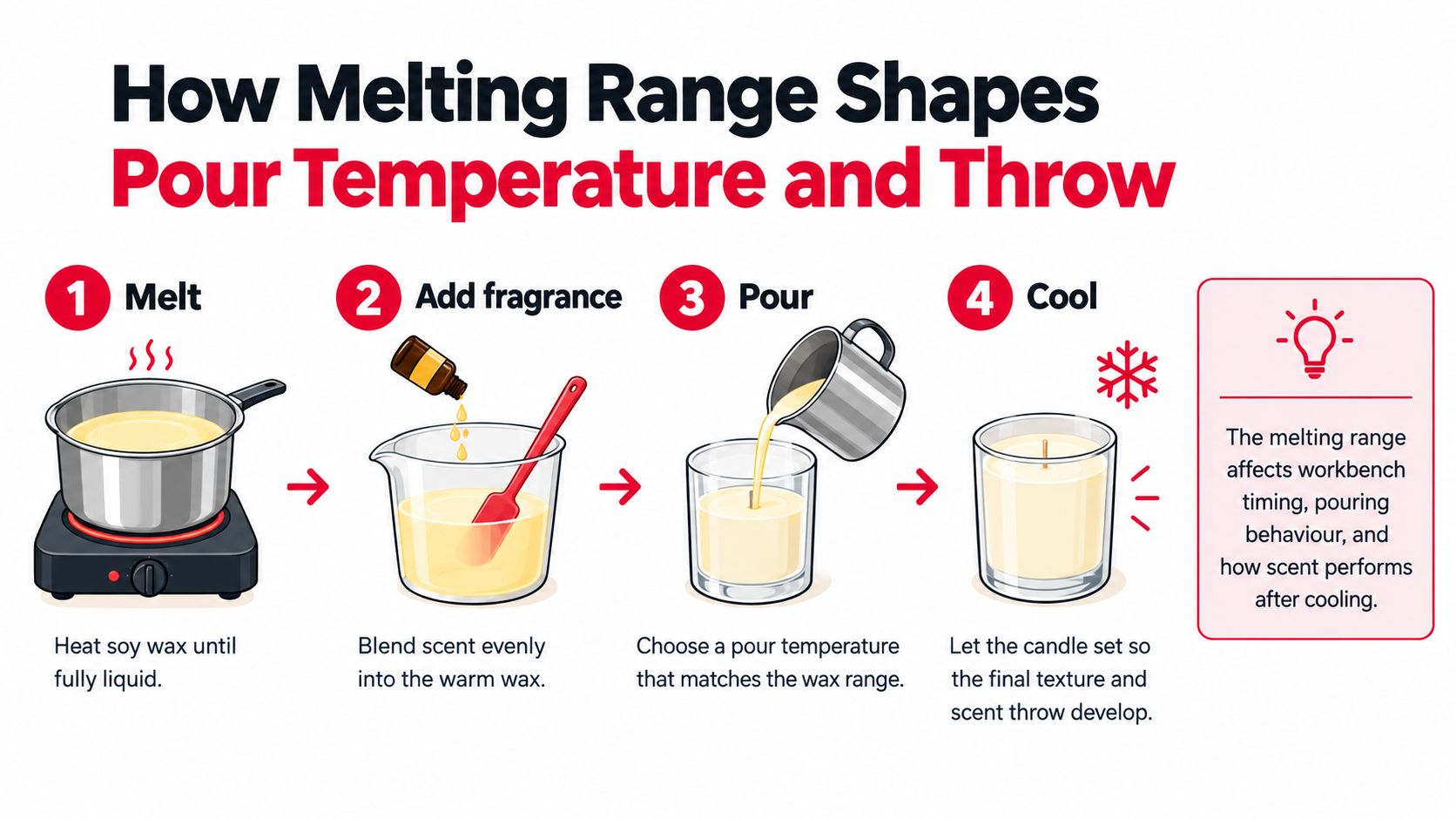
A maker handles heating, fragrance addition, pouring and cooling as separate steps. The illustration shows the sequence at a glance.
Start with the wax instructions
Melting: Heat in a controlled way and use a suitable thermometer. Follow the instructions for your chosen wax. Clear-looking wax alone does not confirm that it has reached the recommended temperature, and another grade may need different handling.
Fragrance addition: Follow the formulation's temperature guidance and fragrance limits. Adding oil because the wax is liquid may not give consistent incorporation.
Pouring: Begin with the supplier's recommended conditions, then assess the finished candle. Record the vessel temperature and room conditions as well.
Cooling: Keep the setting environment consistent. If a fresh pour moves between very different conditions, it becomes harder to tell what affected its surface or adhesion.
A pour that is too cool for a particular formulation may affect adhesion, frosting, surface texture or fragrance distribution. Overheated wax can yellow or darken, and a pour cooled in a draughty spot may develop uneven surface patterns. Note both conditions in your batch record so you can trace them. Repeatable results come from logging each step, because a single melting figure cannot control the finish or adhesion.
Connect the process to fragrance throw
Fragrance throw is the scent a candle or melt releases into the surrounding space. Wax needs to hold fragrance during storage and release it during use, but its melting point alone cannot predict how strong the scent will seem.
The DSC discussion of soy wax and stored thermal energy helps explain why: a phase change involves both temperature and energy. Fragrance oils, dyes, wick heat, vessel geometry, cooling rate and crystallisation history can also affect how the wax behaves.
Change one process variable at a time, record it, then compare the finished results.
The video demonstrates the four-step sequence above. Compare its pouring stage with your supplier's temperature recommendation before you begin.
If a finished candle smells faint, a higher pouring temperature may not solve the problem. This guide to troubleshooting weak soy-candle hot throw in Canada offers a systematic way to investigate the cause instead of changing heat by guesswork.
Why Heat Matters for Wax Melts and Warmers
A wax melt gets its heat from a warmer, so its melting point is only part of the picture. The grade, test method and appliance all matter. A range measured for one soy wax is not a universal setting for every melt or warmer.
Research on fully hydrogenated soy wax reports a melting peak near 57°C and a melting range of 53–63°C. This is a useful example of how a wax's reported peak can sit within a broader melting range. It does not identify the formulation of a retail melt. For a plain-language explanation of the format, see how wax melts work.
Match the warmer to its intended use
A warmer needs to bring the wax into a state where it can release fragrance. If it heats wax only slightly past its transition range, the melt may take longer to release scent, so check that the appliance reaches the range given in the wax's instructions. Follow the warmer's temperature settings rather than raising them to address faint fragrance.
Consider the whole setup:
- Warmer instructions: Use the appliance as directed.
- Wax formulation: Grade, additives and fragrance load affect how a particular melt responds.
- Dish capacity: Follow filling guidance instead of adding more wax to pursue a stronger scent.
- Observed condition: Stop using an appliance that appears damaged or behaves abnormally.
Readers can compare active and passive mattress cooling for a separate household perspective on heat-management terminology. That bedding resource is not candle guidance, so it cannot set a wax-warmer temperature.
A practical melt example
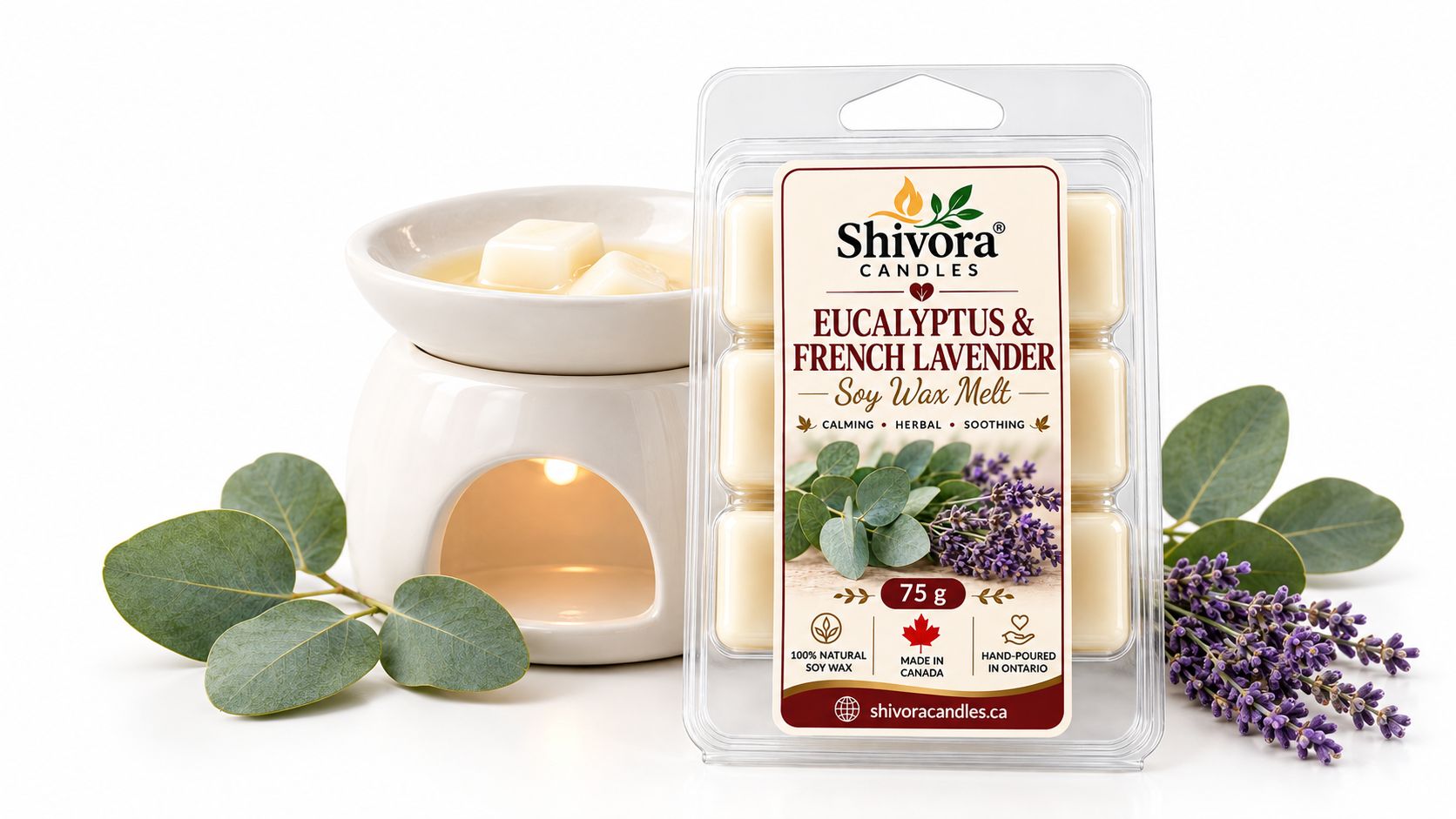
The Eucalyptus & French Lavender Soy Wax Melt – 75 g | Made in Canada is a 75 g soy wax melt made in Canada. It is one format to consider if you already use an approved warmer.
Never add water, overfill the dish or leave the warmer unattended. Keep the warmer away from children, pets and flammable materials.
A visible pool of melted wax does not mean the heat should be increased. Use the warmer and wax according to their instructions, and let the grade-specific range guide your expectations rather than treating one melting point as a rule for every product.
Storage and Summer Temperatures in Canadian Homes
A sunny windowsill can warm a candle far beyond the temperature of the surrounding room. Wax responds to the conditions where it sits, so a candle on a shelf and one near a window may soften differently.
In a typical Canadian home, a gift may wait in a cool hallway in January, sit in a heated living room by February, then rest on a bright windowsill in July. The wax's grade and melting range help explain how it responds, while its immediate storage spot determines the heat it experiences.
Read storage guidance in context
The Canadian Conservation Institute's temperature guidance recommends summer storage below 25°C and winter storage above 5°C to protect temperature-sensitive materials. It also notes that Canadian outdoor temperatures can range from approximately 40°C to −40°C. These are conservation recommendations, not candle-specific limits or a guarantee that wax will stay firm.
Compared with the representative container-wax range in the supplier table, ordinary indoor storage leaves a substantial temperature margin. Yet a comfortable room at home cannot prevent a parcel or candle from encountering concentrated heat in transit.
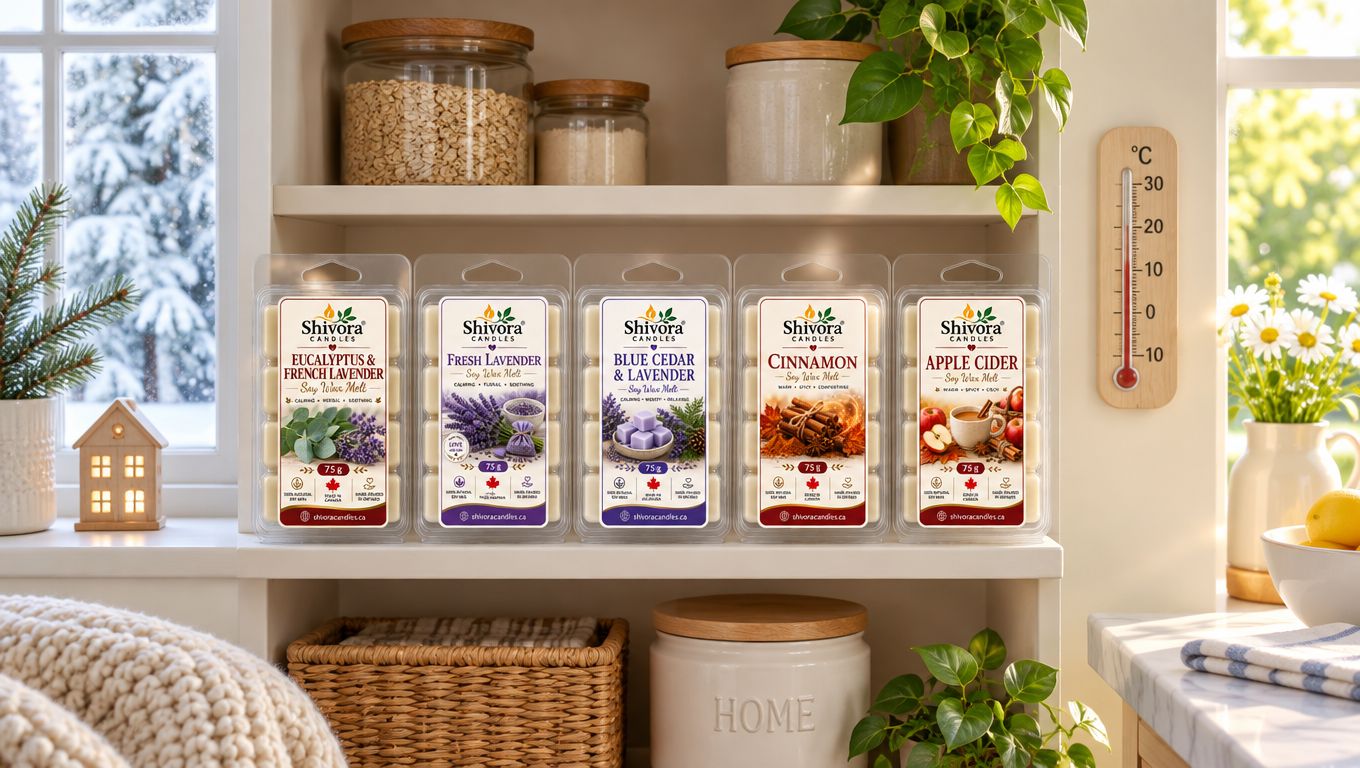
Choose the location, not just the room
A thermostat reading tells you the room's air temperature, but a windowsill or a cupboard near a heater can be much warmer or cooler. A parked vehicle, direct sun or a parcel exposed to concentrated heat may soften wax, especially if its grade has a lower melting range.
A few simple habits help protect candles and melts:
- Store away from concentrated heat: Keep them out of direct sunlight and away from radiators or heated surfaces.
- Choose a cool, dry place: Store unused products where conditions remain reasonably steady.
- Limit temperature swings: Avoid repeatedly moving them between very cold and warm locations.
- Inspect after exposure: If a candle arrives softened or visibly altered, let it settle and ask the maker for advice before use.
Storage rule: Check the conditions around the candle, not only the temperature displayed on the wall.
When planning a bedroom, keep fragrance storage separate from furniture decisions. The Indian River Furniture mattress buying tips offer a separate resource for choosing a mattress, not guidance on storing wax.
For routine summer storage, choose a shaded spot with steady conditions. If wax has softened, avoid abrupt cooling; move it to suitable storage and contact the maker if its appearance has changed.
Why Melting Point Is Not a Safety Rating
A wax's transition temperature tells you when it softens. It does not tell you the flame temperature, the container temperature or the hottest point in a melt pool. Melting point describes the wax, while safe use depends on the candle and how it is handled.
Molten wax can cause burns if it spills or splashes onto skin. Keep it away from skin, and don't use ordinary scented candles for improvised wax play. If a burn happens, cool it under cool running water for at least ten minutes, and seek medical care for a large or blistered area. Fragrance oils, dyes, hot containers and an unknown formulation also affect the risks of contact.
Separate material behaviour from safe use
Health Canada's candle-safety publication notes that relight candles have been prohibited in Canada since 1977. That prohibition and federal candle-safety requirements do not set a soy melting temperature that makes a candle safe by itself.
Look at the whole product and its surroundings. Wick design, flame height, draughts, fragrance load, container temperature and burn duration all matter. A cotton wick and a wood wick may call for different care, so follow the directions supplied for that candle rather than assuming one routine fits every wick.
| Question | What it tells you |
|---|---|
| When does the wax melt? | Material transition behaviour |
| How hot does the candle become? | Actual operating conditions during use |
| Is the candle being used responsibly? | Whether instructions, placement and supervision are appropriate |
Use practical fire-safety habits
Health Canada's candle-safety guidance recommends sturdy, well-ventilated holders. It also advises keeping burning candles away from children and pets, extinguishing them before sleep, never leaving them burning when nobody is in the room, and avoiding lead-containing wicks.
Build those precautions into your routine:
- Prepare the location: Use a stable, heat-resistant surface away from flammable materials and draughts.
- Follow wick directions: Trim and maintain the wick as the maker specifies.
- Stay present: Extinguish the candle before leaving the room.
- Let everything cool: Don't handle hot wax or move a hot container.
- Never use water on a wax fire: Water is not an appropriate way to extinguish burning wax.
If wax spills, keep people away from it while it is hot. Don't rush to touch or clean it up. Stop using a candle that overheats or behaves unusually, and seek advice specific to that product.
Keep the maker's Candle Care & Safety information and related candle-care guidance handy. These instructions help with everyday use; a melting-point figure alone cannot tell you how to burn a candle safely.
Choosing Soy Candles and Wax Melts for Your Space
A melting-point number cannot choose the right fragrance format for you. Start with how the product will fit your room and routine: a container candle needs a flame and supervision, while a wax melt releases fragrance in an approved warmer that also requires attention. The wax grade and intended use matter, too, since a number alone does not tell you how a finished product will perform.
For a gift, include care information the recipient can use. Clear directions help them get started without guessing about the product or its intended format.
A short buying checklist
- Consider the location: Will the product sit near a sunny window or heat source? Warm surroundings can affect how wax holds its shape.
- Choose the format: Do you want a candle, or do you already use an approved warmer?
- Check the product page: Look for the wax's use and care instructions before you buy, especially for a gift recipient who may not see the seller's notes.
- Ask useful questions: Can the maker explain the wax grade and provide processing guidance?
- Plan the placement: Choose décor that suits the candle and allows it to be used as intended.
For décor ideas, you can browse Brentley candle holders from Giorgi Bros. Furniture. Check the dimensions, intended use, and holder instructions rather than assuming one decorative holder fits every candle.
Frequently asked questions
What temperature should I pour soy wax at?
Use the current technical instructions for the selected grade, and ask the supplier for a pouring temperature range before you start a batch. Grades can differ, so a range matched to your wax gives you a more useful starting point than a general melting-point figure.
Can I use container wax to make wax melts?
Ask the supplier whether the formulation suits the intended format. Different grades are designed for different uses.
Does a higher melting point mean stronger fragrance?
A melting-point figure cannot predict fragrance strength on its own. Assess the finished formulation in the candle or warmer you plan to use.
Should softened wax go straight into the fridge?
Storage at a steady, mild temperature matters more than a fridge, so use the storage habits described earlier in this guide.
For a floral option, explore the Ontario-made Fresh Lavender Soy Wax Melt. Free shipping applies to orders of CAD $79.99 or more, and some conditions apply.
Shivora Candles offers hand-poured soy candles with cotton or wood wicks and soy wax melts made in small batches in Ontario, Canada. Visit Shivora Candles to choose a fragrance format that suits your space, then keep its care directions close for everyday use.

