

Does printing your boutique's name on a candle make it private label? Not if the wax, wick and scent were already a standard item on a manufacturer's shelf. A fresh label on an existing candle is white label. Shop owners searching what is private label vs white label usually expect a branding definition. For a Canadian retailer, the useful question is who specifies the candle, who else may sell the same one, and whose name answers a complaint.
We pour soy candles and wax melts in small batches in Ontario. Retailers often want a "custom" line before they know which scent family, vessel or price will sell. Treat the two models as tools for different stages, not as a quality ranking.
Table of Contents
- Private Label and White Label Side by Side
- How Each Model Works for a Candle Retailer
- Specifications That Separate the Two Models
- Labelling, Liability and Contract Terms to Settle
- What Each Model Costs and How Long It Takes
- Choosing the Right Model for Your Stage
- Common Questions About Private Label and White Label
- Confirm the Model and Take the Next Step
Private Label and White Label Side by Side
| Criterion | Private label | White label |
|---|---|---|
| Who defines the product | Retailer specifies scent, vessel, wick and packaging | Manufacturer's existing standard product |
| Customization | High, built to one retailer's specification | Limited to labels, packaging or minor specifications |
| Exclusivity | Usually intended for one retailer; scope set in the contract | The same base product may be sold to other retailers |
| Development effort | Higher; each specification is tested | Lower; the existing product is rebranded |
| Speed to shelf | Slower; longer validation cycle | Faster launch and simpler replenishment |
| Brand and packaging control | Retailer owns artwork and identity | Retailer applies its own branding to standard goods |
| Minimum order approach | Negotiated per program | Set by the manufacturer's existing run |
| Best fit | A differentiated line with a distinct scent or format | A fast test of demand with a proven product |
Who defines the product. You name the scent, vessel, wick and packaging, or you accept the manufacturer's existing candle.
Customization. Private label is built to one shop's brief. White label stops at the label, the carton or a small specification change.
Exclusivity. A private-label candle is usually meant for one retailer, and the contract has to say how far that reaches. The same white-label base can appear in another shop under a different name.
Development effort. Each private-label change needs testing. White label rebrands a candle that already has a burn record.
Speed to shelf. Validation slows a private-label launch. A white-label reorder is mostly a label proof and a production slot.
Brand and packaging control. Both models let you sell under your name. Private label pairs that name with artwork you own. White label puts your branding on standard goods.
Minimum order approach. Private-label minimums are negotiated for that program. White-label minimums follow the run the manufacturer already pours.
Best fit. Private label fits a distinct scent or format when you can carry the extra work. White label fits a fast read on demand.
Private label is not the upgraded version of white label. It is a longer job with a narrower product.
Neither row is a prize. Differentiation costs time and operational work. Speed costs distinctiveness. Write the split of formula ownership, minimums, labels and exclusivity into the manufacturing agreement. The model name will not do that for you.
How Each Model Works for a Candle Retailer
What is private label vs white label on the shelf
Your brand goes on the jar either way. The difference sits upstream, in who decided what the candle is and who answers for it.
Private label means a third-party manufacturer makes the product and you sell it under your brand. You keep brand identity, packaging, positioning and the customer relationship; the manufacturer supplies the production capability. For a boutique, that can mean commissioning Ontario-made soy candles, choosing vessel sizes, scents, wick formats, labels and packaging, then selling the finished goods under your own name. You skip wax-melting equipment, filling lines, a test bench, inventory systems and a dedicated pour room, and you still carry a distinct line.
You do not own that line by default. Formula ownership, minimums, label compliance, fragrance choice, quality standards and exclusivity all belong in the contract. Approvals land on your desk too. Every scent sample, wick test and label proof waits for your sign-off, so a private-label program runs on your calendar as much as the manufacturer's.
Canadian Grocer's account of private-label power reported that private-label products represented 18.6% of retail sales by dollar value in 2017, equal to CAD $14.4 billion, and reached 23.6% by volume. Price was the leading reason Canadians bought private label, cited by 64% of shoppers, while 23% cited trust and prior experience. Broad retail figures, not a candle forecast, but they explain why a shopper will try a name they have never seen on a national brand.
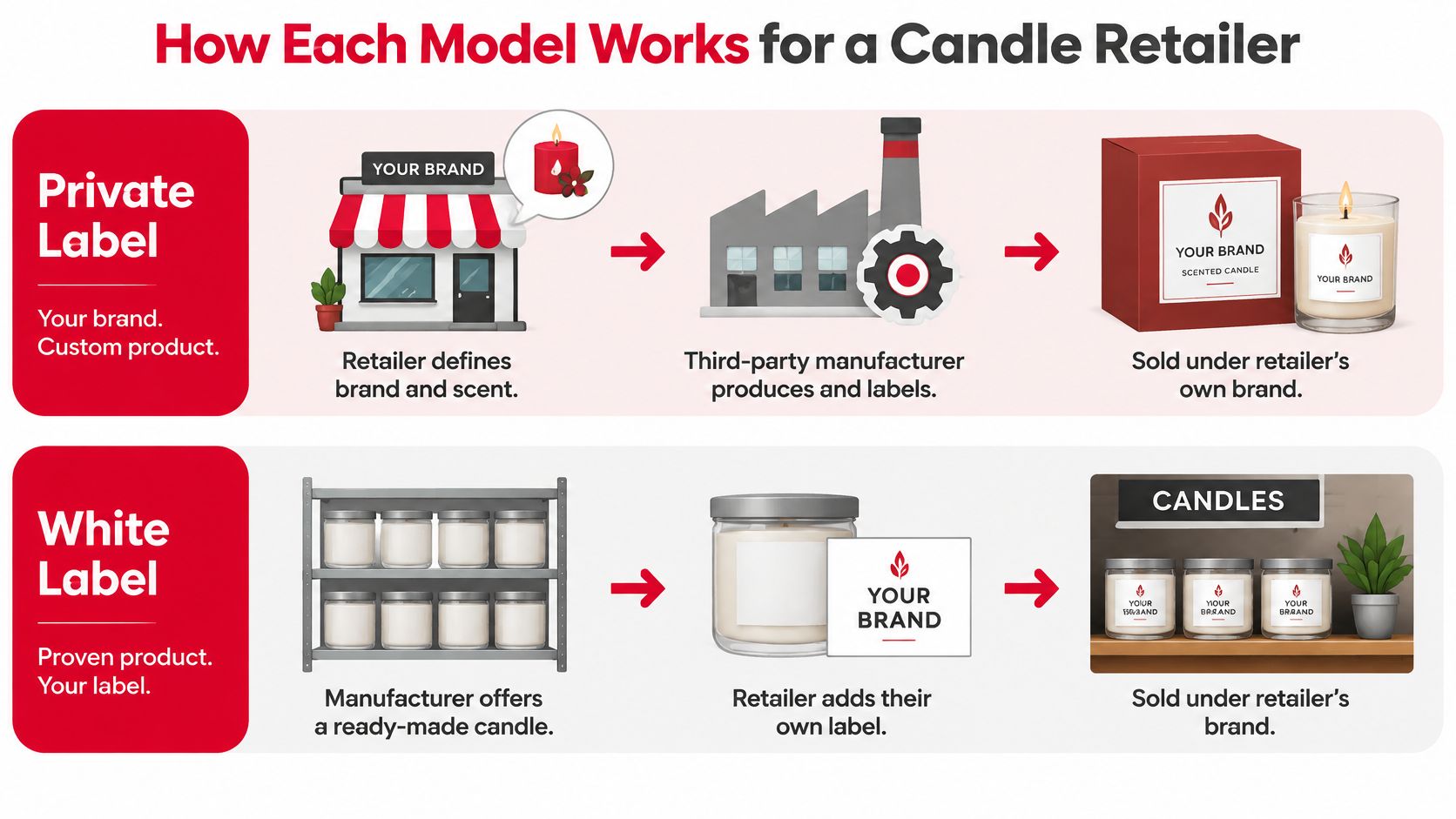
A private-label candle usually moves through six steps.
- Define the scent family and the vessel.
- Set the wick and the burn targets.
- Approve label and packaging proofs.
- Agree minimums and exclusivity.
- Pour and test a sample batch.
- Release the first production order.
Skip a step and the "custom" candle is a guess with your logo on it. If you want a plain comparison of pour methods before you brief a maker, read how hand-poured candles differ from factory runs.
What white label leaves unchanged
White label is narrower. The manufacturer offers an existing, repeatable candle to several buyers. You change the label, the packaging or a minor specification. You do not own a unique formula, the same base can appear under another shop's name, and the story you can tell is mostly about curation and service. Your job shifts from product development to merchandising: picking scents your customers will reach for, pricing them well and keeping them in stock.
A gift boutique might pick three seasonal scents from an approved list, add its branding, and have goods in the same quarter. That speed is the point. A season of white-label sales also works as a low-cost pilot, because the sell-through tells you which scent families earn a private-label budget before you spend it.
Canadian Grocer's report on the private-label ramp found that private-label market share in Canada rose from 17.2% in 2019 to 18.2% between March 1 and July 11, 2020. Retailer-owned brands clearly have an audience in this country, and a standard white-label candle gets its chance to win one on your shelf.
Private label, in the same market, is more likely to mean a custom scent, bespoke packaging or a performance target written for one retailer. The label on the box is the smallest difference between the two models. The bigger ones are who designed the product, who tested it and who is contractually responsible when something goes wrong.
Specifications That Separate the Two Models
The technical split is standardization versus controlled differentiation. White label uses a fixed, repeatable specification and several retailers can share it. Private label is built to one retailer's brief, so every change has to earn its place in testing.
| Specification | What it controls | Who sets it |
|---|---|---|
| Wax type | Melt pool, scent throw and burn behaviour | Manufacturer standard or retailer-specified blend |
| Fragrance load | Cold and hot throw and scent strength | Fixed in white label; set per program in private label |
| Wick series and size | Flame height, soot behaviour and burn rate | Standard in white label; tested per program in private label |
| Vessel internal diameter | Melt-pool diameter and fill depth | Catalogue vessel or custom vessel |
| Target net weight | Burn time and unit price | Catalogue size or program size |
| Cure time | Scent development before sale | Standard schedule or retailer-approved schedule |
| Batch tolerance | Consistency between production runs | Standard tolerance or documented range |
| Retained sample | Traceability for complaints and reorders | Standard practice or written procedure |
Shopify Canada describes white-label goods as generic products sold by multiple retailers, while private-label goods are customized or exclusive to one retailer. A white-label soy candle might lock wax, vessel, fragrance formula, wick, fill weight and pack format. You launch faster, develop less and reorder with ease. Another Canadian retailer may carry the same candle.
What a private-label change must survive
A private-label brief can cover an exclusive scent, vessel size, wick architecture, fragrance load, burn target, label or pack. Each change should be checked for melt-pool diameter, flame height, soot behaviour, adhesion, cold throw, hot throw and burn consistency across batches. That cycle is the cost of differentiation.
For an Ontario producer, write down wax type, fragrance percentage, wick series and size, vessel internal diameter, target net weight, cure time, acceptable batch tolerances and a retained-sample procedure. Vessel choice drives fill depth and how the melt pool behaves, which is why bulk candle jars and vessel choices belong in the brief before artwork does.
Hand-poured reality
Each product is hand-poured in small batches. Because the work is handcrafted, minor variations in appearance, wax finish, colour or label placement may occur. Agree the acceptable range before the first order, or a normal pour looks like a defect.
Shivora Candles is a concrete case of a documented wax choice. The Black Raspberry Vanilla Candle, 10 oz, is made with a premium coconut apricot wax blend. That blend is a specification, not a slogan. A buyer who wants the same behaviour in another scent has to name the wax, not just the fragrance name.
Ask for these items in writing:
- Wax and load: type, fragrance percentage and cure time.
- Burn hardware: wick series, wick size and vessel internal diameter.
- Commercial measure: target net weight and the tolerance band between batches.
- Traceability: who keeps a retained sample, and for how long.
Labelling, Liability and Contract Terms to Settle
Your brand on the jar does not remove packaging duties. For prepackaged non-food consumer products, the Competition Bureau's guide to the Consumer Packaging and Labelling Act requires the label to state the product identity, net quantity and the dealer's name and principal place of business. Product identity must generally appear in English and French, and Quebec can add further language rules. Net quantity for these goods is stated in metric.
White label cuts formulation decisions. It does not cut claim review. Canadian rules prohibit false or misleading representations. "Soy," "phthalate-free," "vegan," "clean-burning" and a burn-time line each need someone who can stand behind them.
Seven points to settle before you order
- Artwork. Who owns the label files, and who may reuse them if you leave.
- Bilingual copy. Who checks English and French, including any Quebec-only lines.
- Named business. Who appears as dealer or manufacturer, and whether you are the business the goods were made for or the importer.
- Claims. Who approves soy, phthalate-free, vegan, clean-burning and burn-time wording.
- Records and response. Who keeps batch records, runs a recall and answers complaints.
- Insurance. Who carries product liability cover, and at what point title passes.
- Exit. Who owns formulas and artwork, and what happens to finished stock, if the relationship ends.
Exclusivity does not move safety or labelling duties onto the maker. The contract has to say who still owns them.
The approval package
Before any production order, require a preproduction package: the final bilingual label proof, a material declaration where it applies, net-quantity verification, safety directions, a batch code and a signed note naming the responsible business. Private label is easier to defend when you need a product only you sell. White label is the more efficient route when you need speed and a wider catalogue. In both cases, the package is what you show if a claim is challenged.
What Each Model Costs and How Long It Takes
Price the job in categories, not as a single unit cost. White label usually spends less on development because the candle exists. You pay for label and packaging setup, the manufacturer's minimum run and the reorder price. Private label adds specification work, sample batches and burn testing. Those fees are quoted per program, and the minimum sits in the agreement.
| Cost or timing item | Private label | White label |
|---|---|---|
| Development and sampling | Quoted per program | Lower, existing product |
| Minimum order quantity | Negotiated per program | Set by manufacturer's existing run |
| Unit cost per candle | Written quote from vessel, wax, fragrance load, wick and fill weight | Written quote on the catalogue size and scent |
| Label and packaging setup | Retailer artwork and packaging | Retailer branding on standard goods |
| Lead time to first order | Longer validation cycle | Faster launch |
| Unsold stock exposure | Higher if demand is untested | Lower when started small |
No public rate card replaces a quote. Unit cost moves with the jar, the wax, the fragrance load, the wick and the fill weight, so each option needs its own written price.
What every quote should list
Ask for four lines on every option: sampling fees, the minimum order, lead time from an approved proof to delivery, and the reorder price. A white-label date depends on catalogue stock and label approval. A private-label date adds specification, sample burns and sign-off before the first release.
The cost people undercount is unsold stock. Model one selling season of holding cost before you accept the larger minimum. How Arlo models return risk is a useful way to see how returns and leftover units change the margin a low unit price appeared to offer. If you are still mapping who you sell to, wholesale candles for Canadian retailers sets the buyer-side context beside the maker's quote.
Choosing the Right Model for Your Stage
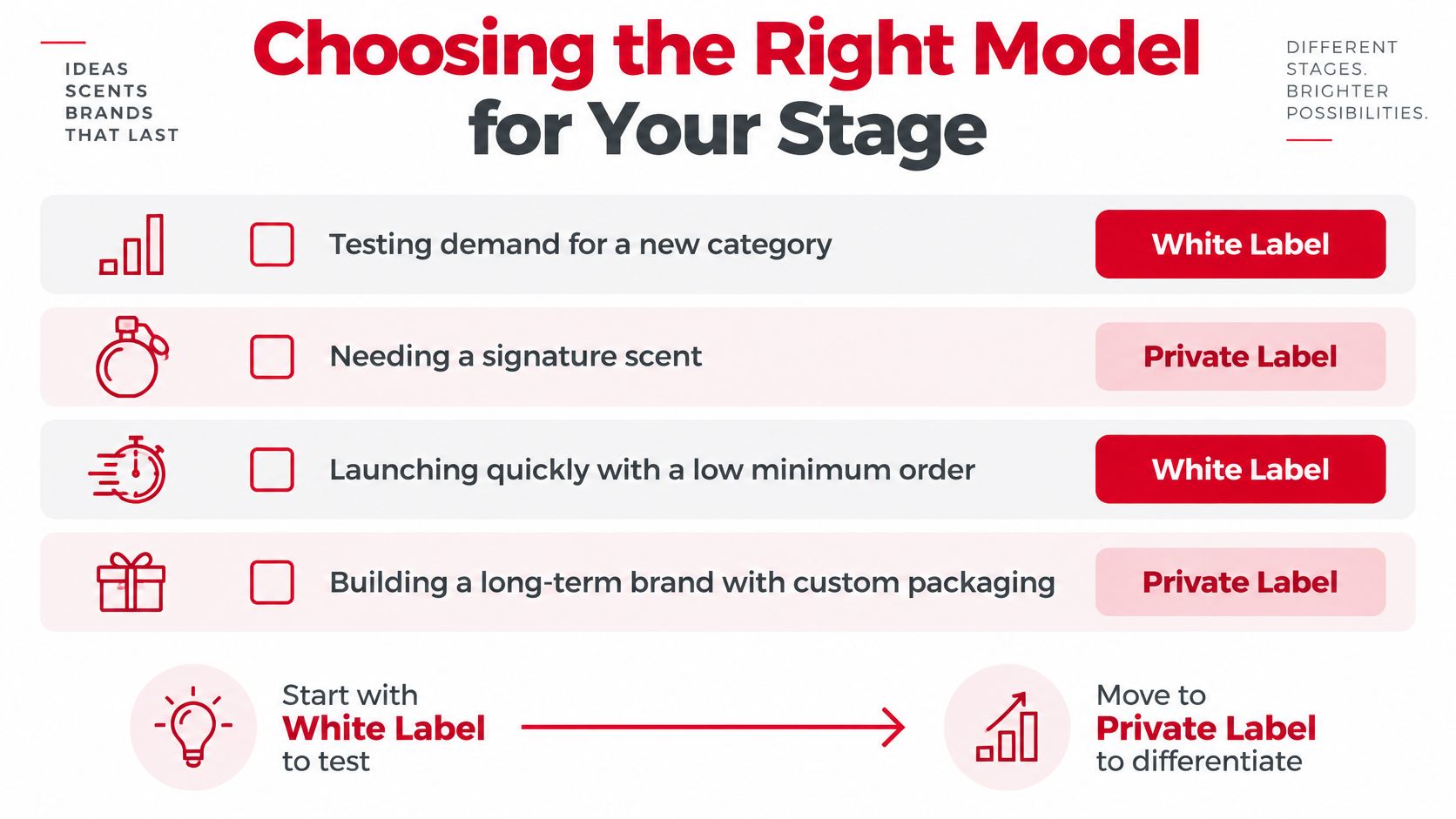
Match the model to the job in front of you, then change models when the sales say so. The label terms matter less than the obligations behind them: who set the specification, who carries the inventory risk, and what the agreement lets you claim. Two candles can look identical on a shelf while sitting under very different commitments, so start by naming the job.
| Situation | Better fit | Why |
|---|---|---|
| Testing demand for a new candle category | White label | Faster launch and lower commitment |
| Needing a signature scent only one shop carries | Private label | Custom formula and exclusive specification |
| Stocking Canadian-made candles quickly | White label | Existing product and simpler replenishment |
| Strong repeat sales and a clear brand story | Private label | Differentiation justifies development time |
| Limited storage and small reorders | White label | Lower inventory exposure |
| Scaling a branded line across seasons | Staged path | Start with white label, move to private label on evidence |
Category research from Agriculture and Agri-Food Canada found that 27% of surveyed consumers planned to buy more private-label products, while 38% preferred branded goods. Those figures come from food categories, so they say nothing direct about candle demand. Use them as a reason to test, not as a reason to commission a full custom line on day one.
The trade-off is speed and a smaller commitment against differentiation and more operational work. A new label alone rarely earns the development time, the larger minimum and the risk of unsold jars. The Wholesale & Private Label section on the Shivora Candles site separates catalogue wholesale from a specified program, so you can see which door you are walking through before you ask for a quote.
A staged path keeps the spend honest.
- Start with a compliant white-label core.
- Measure price, scent family, vessel size and repeat purchase.
- Set a reorder threshold from that sell-through.
- Move to private label only when the numbers support a custom fragrance, custom packaging or exclusivity.
Size the pilot to one selling season. The AdLibrarySpy guide to validating products is a clear checklist for separating a real product signal from a label change before you raise the minimum.
A short walk-through of the same fork, speed against a product only you can claim, sits in this overview.
Common Questions About Private Label and White Label
Is a private-label candle always exclusive?
No. Exclusivity is a contract term, not a side effect of the words "private label." The agreement should name the product or variations, the territory, the duration, the sales channels, who owns custom artwork or formulas, and what happens to leftover inventory if you part ways.
Does white label remove labelling rules?
No. Product identity, net quantity and the dealer's name and place of business still belong on every prepackaged candle, in both English and French where the identity rule applies. Claims such as soy or a stated burn time still need substantiation, even when you did not design the formula.
Can you start with white label and move to private label later?
Yes. Sell a compliant standard candle, watch which scent, vessel and price repeat, and spend on a custom fragrance, pack or exclusive only after that evidence exists. The first model is a test. The second is a commitment you can price.
Does a new label on an existing candle count as private label?
No. If the wax, fragrance, wick, fill weight and vessel stay as the manufacturer already sells them, the product is white label. Private label starts when the specification itself is built for your shop, not when the sticker changes.
Confirm the Model and Take the Next Step
The words on the agreement matter less than the obligations underneath them. A shop that writes a clear specification and runs a small pilot protects itself better than one that spends the negotiation arguing over whether the run should be called white label or private label. Work through the six steps in order, and do not skip the paperwork because the first order feels small.
- Pick white label or private label for the first run, using the situation that matches your shop today.
- Write a specification sheet for wax, fragrance load, wick, vessel, net weight, cure time, batch tolerance and a retained sample.
- Request a written quote that lists sampling fees, the minimum, lead time from approved proof to delivery, and the reorder price.
- Settle artwork, bilingual copy, the named dealer, claims, batch records, insurance and what happens if the relationship ends.
- Hold production until the preproduction package is signed, including the bilingual proof, net quantity, safety directions and batch code.
- Set a pilot quantity for one season and a reorder threshold before you accept a larger minimum.
That last step is where the staged path pays off. A pilot gives you sell-through evidence on scent, vessel and price before you commit to custom work and a bigger minimum, and the specification sheet turns that evidence into a product you can reorder consistently.
Shivora Candles hand-pours soy candles and wax melts in small batches in Ontario, and the site carries a "Proudly Made in Canada" label. The Wholesale & Private Label page on shivoracandles.ca is where a retailer can see how a Canadian-made program is described before a conversation starts. Hand-poured work means minor differences in appearance, wax finish, colour and label placement are normal, so agree on the accepted range before the first pour. Personalized and custom-made products are non-returnable, which makes the signed proof the key point of no return.
For logistics, Shivora Candles ships across Canada with flat-rate shipping, and orders of $79.99 CAD or more qualify for free shipping, with some conditions applying. If you are weighing a white-label test against a private-label scent, visit Shivora Candles and use the collection of soy candles, wood-wick options and wax melts as the reference before you write a specification.
