

Is a beautiful box with 24 doors a good deal if each tiny candle burns out before your tea goes cold? That's the question most shoppers skip when they buy Advent calendar candles, and it's the one that decides whether a countdown feels generous or frustrating by mid-December. A smarter way to judge them is by cost per burn hour, packaging waste, and how you'll really use each candle at home. Once you look at those three things, a smaller set of longer-burning candles or a candle and wax melt pairing sometimes wins.
Table of Contents
- What Advent Calendar Candles Are and How They Count Down
- Safety Rules for Burning a Candle Every Day in December
- Sizes and Burn Times That Work Over 24 Days
- Choosing Between DIY and Pre-Made Advent Calendar Candles
- Scent Choices for a Candle You Light Every Day
- Gifting Advent Calendar Candles to Canadian Recipients
- Advent Calendar Candles FAQ
- Pick Your Advent Calendar Candle Set Before December
What Advent Calendar Candles Are and How They Count Down
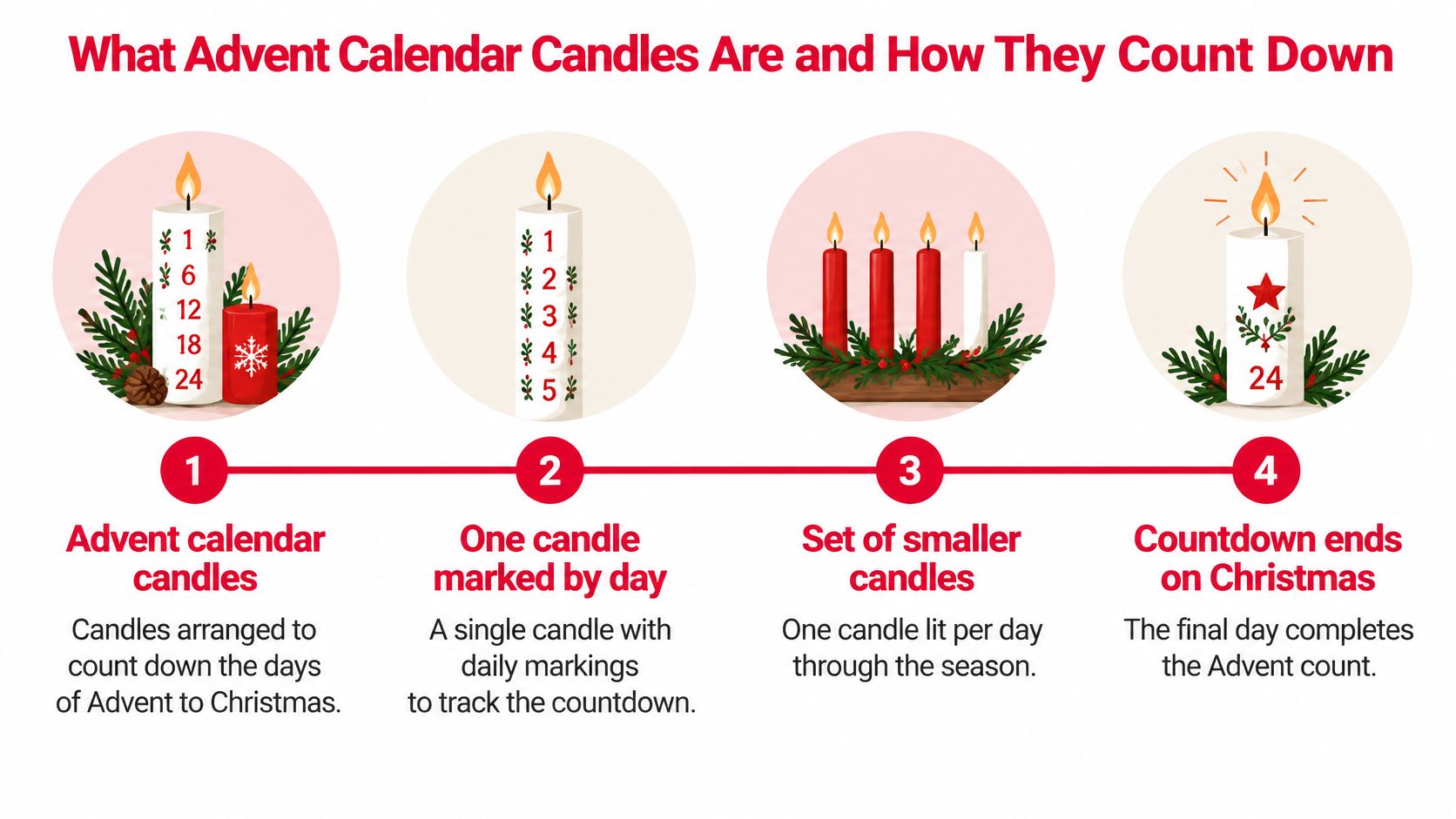
Advent calendar candles are candles arranged to count down the days of Advent to Christmas. You either burn one tall candle marked with date lines, a little each day, or you open and light a different small candle every day. The ritual is the point, and the scent comes second.
The custom comes from German Protestant households, where families marked passing days on a wall or door and burned a candle down to the next mark. A calendar is easy to confuse with an Advent wreath, but they count differently. The wreath holds four candles, one lit on each Sunday before Christmas, while a calendar counts individual days.
Reading the Dates on the Box
A traditional calendar usually has 24 numbered openings, corresponding to the days from December 1 through December 24, while the broader season in Canada begins on the first Sunday of Advent and lasts between 22 and 28 days, ending on Christmas Day, according to timeanddate's Canada Advent holiday page. Christmas Eve is always December 24 in Canada, so a 24-day product follows fixed December dates rather than Sundays. If a box says 12 days, you are choosing a shorter countdown that starts mid-month, not a full December run.
That difference matters at the shelf. A 12-day box and a 24-day box can sit at similar price points while covering very different numbers of evenings.
Advent calendar candle formats compared
| Format | How it works | Burn pattern | Best suited to |
|---|---|---|---|
| Burn-down candle | One candle marked by day, burned down to the next mark | One long countdown burn over 24 days | Traditional displays and keeping the historic ritual |
| 24 numbered mini candles | One small candle opened and burned each day from December 1 to December 24 | About 24 separate burns | Variety and gifting |
| 12-day set | Fewer candles, each burned on a set day | Fewer burns, longer total burn per set | Budget-conscious buyers and shorter countdowns |
| Candle and wax melt calendar | Mixed candles and melts for different rooms or moods | Varied burn lengths | Recipients who like exploring scents |
Read a label the same way you would read that table. Count the candles, find the stated burn time for each one, and add them up. That total tells you how many evenings the calendar can realistically cover, and two boxes with the same door count can still deliver very different totals.
Safety Rules for Burning a Candle Every Day in December
Lighting a candle once for a dinner is one habit. Lighting one 24 nights in a row, often beside a tree, wrapping paper, and a cardboard calendar, is another. The difference is repetition: a routine you perform the same way every evening is a routine your tired, distracted December self can still follow. Build it once, then run it without thinking.
The Daily Routine in Eight Steps
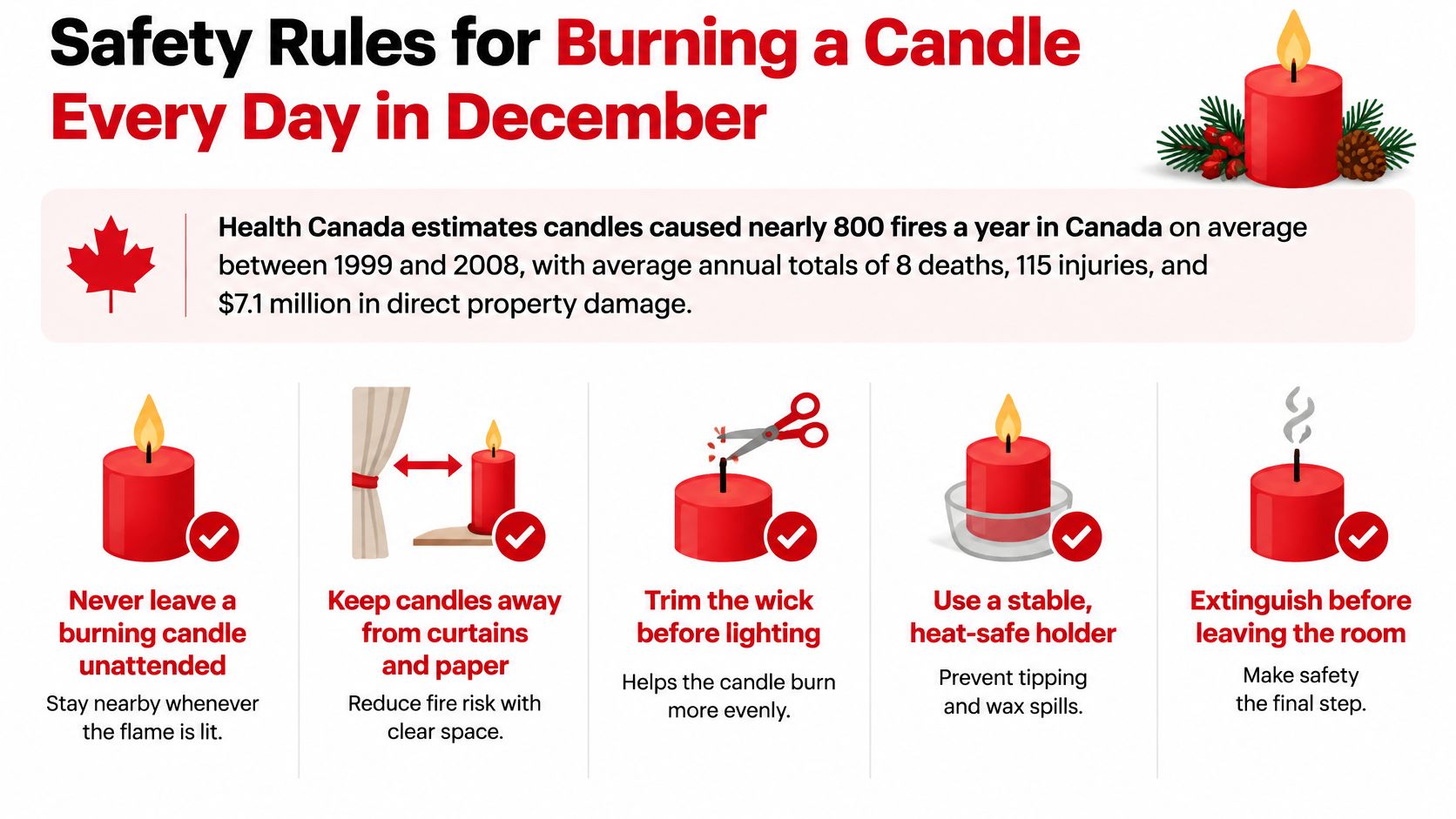
- Remove the candle from packaging. Take each candle out of its cardboard display before the first burn, since the box itself is fuel.
- Choose a stable surface. Set it on a stable, heat-resistant surface in a proper holder, never on or beside a paper calendar.
- Clear a one-metre circle. Keep at least 1 metre from anything combustible, including trees, garlands, curtains, and gifts. That is general fire-safety guidance for open flames, and December decorations count as combustible.
- Trim the wick. Cut it to about one-quarter inch before each burn so the flame stays low and steady instead of tall and flickering.
- Stay in the room. Treat a lit candle like a pot on the stove: fine while you're watching it, a problem the moment you walk away.
- Extinguish before you go. Put it out before sleeping or leaving the room, every time.
- Keep little hands away. Store candles, lit or unlit, out of reach of children and pets.
- Read the label. Check the intended burn duration and holder compatibility before you strike the match.
One candle per day doesn't mean one moment of risk. It means 24 separate times you light, watch, and extinguish a flame.
Why December Deserves Extra Care
Health Canada's candle safety guidance estimates candles caused nearly 800 fires per year in Canada on average between 1999 and 2008, based on data from Ontario, Manitoba, Alberta, and British Columbia, with those incidents averaging 8 deaths, 115 injuries, and CAD 26.2 million in property damage annually. Candle fires are most common during holidays and special occasions, and the same guidance traces a longer climb: candles accounted for 1.1% of home fires in the early 1980s, a share that had risen to 4.7% by 2001.
These figures cover candles in general, so treat them as context rather than a calendar accident rate. They explain why a daily December routine should run on habit rather than luck.
If a room has curious pets, a busy hallway, or no clear spot away from decorations, skip the flame that night. Flameless options such as indoor and outdoor LED candles can give you the glow for a display where an open flame doesn't fit, and the countdown still works.
What Honest Labelling Looks Like
Distrust packaging that promises too much. Words like "fireproof" or "completely safe" describe no real candle, and broad claims hide the details that matter. Look for measurable information instead: wick material such as cotton or wood, candle size, intended burn time, and clear warnings. Those details do double duty. They tell you how to burn safely, and they let you compare calendars and candle sets on cost per burn hour rather than on the box alone.
Canadian packaging should also read clearly across the country, so a bilingual English and French warning panel is a good sign. Keep that panel through the season. You will want it on day 17, not just day 1.
For wick trimming, placement, and snuffing versus blowing out a flame, follow our candle safety tips for everyday burning and keep the same habits all month.
Sizes and Burn Times That Work Over 24 Days
Start with simple multiplication. Total burn hours equal your daily session multiplied by 24. If you light a candle for one hour each evening, you need 24 hours of burn time across the calendar. If your set only adds up to half that, you'll run out early or rush each burn.
Total burn hours for a 24-day calendar
| Daily burn session | Total over 24 days | Suitable candle size | Best setting |
|---|---|---|---|
| 30 minutes | 12 hours | 4 oz or wax melt | Small room or bedroom with a light scent |
| 1 hour | 24 hours | 4 oz to 8 oz | Single living space with someone nearby |
| 2 hours | 48 hours | 8 oz to 10 oz | Ventilated room, watched throughout the burn |
| 3 hours | 72 hours | 10 oz, or two candles split across rooms | Larger spaces, with burns split to keep each session supervised |
Matching Session Length to Your Evening
A 30-minute session keeps scent light and suits a small bedroom, a bathroom, or a quick wind-down while you read. It's also the easiest session to supervise fully on a busy weeknight. You light it, stay nearby, and put it out.
A one-hour session fits most single living spaces. It gives fragrance time to build without committing your whole evening to watching a flame. A two-hour session suits a ventilated room where you're settled in, perhaps during a film, and won't wander off.
The First Burn Sets the Pattern
Give the first burn enough time for the melt pool to reach the edge of the container. That helps prevent tunnelling, where wax melts down the centre and leaves a thick ring you'll never use. A common guide is roughly one hour per inch of diameter, though the label on your candle takes priority.
Planning rule: Pick your session length first, then choose the candle size that fills that time comfortably.
When to Shorten or Change the Plan
Some rooms change the numbers. A child's bedroom or a space where pets roam calls for shorter, closely watched sessions, or a wax melt in a warmer instead. A candle sitting in a draught from a door or heating vent burns faster and less evenly, so move it rather than letting it struggle.
Size matters here too. A 4 oz candle suits sampling a new scent or scenting a smaller space, while a 10 oz candle suits a larger room and longer sessions. Plan multi-day burns so no candle is ever left alone to finish on its own.
Our guide to candle burn time and candle sizes walks through how diameter and session length affect the wax you use.
Choosing Between DIY and Pre-Made Advent Calendar Candles
Buy pre-made if you want predictable burns, finished labelling, and no testing on your kitchen counter. Make your own if you want full control over wax, scent, and vessel, and you're willing to test properly. Neither choice is automatically cheaper. The math decides.
Work Out Cost Per Burn Hour
Divide the price by the total burn hours. That's your cost per burn hour, and it lets you compare a big box fairly against a small one.
For context, in 2025, 35 advent calendars were listed with Canadian prices, with a median price of CA$190.43, according to The Advent Index Canada listings. If a calendar at that median price held 24 candles burning one hour each, you'd pay about CA$7.93 per burn hour. That median is an average across calendars, so treat the example as an illustration, not the price of any one product.
A smaller set can cost more per hour. One 12-day set was listed at CA$245 and contained 12 coconut-wax-blend candles with a stated total burn time of 25 hours, according to CAA North and East Ontario's advent calendar roundup. Divide CA$245 by 25 hours and you get about CA$9.80 per burn hour. Fewer doors doesn't always mean better value.
DIY vs pre-made advent calendar candles
| Factor | Making your own | Buying pre-made |
|---|---|---|
| Control over scent and size | Full control over wax, fragrance load and vessel | Limited to the scents and sizes the maker offers |
| Wick and burn testing | You test each wick and container pairing and log trial burns | The maker specifies the wick and burn behaviour on the label |
| Warnings and labelling | You write and print every warning, bilingual for Canada | Packaging carries the maker's warnings and burn guidance |
| Time needed | Pouring, curing and testing over several days or weeks | Ready to unwrap and place |
| Packaging waste | You choose materials and can plan for recycling | Limited to the packaging the maker uses |
What DIY Really Involves
Budget for wax, fragrance, wicks, containers, and the candles you'll sacrifice to testing. You need to match wick size to each container, run trial burns, allow the curing time your wax supplier specifies, and write your own warning labels. If you sell in Canada, those warnings should be bilingual.
It's a satisfying project alongside other homemade holiday touches, much like the nontraditional Christmas trees to make yourself that suit small spaces. Just don't gift an untested candle. A pretty jar with the wrong wick can smoke, tunnel, or burn too hot.
We hand-pour soy candles and wax melts in Ontario, Canada, for buyers who'd rather have known materials and finished labels than a testing schedule. Whichever route you choose, add packaging waste and shipping to your comparison. A low price per burn hour means less if half the box is mixed material you can't recycle.
Scent Choices for a Candle You Light Every Day
A month of candles works like a playlist. A few favourite styles on rotation keeps you listening, while a jarring new genre every night wears you out. Aim for four to six scent families across the countdown instead of 24 unrelated fragrances competing for attention.
Families That Rotate Well
- Fresh florals: Light and clean for early December evenings
- Warm gourmands: Vanilla, caramel, and coffee for cozy, food-inspired warmth
- Lavender and herbal blends: Calmer scents for bedrooms and quiet routines
- Woods and amber: Richer notes that suit longer, darker nights
- Citrus with sage: Bright and herbal when a room needs freshening
- Seasonal spice: Cinnamon or apple cider for a classic holiday feel
Start lighter while December routines are still settling, then move toward warmer, heavier scents as the nights lengthen. You'll notice each shift more because your nose hasn't been overwhelmed the night before. That pacing also stretches your budget: a candle you burn through slowly delivers more evenings per dollar than one you tire of halfway down the jar.
Placing Scents Room by Room
A spiced candle in the kitchen and a floral in the hall can blur into something muddled at the doorway, so give each space one clear scent at a time. Two strong candles with competing notes rarely read as layered; they read as confused.
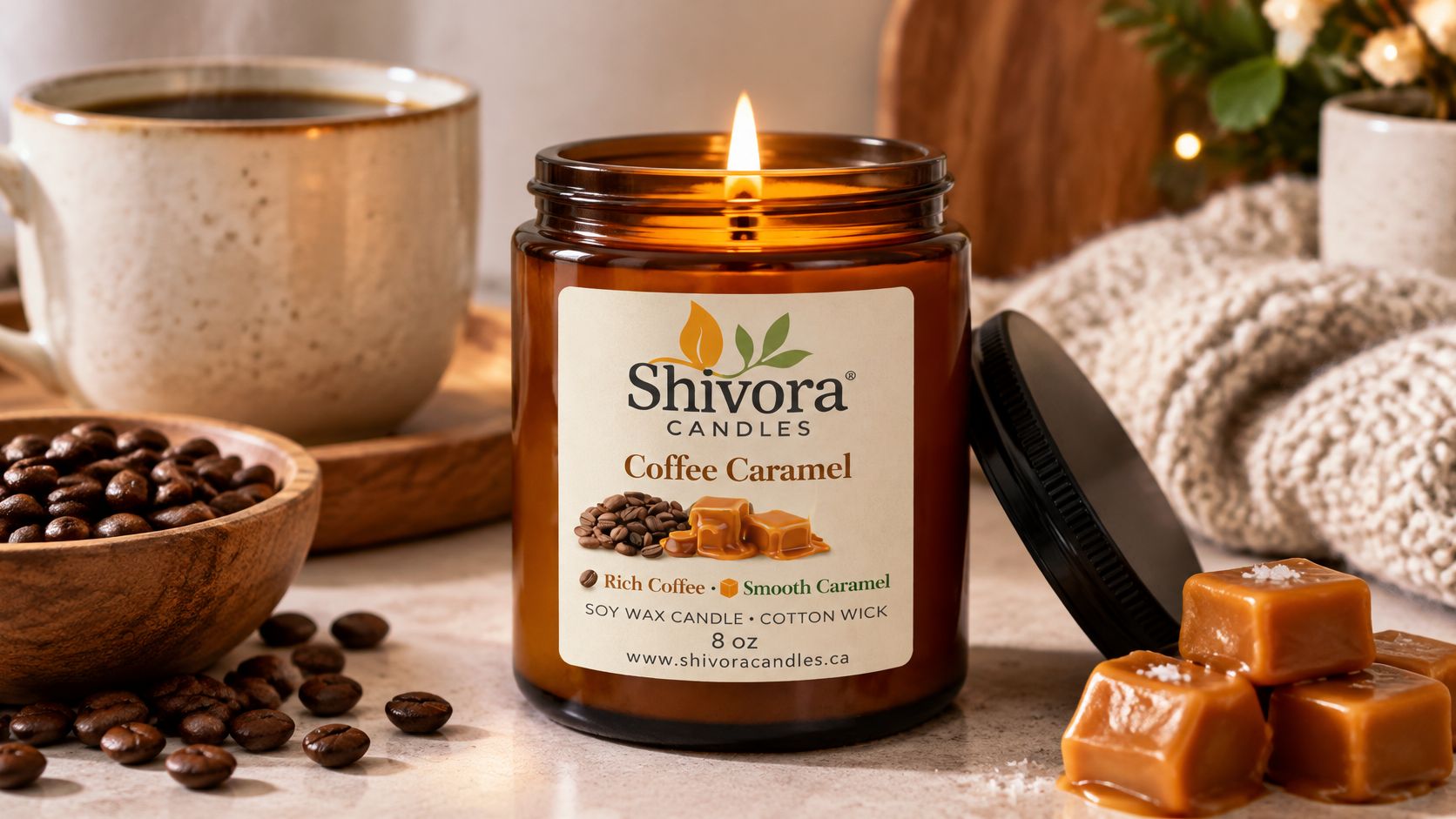
For a kitchen or morning routine, the Coffee Caramel Soy Candle Canada – 8 oz Cotton Wick pairs coffee and caramel notes with a lead-free cotton wick and an approximate burn time of 40 to 45 hours, hand-poured in Ontario, Canada. At that burn length, one jar can carry a single room through most of December, which changes the cost-per-hour math compared with a box of short-burning minis. A buttercream and vanilla style scent, by contrast, suits a bedroom or a dessert lover who wants softness rather than a café note.
Room size changes everything. A candle that fills a studio apartment may feel faint in a large open-concept space with high ceilings and air moving through it. Test a new scent in the room where you'll burn it, and keep notes for next year's order.
Gifting Advent Calendar Candles to Canadian Recipients
A calendar is a lovely gift for the right person and a burden for the wrong one. Give it to someone who enjoys a daily ritual, lights candles regularly, and likes trying new scents. Choose a smaller set or a candle and wax melt pairing for someone with limited space, an occasional habit, or a preference for flameless fragrance.
Before you wrap anything, run through five questions.
Five Questions Before You Buy
- How often do they light candles: Daily, weekly, or only when guests visit?
- How much room do they have: A studio needs smaller candles than a house
- Who shares the home: Children or pets may make a warmer the better fit
- Flame or flameless: Do they own a wax warmer, or prefer an open flame?
- Open or keep: Do they love unwrapping something daily, or one lasting gift?
If you're still unsure, it helps to browse holiday gifts by personality and match the format to the person's habits rather than the season's trends. A thoughtful match beats a bigger box.
What Canadian Shoppers Value
Price and origin both matter here. According to Deloitte Canada's holiday retail outlook, 78% of Canadians planned to seek the best deals, while 73% preferred supporting local or Canadian-owned businesses. A made-in-Canada note gives many recipients a reason to value the gift, so write it on the card.
That same value thinking applies to format. A 24-day calendar spreads its price across many short burns and leaves behind a small jar for every day, so its cost per burn hour runs higher than a single larger candle's. When deals and packaging waste both matter to your recipient, a smaller set of longer-burning candles or a candle and wax melt pairing usually delivers more light per dollar with less to recycle afterward.
Pairings That Fit Different People
Give a dessert-scented 8 oz candle to a bakery lover who'll burn it through January. Give a 4 oz candle as a sampler to a coworker, since it's compact, suited to smaller spaces, and easy to finish. Give a wax melt to someone who prefers a warmer, lives in a building with flame restrictions, or forgets to extinguish candles.
Shivora Candles hand-pours its soy candles and wax melts in Ontario, and ideas for candle gift sets for Christmas giving can help you scale any of these pairings up or down. Whatever you wrap, keep the label and burn instructions with it, and never suggest burning a calendar candle inside its box.
Advent Calendar Candles FAQ
Are Advent Calendar Candles Safe to Burn Every Day
Daily burning asks more of your habits than of the candle. The risk arrives around week three, when the ritual feels automatic and attention drifts. Anchor the burn to a fixed evening moment, keep the candle in one dedicated spot clear of the box and wrapping, and trim the wick to ¼ inch before each light so every session starts the same way.
How Long Should Each Daily Candle Burn
Decide your evening session first, then pick a size to match. A 4 oz candle suits a short burn in a smaller room, while 8 oz and 10 oz candles carry longer sessions over more nights. Shorter sessions also stretch each candle's total burn hours, so a box of minis and one larger candle can deliver very different hours per dollar even at a similar price.
What Is the Difference Between a Calendar Candle and a Wreath
They count different units. A calendar marks the days to December 24, one light or one mini candle at a time; a wreath marks the four Sundays before it, one candle added each week. If your household gathers on weekends, a wreath fits the rhythm. If you want a nightly ritual, the calendar rewards it.
Do Canadian Advent Calendar Candles Need Bilingual Labels
Check before you buy rather than assuming. The warnings and burn instructions are the part of the label that needs to be readable, so look for them in the language your recipient uses. For gifts travelling between provinces, English and French panels keep the directions clear for whoever unwraps them. If you're gifting loose minis without the original box, tuck the warning panel in with the candles.
Pick Your Advent Calendar Candle Set Before December
Decide in order and you won't overbuy. Start with the countdown, then the format, then the burn time. Pick your scents last, once those three are settled. A quick value check helps here: dividing a set's price by its total burn hours tells you more about what you're paying for than the box design does, and one longer-burning candle or a small candle and wax melt pairing leaves far less packaging behind than 24 mini jars.
Your Six-Step Decision
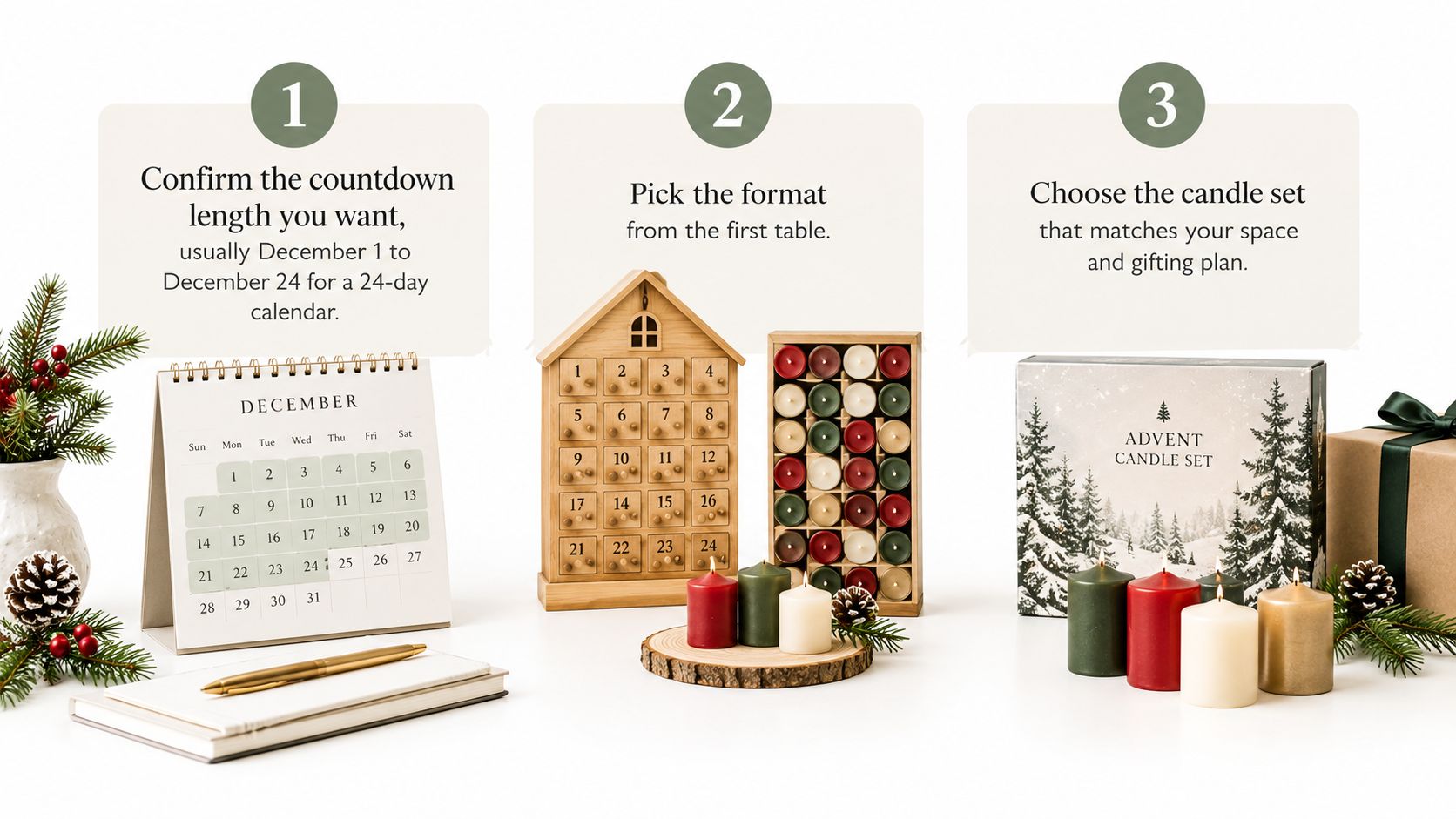
- Confirm the countdown: Choose December 1 to December 24, or a shorter 12-day run if a full month feels long.
- Pick the format: Burn-down candle, mini candles, 12-day set, or a candle and melt mix for days you'd rather skip the flame.
- Set the session: Choose your daily burn length first, then match the candle size to it.
- Plan the scents: Pick four to six families and order them from light to warm so the month builds gradually.
- Check the label: Look for wick type, burn time, and placement guidance before you buy.
- Do a trial burn: Light the first candle before December 1 to check the melt pool and scent strength.
This short video shows the kind of calm, watched burn you're aiming for each evening.
The Candy Cane Soy Candle is a natural fit for holiday décor, stocking stuffers, and gifting on cozy winter nights. The 4 oz size suits sampling a new scent, while the 8 oz and 10 oz sizes suit longer burns, and a warm gourmand candle paired with a wax melt covers the evenings you want fragrance without a flame.
Free shipping on Canadian orders of $79.99 CAD or more. Some conditions apply. Order before December so your trial burn happens in November, not in a rush on the first night.
Build a countdown you'll enjoy finishing with hand-poured soy candles and wax melts made in Ontario, in sizes for sampling, gifting, and longer winter evenings. Choose a few scent families you love, plan your daily burn, and visit Shivora Candles to put your December set together before the first door opens.

