

The most repeated buying tip for a candle jar bulk order is to lock the lowest unit price and match the ounce size on the listing. That advice fails once you pour. A cheap tumbler that chips in transit, rejects a bilingual label, or runs hot on a full burn costs more than the jar you passed over.
I would price the hidden costs beside the quote before I signed a purchase order. Failed burns, label reprints, breakage and freight turn a bargain case into the expensive one. Shivora Candles pours soy candles and wax melts in small batches in Ontario, and the same checks apply whether you fill fifty jars or five hundred.
Table of Contents
- Standard Candle Jar Sizes and Specifications
- Glass, Lid and Finish Options Compared
- Minimum Order Quantities and What Drives Price
- How to Test Candle Jars Before a Bulk Fill
- Bilingual Labels and Compliance Records in Canada
- Shipping Bulk Jars and Filled Candles Safely
- Recycling and Packaging Trade-offs for Canadian Jars
- Frequently Asked Questions About Bulk Candle Jars
- Confirm Your Bulk Jar Checklist Before You Order
Standard Candle Jar Sizes and Specifications
Capacity starts the spec. Internal dimensions finish it, because they determine the space available for wax and the wick.
| Size | Approx. wax weight | Typical use | Confirm with supplier |
|---|---|---|---|
| 4 oz | about 113 g | Sampling, compact spaces, small gifts | Internal diameter, usable height, lid thread |
| 8 oz | about 227 g | Everyday retail staple for bedrooms and kitchens | Wick-centring space, rim finish, lid fit |
| 10 oz | about 283 g | Larger room use and gift sets | Wall thickness, base stability, carton weight |
| 16 oz | about 454 g | Statement candles and multi-wick formats | Base diameter, heavier-glass test burns, carton fit |
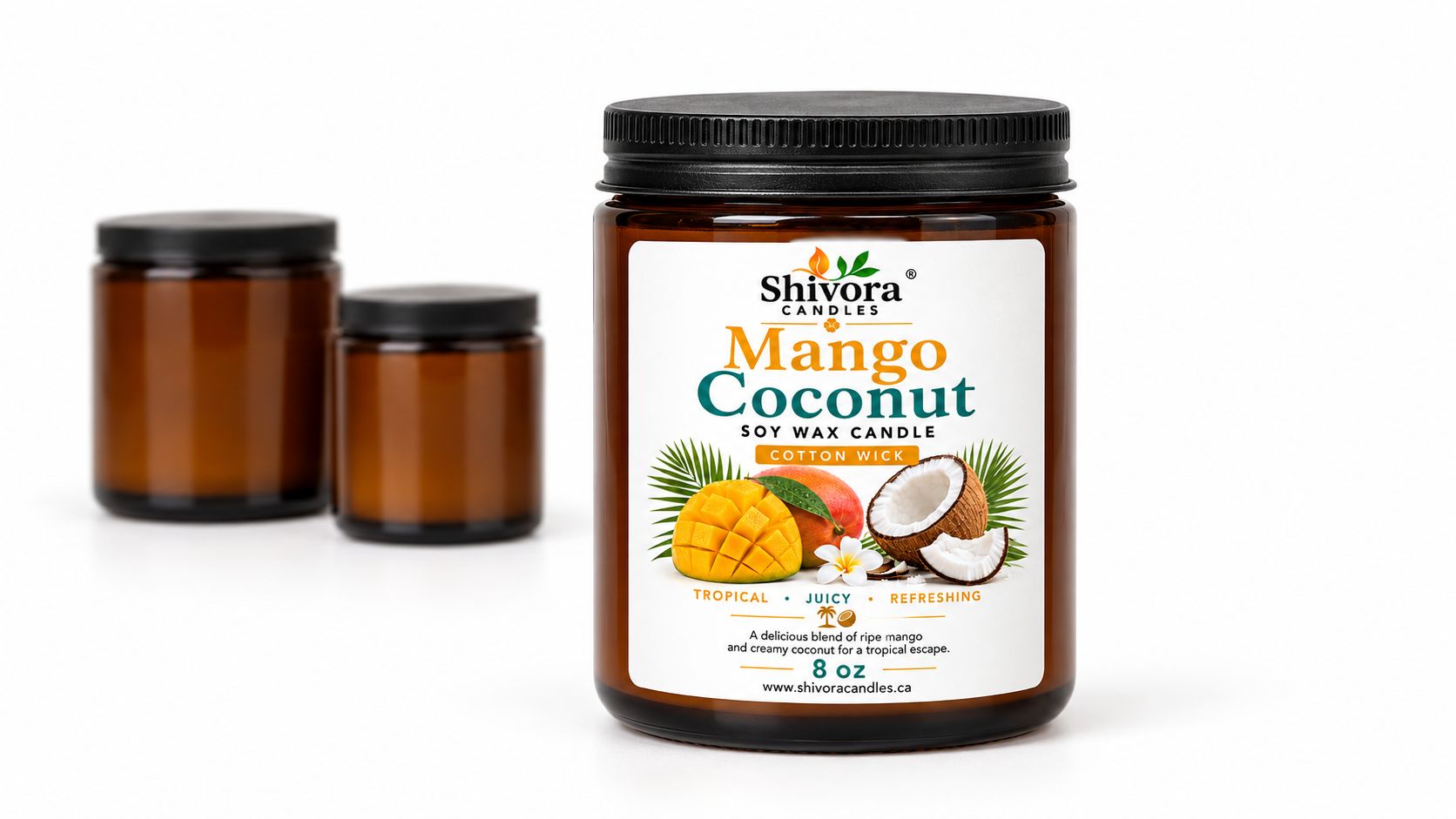
Shivora Candles offers 4 oz, 8 oz and 10 oz candles. The 4 oz size suits sampling, smaller spaces and gifts, while 8 oz and 10 oz formats suit everyday rooms. The Mango & Coconut Soy Candle Canada – 8 oz Cotton Wick is an 8 oz soy candle with a lead-free cotton wick, hand-poured in Ontario. For any jar order, ask the supplier to specify nominal fill weight, wick type, headspace and whether the ounce figure refers to brim capacity or usable fill. That detail makes the quoted size useful for production planning.
What to measure besides ounces
Internal diameter sets wick-centring space and melt-pool width. A wider jar gives the flame more distance to cover before the melt pool reaches the glass. Any change in diameter calls for a fresh burn test with the intended wax and fragrance.
Usable height is the inside depth minus the headspace left beneath the lid. A listing's overall height may include the lid, so it can overstate the room available for wax.
Wall thickness, base diameter and rim finish affect stability, heat at the base and lid fit. Specify the lid thread or lug size in millimetres rather than relying on “standard.” These dimensions also help identify jars that vary enough to cause wick placement, fit or packing problems across a case.
A one-line spec for 500 units
Write the purchase specification in a form the warehouse can check: 1. capacity, 2. agreed internal diameter tolerance in millimetres, 3. rim finish, 4. lid type, 5. glass colour, 6. units per carton.
Copy this line into the purchase order and fill it from the written quote:
Capacity: ____ oz / ____ ml usable. Internal diameter: ____ mm ± ____ mm. Usable height: ____ mm. Wall thickness: ____ mm. Base diameter: ____ mm. Rim finish: ____. Lid type and thread: ____. Glass colour: ____. Units per carton: ____. MOQ: ____. Lead time: ____. Tolerance on empty weight: ____ g.
Measure a sample pack before committing to a bulk fill. When the case arrives, check ten jars from different cartons and record the lowest and highest readings, not just the average. This catches dimensional variation that a single sample can miss.
Glass, Lid and Finish Options Compared
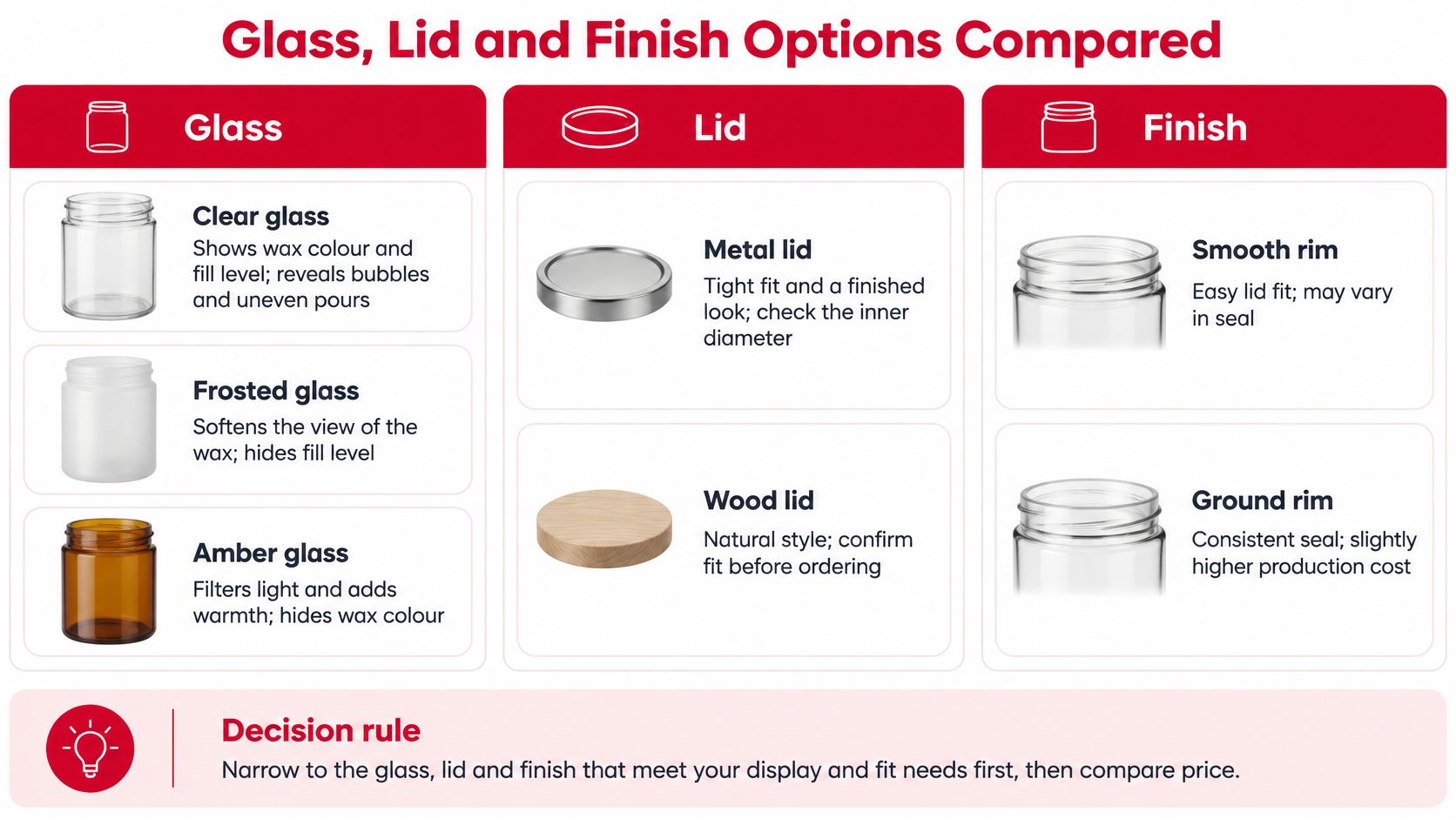
Match the look to the shelf first, then to the truck. A finish that photographs well can still fail a humid stockroom or a long haul out of Ontario.
| Option | Strengths | Trade-offs | Best fit |
|---|---|---|---|
| Clear glass | Shows wax colour and fill level | Shows residue, scratches and wax marks more readily | Clean-look candles and layered colour designs |
| Amber glass | Hides minor marks and gives a warm look | Less visibility of wax level and interior residue | Woody, spiced and amber-style scents |
| Coloured or frosted glass | Distinct shelf identity for private-label lines | Harder to inspect for chips and wax level; test label adhesion | Seasonal and branded collections |
| Lightweight tumbler | Lower freight weight | Thinner walls need extra thermal and breakage checks | High-volume, lower-cost lines |
| Heavy-wall jar | Sturdier on rough freight routes | Higher freight and unit cost | Premium gifting and long-distance shipping |
| Metal lid | Durable and classic in appearance | Fit tolerance and corrosion to verify | Traditional and premium looks |
| Wood or bamboo lid | Natural appearance | Warping risk in humid conditions; fit varies by batch | Natural and rustic brand styles |
| Plastic lid | Light and low cost | Fit variation and colour matching to verify | Budget lines and travel sizes |
How I would choose
Clear glass suits a soy pour where colour is part of the product. You will also see every bubble and wax ring, so your pour has to be tidy.
Amber suits warm woody scents and hides small marks. You lose an easy visual check of fill level, so weigh fills rather than judging them by eye.
Frosted or coloured glass gives a private-label line a shelf identity. Chips hide in the colour, and adhesives behave differently on a coated surface. Run a label peel test before you print a season's worth of artwork.
Weight is a freight decision. Lightweight tumblers cut the carton weight and need tighter thermal checks. Heavy-wall jars survive rough routes and raise both the unit price and the freight bill. For lids, metal reads traditional, wood or bamboo reads natural and can warp in humidity, and plastic stays light for budget and travel sizes. In every case, test the lid on the actual rim, not on a photo. A comparison of candle lids and dust covers is a useful companion when you are choosing between a sealing lid and a simple topper.
Practical rule: Match the finish to the retail or gift use, then test that same jar on the freight route before you commit to volume. Ask for documentation if a supplier claims recycled content. Do not treat the claim as given.
Minimum Order Quantities and What Drives Price
A stock jar and a custom mould are different purchases. The stock jar usually has a lower floor. A new mould can add tooling and weeks of lead time. Minimums are set per SKU and per finish, so an amber 8 oz with a wood lid is not the same order as a clear 8 oz with a metal lid.
| Cost factor | How it moves unit cost | Ask before ordering |
|---|---|---|
| Order volume and case pack | Full cases and higher volumes lower the per-unit price | Which quantities trigger each price break? |
| Minimum order quantity | Sets the floor for a first order; set per SKU and finish | What is the MOQ per size and per finish, in writing? |
| Glass weight and wall thickness | Heavier glass costs more to make and to freight | What is the weight per jar and the wall spec? |
| Custom size or new mould | One-time tooling charges may apply and lengthen lead time | What is the tooling fee and lead time? |
| Decoration (print, emboss, labels) | Each finish adds set-up and per-unit cost | What is the minimum print run? |
| Lid material and fit | Metal, wood and plastic lids price differently and vary in fit | Which lid supplier is used and what is the fit tolerance? |
| Freight and breakage allowance | Carton protection and pallet pattern change landed cost | What is the packing spec and breakage replacement policy? |
| Recycled content or documentation | Price varies and may require paperwork | Is documentation available for the claimed content? |
Compare quotes on the same jar
Line up quotes only when capacity, glass weight, lid, decoration, carton count and delivery terms match. A lower number on a thinner wall is not a saving. If you are building a retailer program, our notes on wholesale candles in Canada sit beside this costing work. For the arithmetic itself, the top tools for calculating MOQs from Supply Automate help you test price breaks before you commit to a case quantity.
A landed-cost line you can fill in
Use placeholders until a supplier sends a current written quote. Published web prices go stale.
Landed cost per jar = unit price (X) + decoration + lid + freight allocated per unit (start from Y per carton, divided by jars in the carton) + a breakage allowance + the time you spend on test burns.
Say a quote shows X per jar and Y to your postal code for one carton. Divide Y by the carton count, add a breakage share you agree in writing, and add decoration and the lid if they were quoted separately. A jar from Ontario or a nearby plant shortens the haul, which often helps freight and breakage, but still get the rate to your own postal code.
The cheapest quote costs the most when the glass is heavier or thinner than the spec, the cartons crush, or the test burns fail and you scrap a lot. I would reject a quote that will not state weight per jar and a breakage replacement policy.
How to Test Candle Jars Before a Bulk Fill
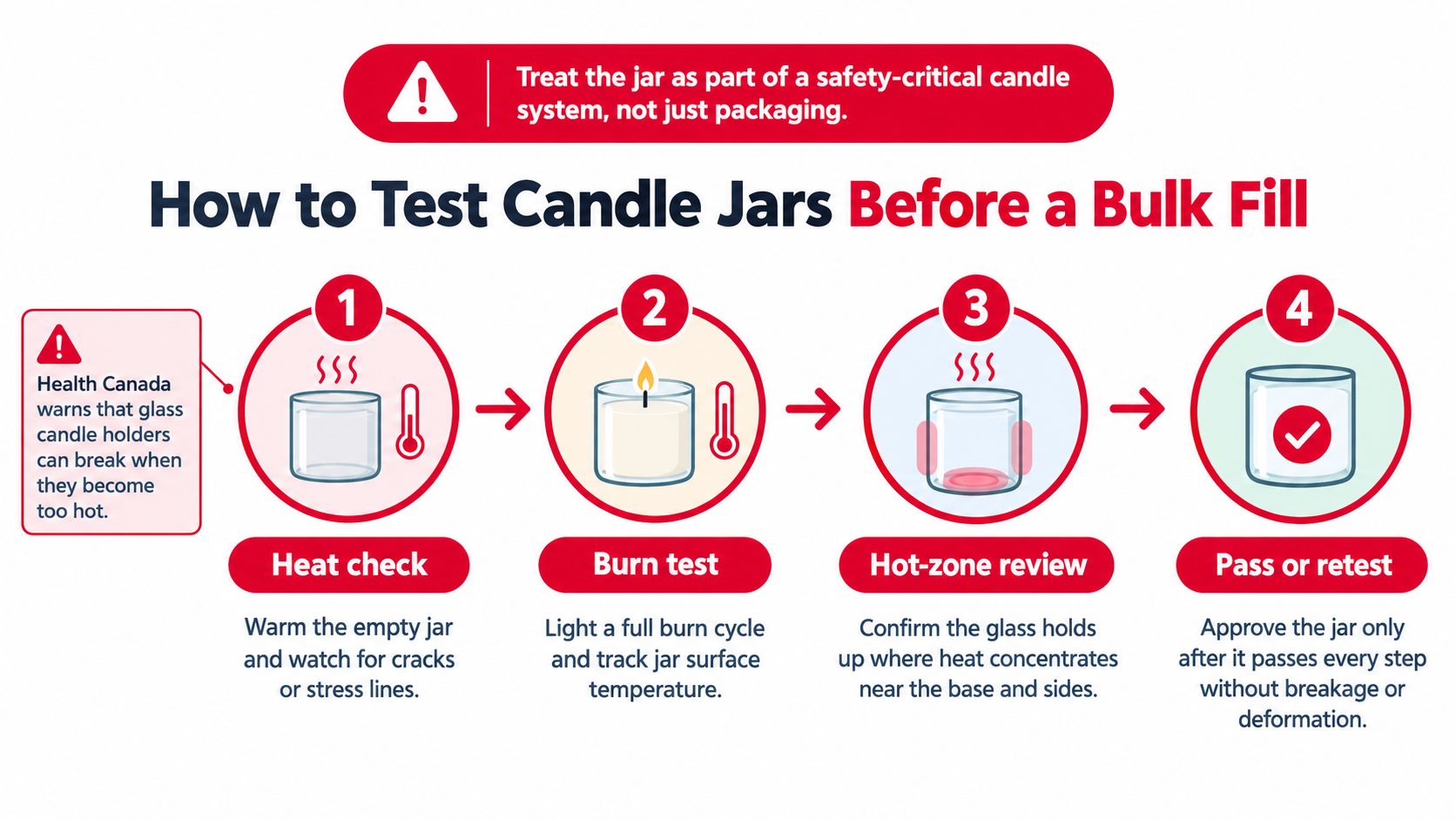
Treat the jar as part of the candle, not as a box the wax happens to sit in. ASTM F2417, as described by SGS, sets minimum fire-safety requirements for candles and candle ensembles, including containers, coatings and embeds, to reduce fire, injury and death risk in normal use. Health Canada warns that glass candle holders can break when they become too hot, and it states that Canada-wide candle-fire statistics are unavailable. A marketing line that calls a jar "candle safe" is not a pass.
The incoming check
- Ask for intended-use papers. Request glass composition and any thermal suitability data. Do not approve a lot because the catalogue says it is for candles.
- Inspect the lot. Check chips, cracks, bubbles, sharp edges and dimensional spread against a written sampling plan. Flat, stable bases and compatible lids belong on that sheet.
- Pilot-burn the actual recipe. Each new jar, wax, wick and fragrance combination gets the full burn schedule. A change in geometry changes heat distribution, melt-pool diameter, flame behaviour and residual-wax temperature.
- Retest after the truck. Impact and thermal shock can leave damage you will not see on the bench. Quarantine damaged cartons. Keep a sample from every supplier lot.
A short walk-through of a controlled burn helps a new buyer see what "full schedule" means in practice.
For day-to-day burning once a candle is in a home, follow the guidance on our Candle Care & Safety page: trim the wick, limit each burn and keep the candle attended. Testing at the bench is a separate job from that customer advice.
| Burn test record field | Why it matters |
|---|---|
| Jar dimensions | Confirms internal diameter and height match the spec and affects melt-pool size |
| Nominal fill weight | Links the wax quantity to burn time and heat output |
| Wick type | Sets flame behaviour and wick-centring requirements |
| Fragrance load | Affects burn stability and residue |
| Burn-session duration | Shows how the jar performs over a full schedule |
| Maximum observed jar temperature | Flags thermal stress on the glass |
| Soot and residue | Shows how cleanly the candle and jar wall perform |
| Cracking or deformation | Identifies glass failure before shipping |
| End-of-life behaviour | Shows how the candle performs when nearly burned out |
No statistic proves a jar is safe. Approve a lot only when the records above are complete for that wax, wick and fragrance.
Bilingual Labels and Compliance Records in Canada
Label space changes which jar you can buy. Amazon Canada's seller guidance identifies the Candles Regulations, SOR/2016-165, ASTM F2417 fire-safety requirements and ASTM F2058 candle-fire-safety labelling as relevant for candles sold in Canada, and it calls for English and French safety warnings and instructions. That page is a marketplace summary. Confirm the wording against the Candles Regulations and the ASTM standards themselves, and with a qualified compliance professional, before you scale. This is not legal advice, and the rules move.
Warnings the label has to carry
Plan bilingual lines for these themes:
- Attendance: Never leave a burning candle unattended.
- Clearance: Keep it away from combustible materials.
- Household: Keep it away from children and pets.
- Use: Follow wick-trimming and burn-limit instructions.
Health Canada's consumer guidance, as noted in that same seller page, directs people to follow the instructions printed on the label. If the jar's flat area is too small, the French lines get cramped or they cover the glass you need to inspect for cracks.
Adhesion and the file you keep
Choose a smooth panel that holds durable bilingual copy without sitting on a heat-sensitive zone. Before a large print run, confirm the adhesive stays bonded through oil, fragrance handling, condensation and normal candle heating. A label that lifts after the first burn forces a rework on every jar in the lot.
Keep artwork under version control. File supplier declarations. Tie each finished-candle lot to its jar lot, wick, wax, fragrance and the burn-test record. When a complaint arrives, that chain is what tells you whether the vessel, the wick or the fill changed.
Shipping Bulk Jars and Filled Candles Safely
Shipping risk depends on what is in the carton, how the glass is protected, and how the shipment is classified. Plan those details before booking a carrier. A low jar price can be erased by breakage, replacement freight, or rework.
Transport Canada says a shipping document is generally required for dangerous goods unless an exemption or special provision applies. The consignor prepares it before handoff, and the consignor, carrier, and Canadian importer keep copies for at least two years. The document includes required information and a consignor's certification that the goods are properly classified, packaged, marked, and suitable for transport.
A trained, competent person should classify the contents, select packaging, and prepare any required marks and documents. Keep the jar specifications separate from the contents assessment on the purchase order. Record capacity, diameter, lid fit, colour, and carton quantity for the jars, then document the regulatory assessment for what is being shipped. A standard parcel label does not settle that assessment.
Questions to send the supplier
- Carton grade and dividers. What board weight is used, and do cells prevent jars from touching?
- Void fill. How is movement controlled when a case is not full?
- Pallet pattern and stack height. What is the maximum stack, and is it marked on the carton?
- Lot identity. Does each carton show a lot number that can be matched to your traceability records?
- Breakage terms. Who replaces cracked jars, and what is the claim window?
For filled candles, confirm that the packing keeps glass from knocking together in transit. Heavier cartons may protect the jars, but they also add shipping weight, so balance protection against freight cost. Check samples after delivery and repeat burn checks if transit damage or handling may have affected the vessel.
For shoppers ordering finished candles, Shivora Candles offers flat-rate shipping, with free shipping on orders of $79.99 CAD or more. Some conditions apply.
Recycling and Packaging Trade-offs for Canadian Jars
A glass jar accepted in one province may be rejected or sent to landfill in another. For a candle buyer ordering by the case, the lowest unit cost can become the highest total cost once freight, breakage, protective packaging and end-of-life handling are included.
Canada has no single national packaging extended producer responsibility regime. A UL Solutions white paper on EPR says requirements are set provincially and that nine of 13 provinces and territories had packaging-and-printed-paper EPR rules as of January 2025. Ontario's Blue Box transition makes producers financially and operationally responsible for covered packaging, with full implementation scheduled for January 1, 2026. The same UL Solutions white paper on EPR reports Ontario's 2025 glass supply at 64,801 tonnes and collected glass at 62,374 tonnes. Supply and collection are separate measures, and neither shows that every jar is recycled.
Compare formats by their full handling costs. Lightweight jars can reduce freight, while a heavier wall may affect breakage risk. Case protection adds packaging and shipping weight; a refill option helps only if customers reuse the jar in practice. Label stock and coatings also matter because local programs may have specific preparation rules.
What "recyclable" does not promise
At a recycling plant, glass is crushed into cullet, a sand-like material. Encorp Atlantic reports that more than 78% of beverage containers in Canada are diverted through provincial programs. That figure covers beverage containers, not candle jars, so it should not be presented as a candle-jar recycling rate.
In British Columbia, the Capital Regional District says glass bottles and jars go in designated glass bins or depots, loose rather than in plastic bags. Labels may stay on; lids come off and go to mixed recycling. Coloured glass and non-food-shaped containers need a check with the local program. In Ontario, confirm how the local Blue Box program handles the specific jar and its packaging. In other provinces, including Quebec, check the applicable provincial or municipal guidance before printing disposal instructions. The guide to candle recycling explains options for an empty vessel.
Before printing disposal copy:
- Request the glass specification, including colour and any coating.
- Choose removable label stock if local guidance calls for labels to come off.
- Match instructions to the destination: check the local rules for each province where jars are sold, then use wording that fits those accepted formats.
Frequently Asked Questions About Bulk Candle Jars
What MOQ should I expect for a 500-jar order?
A 500-jar order may fit a supplier's stock-size minimum, but the answer depends on the jar, finish and lid. Ask whether the quoted quantity applies to the full order or separately to each combination.
How do I estimate the cost of a label reprint?
There is no single reprint cost: it depends on the label order and how much approved stock must be replaced. Before approving artwork, ask the printer for the cost of reprinting the label quantity you would need after a bilingual text or layout change.
Can I use one jar specification for every candle?
Only if the vessel and lid suit each candle's fill and presentation. A jar that fits one product may not work for another, so keep product-specific specifications with each purchase order.
What should I do if a delivered case has broken jars?
Photograph the damage and retain the case and packing materials, then contact the supplier or carrier using the claim process agreed for the order. Confirm responsibility for replacement before placing the purchase order.
How should I compare two bulk quotes?
Compare the same jar, lid, finish and quantity, then include expected costs for breakage, label rework and freight. A lower unit price is not necessarily the lower-cost order.
Confirm Your Bulk Jar Checklist Before You Order
A low unit price can become costly when jars break, burns fail, labels need reprinting or freight damages the order. Before issuing a purchase order, check the points that determine whether the jars work in production and remain practical after use.
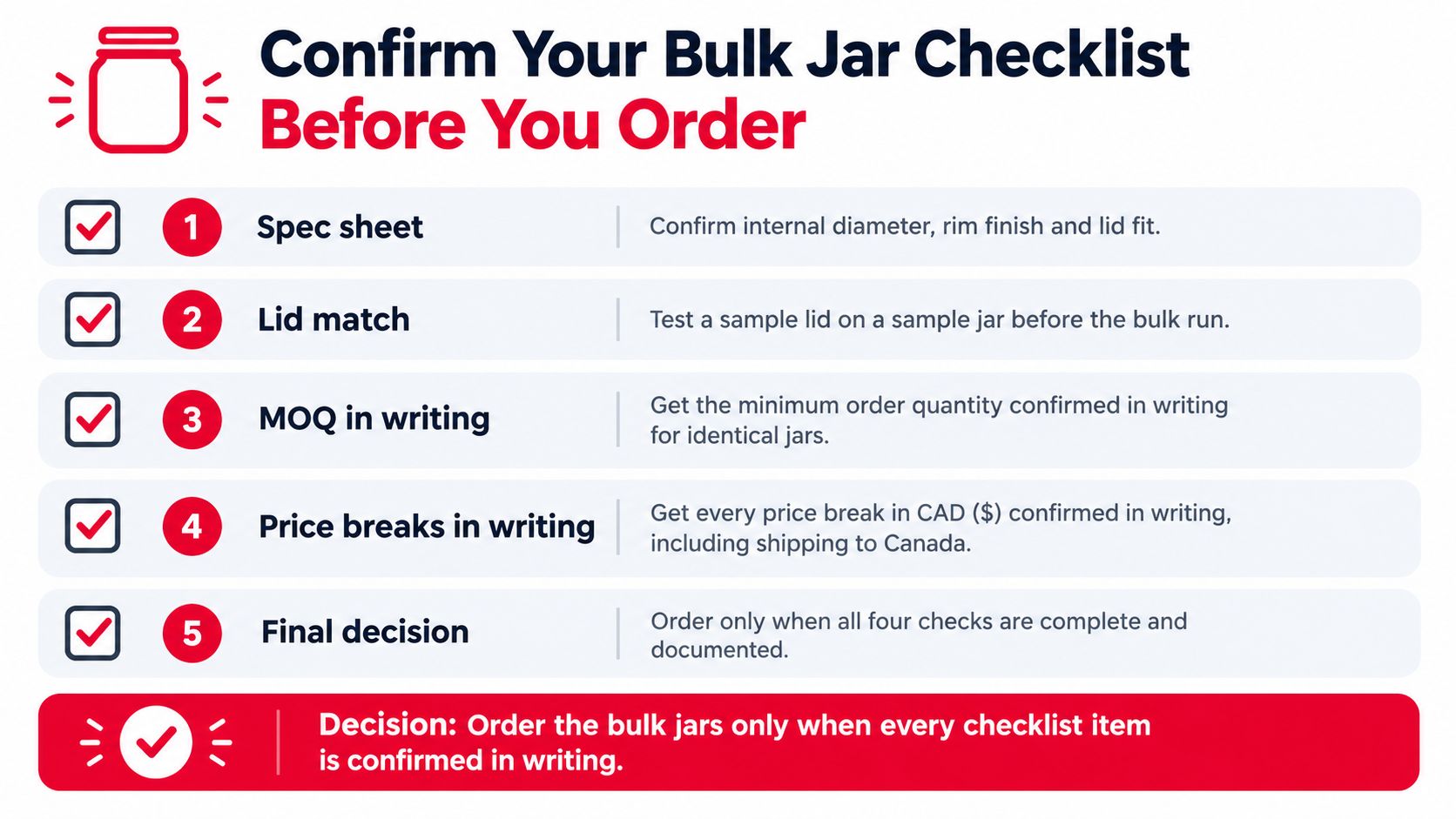
- Production fit: Confirm that the selected jar works with your filling process and planned candle format, not just the product photo.
- Comparable pricing: Request quotes for the same jar, lid, finish and delivery terms. Compare the landed cost, including likely breakage and any label changes, rather than unit price alone.
- Approval samples: Keep an approved sample and written specifications as the reference for incoming orders. This helps identify a finish or fit change before it affects a full run.
- Label and presentation: Check the label on the actual jar. Allow room for required bilingual information while keeping the design legible on the chosen surface.
- After-use plan: Check recycling guidance in the provinces where you sell. Jar colour, local program rules and separation of lids can affect what customers can recycle.
- Order terms: Record who handles transit damage and what remedy applies. Confirm the free-shipping threshold and applicable conditions before budgeting freight.
For Canadian-made soy candles and wax melts, Shivora Candles offers a Wholesale & Private Label section for retailers and partners. Its candles are hand-poured in small batches with 100% natural soy wax and premium fragrance oils. The jar, label and delivery terms still need to suit the buyer's production and sales requirements.
Before committing to a case, weigh the purchase price against breakage, burn performance, relabelling and freight. A jar that fits the product and holds up through handling is often the more economical choice.


