

Are phthalate free fragrance oils safe enough to burn at home? The label removes one named concern: no phthalates were intentionally added to the oil. It does not settle the larger safety question, because an ingredient declaration is not a test of the finished candle, the air it produces, or the people breathing it.
Read the claim as three checks. First, what was added to the fragrance oil. Second, what heat or a flame can turn that mixture into once the candle or wax melt is used. Third, who is in the room and how sensitive they are. Each check has a different proof: the supplier's ingredient statement, the way the product is burned and ventilated, and the household's tolerance.
Table of Contents
- What Phthalate-Free Means and What It Leaves Open
- Why Burning and Heating Change the Safety Picture
- Reading a Phthalate-Free Claim Before You Buy
- Who Should Take Extra Care at Home
- How to Burn Phthalate-Free Candles With Less Exposure
- Frequently Asked Questions About Phthalate-Free Fragrance Oils
- Confirm the Label Before You Light Your Next Candle
What Phthalate-Free Means and What It Leaves Open
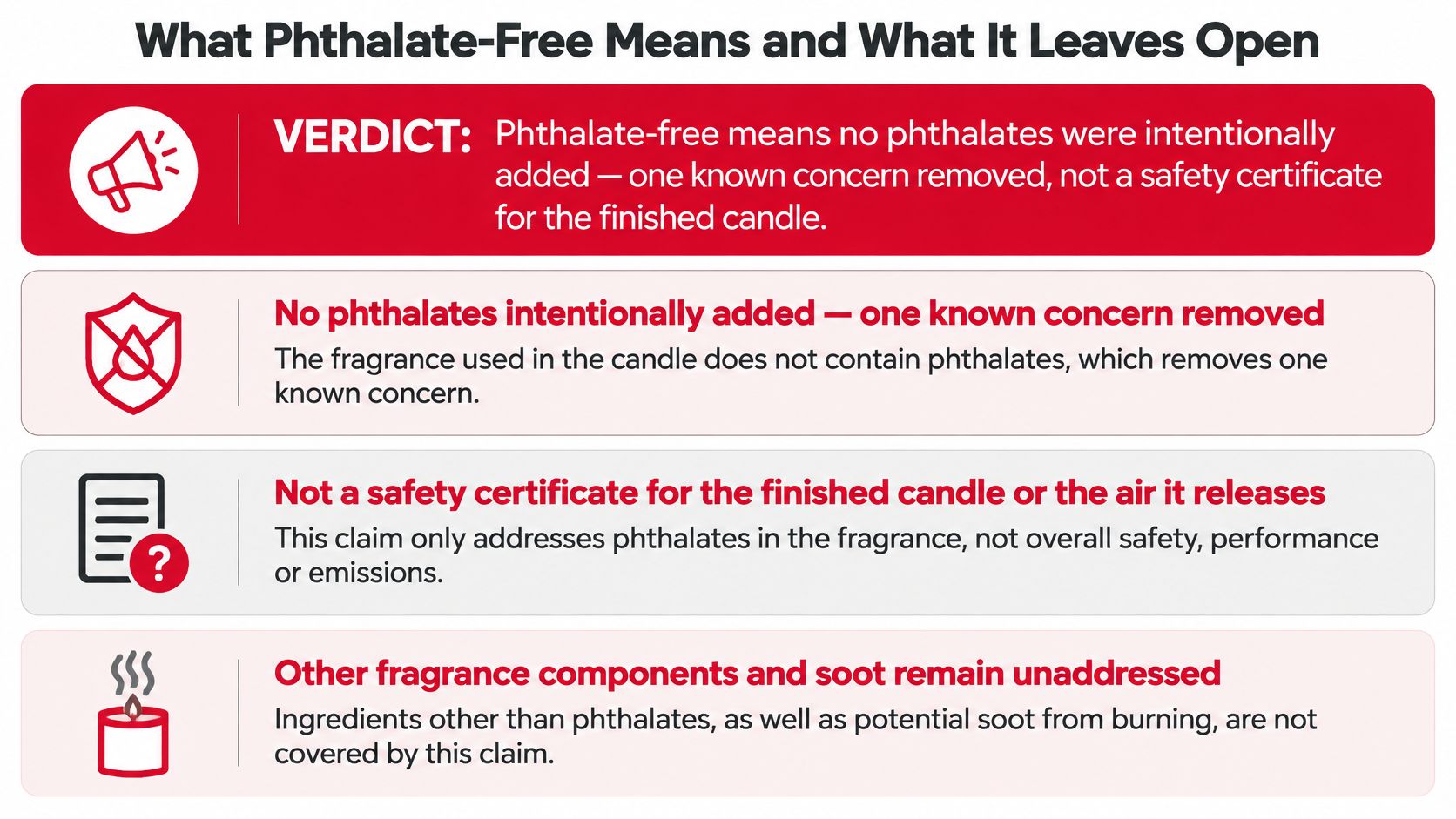
A phthalate-free declaration covers one document: the fragrance oil's ingredient list. The finished candle on your shelf is a wider question, and the label was never designed to answer it.
Health Canada's phthalates and chemical safety page treats the term as a claim about intentionally added ingredients. A supplier can state that no listed phthalates went into the oil, and that statement still says nothing about the wax, the wick, or what the mixture becomes at burning temperature.
For a candle or a wax melt, the practical question takes in the fragrance mixture's individual volatile ingredients, the concentration the maker used, impurities in the oil, what combustion produces, and the route by which you're exposed: lungs first, skin second, and occasionally the eyes if you lean over a warmer.
Each of those sits outside the phthalate panel. Concentration matters because an ingredient tolerated at a low dose can irritate at a heavier load. Impurities matter because the declaration covers what was added on purpose, while trace carryover from raw materials belongs to a different document further up the supply chain.
The label answers a question about an ingredient list. The air in the room is a separate question.
The coverage gap is easier to see charted than described.
| Question | Does the label answer it? | Why it matters |
|---|---|---|
| Were listed phthalates intentionally added? | Yes, if the supplier declares it | It removes one intentionally added plasticizer concern |
| Was the finished candle or melt tested? | Not always stated | A declaration on the oil alone doesn't cover the finished product |
| Could fragrance allergens cause irritation? | No | Allergens are a separate disclosure question |
| What is released when burned or heated? | No | Combustion and heat change the exposure picture |
| Is the product suitable for pets or infants? | No | Only the maker's intended-use statement answers this |
A phthalate-free declaration is still worth having. It tells you the maker chose to leave a known family of plasticizers out of the oil, which is real information. Paired with the maker's ventilation and use guidance, it gives you a fuller answer than either document provides alone.
Why Burning and Heating Change the Safety Picture
A fragrance oil that leaves the bottle as a clean formulation can still put something else into the air once it meets a wick or a warmer.
Health Canada's guidance on fragrance ingredient safety points to a chamber and indoor-environment study that detected diethyl phthalate (DEP) in emissions from all eight candle and incense varieties tested, with DEP representing about 2.4% of identified molecular features in candle aerosols. Read that result for exactly what it is. It doesn't show that every phthalate-free candle emits DEP, and it doesn't establish harm to anyone sitting in a living room.
The figure is also easy to overread. "Identified molecular features" is the share of compounds the instruments could name, so 2.4% describes a measured subset of the aerosol, detected consistently across eight varieties rather than in a single outlier. What the study separates cleanly is formulation from output: a maker controls the compounds that go into the wax, while the aerosol that comes off it is a separate measurement, because heat changes the chemistry of the wax, the wick and the oil together.
The kettle comparison: clean water still fills a room as steam. The ingredient list describes the water, and the steam is a separate question you answer with ventilation.
Wax melts, soot and the parts you can see
A flameless warmer removes the open flame. It doesn't remove the airborne fragrance, because the wax still melts and still releases volatiles into the same room air. With no flame there is no combustion, so a warmer avoids that category of emissions while the scent compounds still reach the room. Anyone who switched to melts for air-quality reasons should keep the ventilation habits they'd use with a wick.
Soot is the visible half of incomplete burning. A wick that's too long, a wick that's too thin for the wax pool, or a candle burned in a draught will produce a taller, smokier flame and more residue on the jar and in the air. That residue is generated by the burn conditions, and it is the one piece of emission evidence a shopper can read without instruments: a clean jar and a steady flame say more about the air in the room than any phthalate-free claim on the box.
The population trend that keeps this in perspective
Canadian biomonitoring shows widespread but falling exposure. In the Canadian Health Measures Survey, Health Canada and Statistics Canada detected some phthalate metabolites in the urine of more than 95% of participants and recorded DEHP's geometric mean among Canadians aged 6 to 49 falling from 42 µg/L in 2007–2009 to 9.5 µg/L in 2018–2019, a statistically significant reduction of 77% (P < 0.001) (Health Canada's DEHP assessment).
Detections that widespread show how many everyday sources contribute.
The DEP metabolite followed the same path, from a geometric mean of 56 µg/L in 2007–2009 (95% confidence interval 47–66 µg/L) to 17 µg/L in 2018–2019, an average decline of 70% (Health Canada's diethyl phthalate biomonitoring summary).
| Survey period | DEHP geometric mean (µg/L) | MEP (DEP metabolite) geometric mean (µg/L) |
|---|---|---|
| 2007–2009 | 42 | 56 |
| 2009–2011 | 24 | 45 |
| 2016–2017 | 11 | 20 |
| 2018–2019 | 9.5 | 17 |
These are trends measured in people rather than tests of any single candle, and Health Canada is explicit that the data describe metabolite levels in a population instead of proving that a particular product caused exposure. Read them as context: the label is one input, and the room is the other.
Reading a Phthalate-Free Claim Before You Buy
Ask for the certificate of analysis first. That single request tells you more about a phthalate-free claim than the label itself, because a maker who can produce a dated test result has evidence, and one who cannot is asking you to take the phrase on trust.
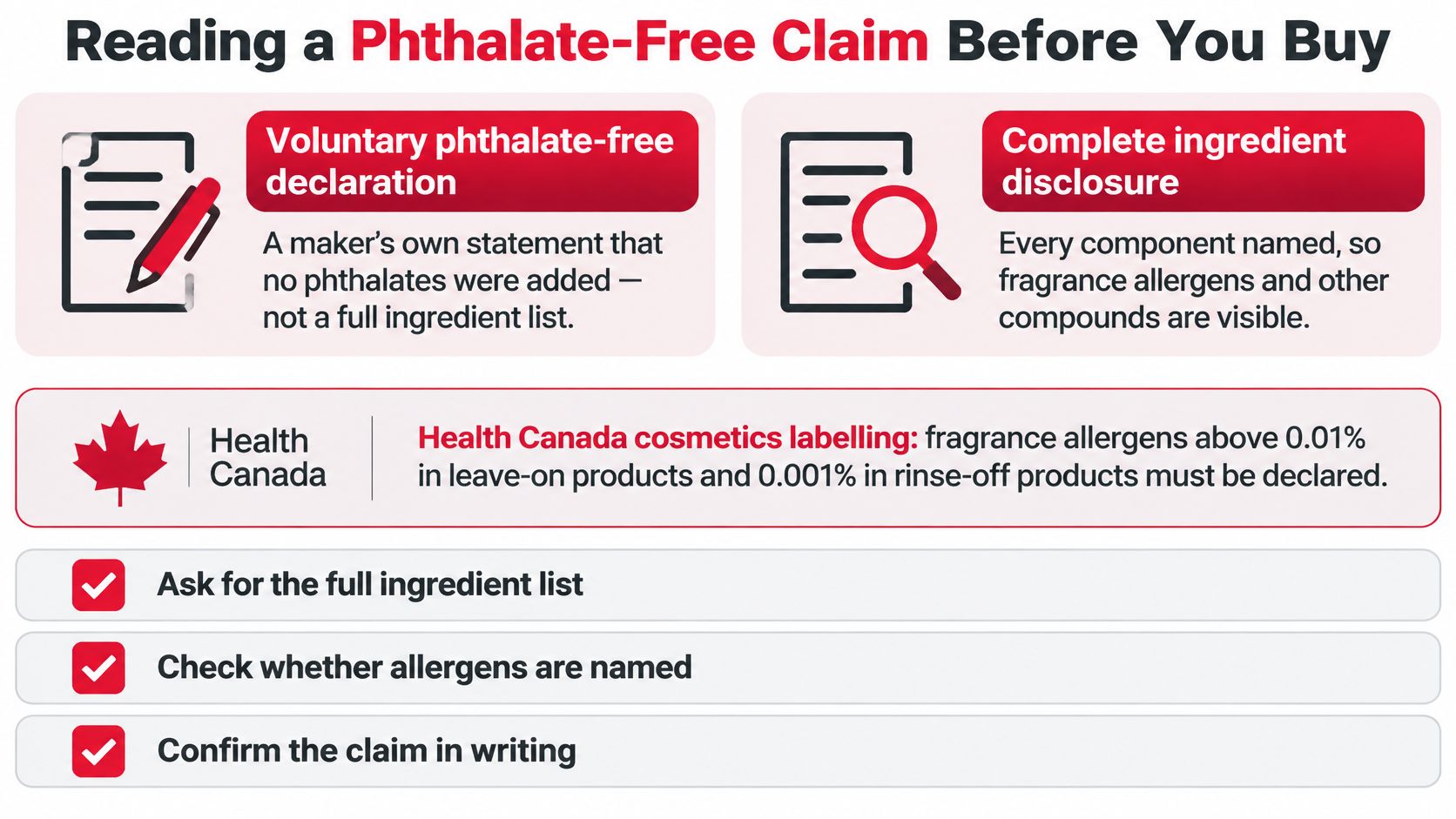
Health Canada's cosmetics labelling guidance requires fragrance allergens to be disclosed when they're present above defined thresholds: more than 0.01% in rinse-off products and more than 0.001% in leave-on products. Those thresholds govern cosmetics, and they shouldn't be assumed to apply to candles, wax melts or other home fragrance, so treat them as a benchmark for how specific a disclosure could be rather than a rule a candle maker must follow.
That gap is why paperwork matters more in home fragrance than in skincare. A label can say phthalate-free in good faith and still tell you nothing about limonene content, which is why the document behind the claim carries the weight.
Shoppers are already asking. A 2025 survey of 200 women in Toronto, published in Toxics, examined knowledge and perceived health risks around endocrine-disrupting chemicals including phthalates, which confirms the interest is mainstream and the answers are uneven.
A six-step document check
- Start with the certificate of analysis or a written declaration. It should name the phthalate panel tested and the analytical detection limits, not just repeat the phrase phthalate-free.
- Ask for the safety data sheet for the fragrance. An SDS covers hazards, handling and storage; it isn't the same as a use-limit document, and you want both.
- Ask which allergens are present and at what level. Limonene, linalool and citral are common in lavender, citrus and floral blends, so expect named compounds with concentrations attached.
- Ask whether the finished candle or melt was tested, and under what conditions. A statement about the oil describes an input, not the product on your shelf.
- Confirm the intended-use instructions and ventilation guidance. If nobody can state a burn-time limit or a recommended room, that's information too.
- Ask about fragrance load and wick specification. These two numbers shape how the candle behaves far more than the word phthalate-free does.
At Shivora Candles, our fragrance oils are phthalate-free, and every candle and wax melt is hand-poured in Ontario, Canada, so those questions can be answered before you order rather than after. Take something like the Fresh Lavender Soy Candle Canada – 8 oz Cotton Wick: a soy wax candle with a lead-free cotton wick and a lavender-forward floral scent, where the wick type, the wax and the fragrance declaration are all things a shopper can ask about. For the wider ingredient picture beyond fragrance, the guide to clean burning candle ingredients that matter covers wax choice, wick choice and fragrance load together.
If you'd rather see the reasoning walked through than read it, this short video covers the same distinction between an ingredient claim and a safety claim.
What a good answer sounds like
How a maker responds is itself evidence: a vague assurance that everything is safe is the weakest possible answer, even when it's offered warmly.
Who Should Take Extra Care at Home
A ventilated room covers a lot of households, but sensitivity changes the math. The label can answer whether phthalates were added. Warm wax, soot, fragrance load and the people breathing the room are separate questions, so the cautious default should follow the household rather than the marketing line.
Health Canada notes that the general population encounters phthalates through indoor air, dust, food and consumer products, and it identifies fragrance and other self-care products among the potential sources (Health Canada's human biomonitoring report). A recent Ontario in-home study looked for phthalate residues in hand wipes and on indoor residential surfaces, which points to dust and skin contact as exposure routes a candle claim does not measure. For a household, that means the candle is only one input: cleaning residue, dust on floors and hands, and time spent in the room can matter alongside what is in the jar.
The groups who need more care
Infants and young children, people with asthma or another respiratory condition, anyone who has reacted to a fragrance before, and anyone sharing a small room with a lit candle or a warmer all sit in the more cautious group. The precautions here are this guide's practical recommendation rather than a Health Canada directive: keep candles and warmers out of a room where an infant is sleeping, skip them when someone with asthma is present, and keep sessions short in a normally ventilated space.
When to stop: headache, irritation, wheezing or coughing that appears while a candle or melt is in use is the signal to put it out, open a window and leave the room to clear.
Pets, infants and the limits of a label
A phthalate-free claim says nothing about an animal's response to airborne fragrance, and species differ from us in ways a label cannot capture. We do not claim that Shivora scented candles are completely pet-safe or non-toxic to pets, and no fragrance label can make that decision for your household. If you have a bird, a cat with respiratory issues or a dog that shares a small apartment, ask a veterinarian about the scent before you make it a habit.
Households with more moving parts need more coordination. Where a parent is aging in place with housekeeping support for aging in place, the cleaning products and the candle share the same air, so agree on a simple rule such as nothing lit during or immediately after a visit. Readers managing scent around reactive family members will find more in the guide to candles for sensitive noses.
Testing a new scent in your own home
Try one scent at a time, in one room, and give it three or four sessions before you decide. Keep a short log with the date, the scent, the room, the burn length, who was present and how the air felt an hour later. Patterns show up fast, and a scent that seemed fine in a shop often reads differently in a closed bedroom.
If the log shows headaches or irritation clustering around one fragrance, retire that scent. If symptoms cluster around one room, change where the candle is used before changing what is burned.
How to Burn Phthalate-Free Candles With Less Exposure
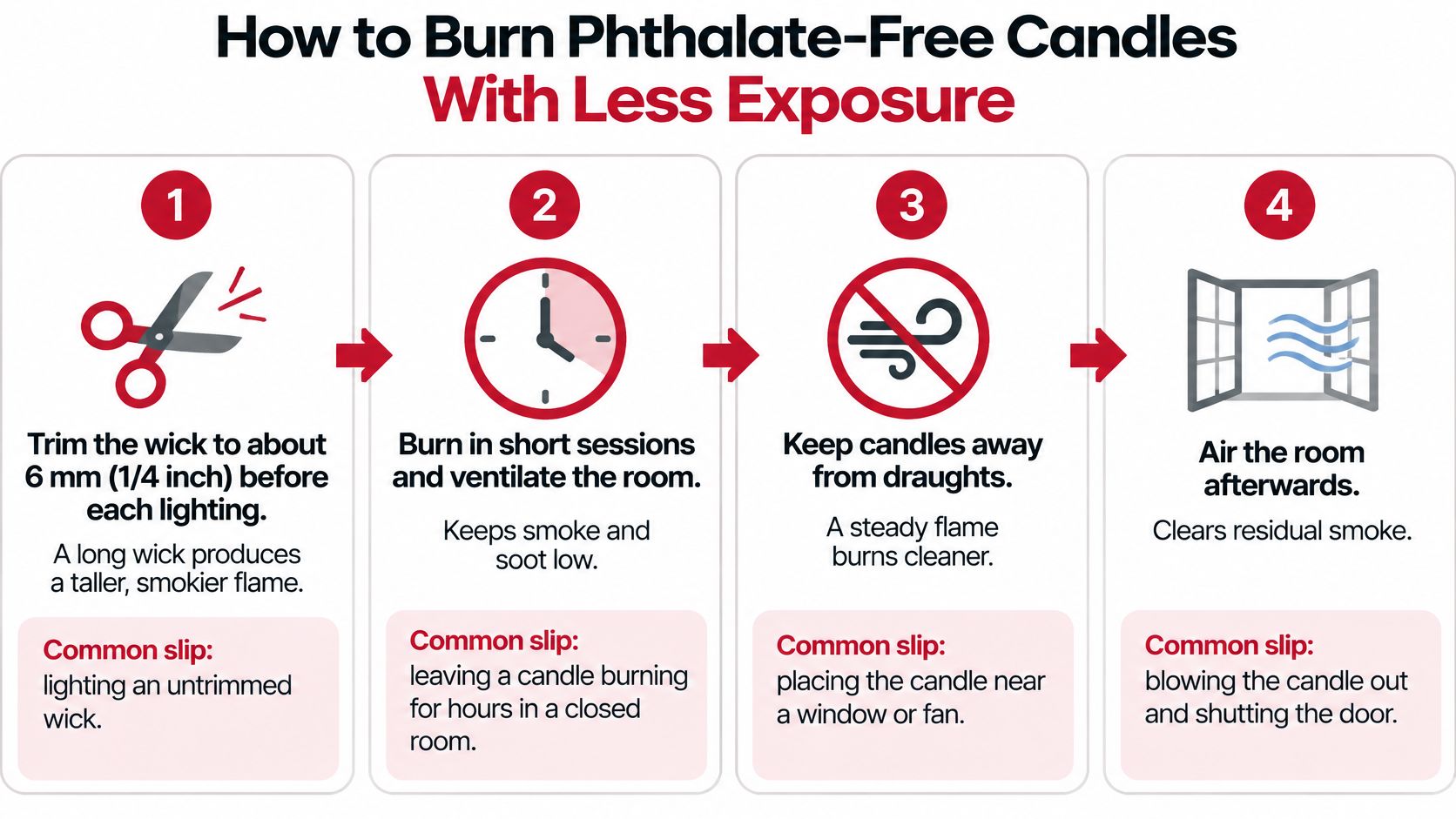
A phthalate-free label settles what went into the oil. What reaches the air in your room is settled by habit, and the routine below shifts the exposure picture at home. Each step has a reason behind it and a slip that undoes it.
The six steps
- Trim the wick to about 6 mm (1/4 inch) before every lighting. A long wick produces a taller, smokier flame and more soot on the jar and in the air. The common slip is trimming once a week and lighting a mushroomed wick four nights running.
- Set the candle or warmer on a stable, heat-safe surface away from curtains, draughts and vents. A steady flame burns cleaner than one pushed sideways by moving air. The common slip is a bedside table next to a curtain or a cushion.
- Crack a window or leave the door open before you strike the match, not after the room feels stuffy. Air moving through the space carries out what the flame and wax release while the candle is still burning, which is when it matters. The common slip is lighting first and remembering airflow an hour in.
- Burn one candle per room, in shorter sessions, and let the space clear overnight. Two candles double what enters the air without doubling the pleasure, and a closed bedroom holds whatever you released until morning. The common slip is running several candles at once because the throw feels stronger.
- Use a warmer made for wax melts and treat the wax as consumable. The cubes fit any warmer, and a melt can be reused by remelting the wax until the fragrance fades, then letting it cool and replacing it. The common slip is leaving spent wax in the dish for days or assuming a flameless device needs no fresh air at all.
- Watch the people sharing the room, not only your own reaction. Sensitivity varies from person to person, and a guest, child or partner may respond to a scent you find pleasant. The common slip is judging the room by your nose alone.
Room-level air quality is bigger than candles, and a Dallas guide to healthier home air covers filtration and ventilation basics that apply to any Canadian home in heating season, when windows stay shut for months.
A candle like the Blue Cedar & Lavender Soy Candle Canada – 8 oz Cotton Wick makes the routine easy to follow: an 8 oz candle in 100% natural soy wax with a lead-free cotton wick, hand-poured in small batches, with the wick visible, trimmable and simple to check before each lighting. Pair it with the candle safety tips guide for the full care routine.
A steady routine of trimming, airflow and moderation does more for a candle's safety than any single label, and it costs nothing.
Frequently Asked Questions About Phthalate-Free Fragrance Oils
Does phthalate-free mean non-toxic?
No. It settles whether phthalates were added to the oil and leaves the rest open. Ask what the declaration covers: one naming specific phthalates and detection limits closes that question; allergens and emissions are separate checks.
Do phthalate-free candles release anything into the air?
Possibly, yes. The label describes what went into the oil; the air depends on what burning produces. Candle and incense emissions can include DEP, so a phthalate-free formula is no guarantee of phthalate-free air. Ventilation and moderate sessions carry the weight here.
What should I ask a candle maker for?
Three documents: a certificate of analysis or written declaration naming the phthalates tested and detection limits, plus the safety data sheet and the intended-use statement. Press on the phthalate list itself: naming each excluded compound shows a measured test sits behind the claim.
Are phthalate-free candles safe around kids and pets?
It depends on who shares the room, the sensitivity question no label settles. Follow the intended-use statement, keep sessions moderate with ventilation, and ask a veterinarian about pets; animals respond differently from people.
What if a scent gives me a headache?
Put the candle out, air the room and give it a day. With added phthalates already excluded, the reaction points to the fragrance blend or combustion products, so note the scent family and skip it. If symptoms continue or you notice wheezing, see a health professional.
Confirm the Label Before You Light Your Next Candle
Shivora Candles states the inputs behind its claim: 100% natural soy wax, phthalate-free fragrance oils, and lead-free cotton or crackling wood wicks, hand-poured in small batches in Ontario. That settles the first question, whether phthalates were added. The other two are handled by habits and observation: keep sessions moderate in a ventilated room, and treat irritation, scent sensitivity or concerns around children and animals as a reason to extinguish the candle and reassess.
Choose the format that fits the room. Soy candles suit wick-lit evenings, soy wax melts give flameless fragrance for warmers, and the Candle Guide can help narrow scent families before ordering. Orders ship across Canada at a flat rate, with free shipping at CAD $79.99 or higher; conditions apply.
The useful next step is specific: pick a scent, ask for its ingredient and safety details, then match wick type, room size and burn time to how the space is used. Browse the collection at Shivora Candles with that checklist in hand.


