

The tree is up, the room smells faintly of evergreen, and there's a candle flickering on the side table doing its quiet December thing. Everything looks the way the season is supposed to look. Then someone in the room asks the practical question out loud, is that candle far enough from the tree? Most of us are guessing at that point, and the guess usually leans generous because the room is small and the tree eats more floor than planned.
Getting Christmas tree and candles right comes down to two numbers, and they're different rules for different hazards. Once you know both, the rest of the decisions, where a candle can live, which room gets which scent, when it's smarter to switch to something flameless, get much easier. At Shivora Candles, we hand-pour soy candles and soy wax melts in Ontario, and the advice below is the same advice we'd give a friend standing in that living room with a box of matches.
Table of Contents
- Safe Distances for Christmas Tree and Candles Setups
- Why Candles and Christmas Trees Make a Risky Pair
- How to Place and Light a Candle Safely
- Checklist Before the First Candle Is Lit
- Room-by-Room Examples for Canadian Homes
- Flameless and Lower-Risk Ways to Add Candlelight
- Choose a Candle Setup for Your Holiday Room
- Christmas Tree and Candles FAQs
Safe Distances for Christmas Tree and Candles Setups
Two numbers settle most holiday layouts: 30 cm between a burning candle and anything that can burn, and 1 m between a Christmas tree and any heat source. The two numbers measure different hazards: one runs from flame to fuel, the other from foliage to heat. That difference explains why the tree rule is the larger of the two, since heat does not need a flame to do damage and a radiator or fireplace never has to touch a single needle.
The Canadian Association of Fire Chiefs holiday guidance recommends skipping real candles in holiday decorating altogether. If you use one anyway, keep it at least 30 cm from anything combustible, and hold the tree at least 1 m from heat sources, including candles, fireplaces, radiators and stoves.
Minimum distances for candles and Christmas trees in Canada
| Item | Minimum distance | Source guidance | What it means in practice |
|---|---|---|---|
| Lit candle to anything combustible | 30 cm (12 in) | Canadian Association of Fire Chiefs holiday tips | Measure from the flame; include garland, curtains and paper |
| Christmas tree to candles and other heat sources | 1 m (about 39 in) | Canadian Association of Fire Chiefs holiday tips | Use this as the working distance for any tree |
| Christmas tree to heat sources, municipal guidance | 3 ft (about 91 cm) | City of North Vancouver holiday safety page | Shorter than the 1 m figure, so follow the larger one |
| Candle beneath low-hanging boughs or attached to branches | Not permitted | City of North Vancouver holiday safety page | Keep candles clear of the tree entirely |
| Flameless candle or wax melt near the tree | No open-flame distance | Health Canada candle safety guidance | Follow the device's own instructions for placement |
Where two sets of guidance disagree, the bigger number wins. A tree parked at the municipal minimum of 3 ft sits about 10 cm inside the 1 m rule, so push it out to a full metre and both requirements are covered at once. Treat that metre as your default rather than a target to shave.
How to measure without guessing
Measure from the flame itself rather than from the glass. A flame leans, and the heat above a jar's rim reaches further than the jar's outline suggests, so a gap that reads 30 cm from the vessel's side can shrink well below that once the flame bends toward a curtain or a paper garland.
Measure the tree from its outermost branch tips, then check again the next day. A tree relaxes once it has spent about 24 hours in a warm room, and the lower boughs droop outward toward the very sill or side table you measured against. The gap you set on decorating day is rarely the gap you still have by Christmas.
One rule that overrides the numbers: a candle tucked under low-hanging boughs or clipped to a branch is out, whatever the tape measure says.
Flameless candles and wax melts sit outside the open-flame distances, though each device still carries its own placement instructions. And no spacing covers the last variable in the system: a burning candle should never be left unattended, because every distance in the table only holds while the flame stays where you put it.
Why Candles and Christmas Trees Make a Risky Pair
A dry Christmas tree works like a pile of kindling standing upright in your living room: thin dry needles, resin in the bark, and a wide run of air between the branches to feed a flame. A flame doesn't need to touch much of it to take hold, which is why municipal holiday fire guidance warns that a dry tree can be consumed in seconds once ignited. Canadian fire authorities continue to report Christmas tree and holiday lighting fires every winter, and dry trees have figured in fatal fires in Ontario in recent years.
The candle side of the equation has its own Canadian record. Health Canada's candle safety page explains that nationwide candle-fire statistics aren't collected, but estimates drawn from Ontario, Manitoba, Alberta and British Columbia point to nearly 800 candle fires a year on average between 1999 and 2008, with annual averages of 8 deaths, 115 injuries and CAD 26.2 million in property damage. Health Canada notes those figures are historical rather than a current surveillance series, and it also notes where candle fires cluster: holidays and special occasions, when candles come out for decoration, gatherings and seasonal atmosphere.
The useful way to read this is as one system with four parts. The tree is the fuel, the candle is the ignition source, and the room around them supplies the other two: the layout and airflow that steer a flame, and the supervision that catches a problem early. Change any one of the four and the risk changes with it, which is why the same candle can be unremarkable in one corner and dangerous in another.
Three triggers that do most of the work
- The unattended burn. Someone lights a candle, then leaves to answer the door, plate dessert or put a child to bed. The room empties, the candle doesn't.
- The drifting flame. A wick that's too long, a jar near a doorway, a curtain that moves. The flame finds the fuel rather than the other way round.
- The draft. A heating vent, a range hood, a ceiling fan or an open window pushes a flame sideways, and sideways is usually toward decorations.
Each trigger maps to a different part of the system: supervision, placement, airflow. That is why no single "safe distance" number can carry the whole job by itself.
The tree's condition sets the timeline
A fresh, well-watered tree resists ignition far longer than a dry one, and that difference is measurable in minutes rather than seconds. Keep the trunk continuously immersed in water, check the stand daily, and tap a branch over the floor. If needles drop easily, the tree is drying and it should come out of the house, decorations and all. Position it away from heat vents, fireplaces and draughty doors.
What the wax doesn't change: ignition depends on flame, distance, heat and available fuel. A soy candle beside a dry tree is still an open flame beside dry fuel.
A "clean-burning" claim describes what happens during normal combustion. It says nothing about what happens when a flame meets a curtain. That's the assumption worth dropping this December.
How to Place and Light a Candle Safely
A routine beats a warning. Run the same sequence every time you light a candle and the safety part stops requiring thought.
Here's the short version before the detail.
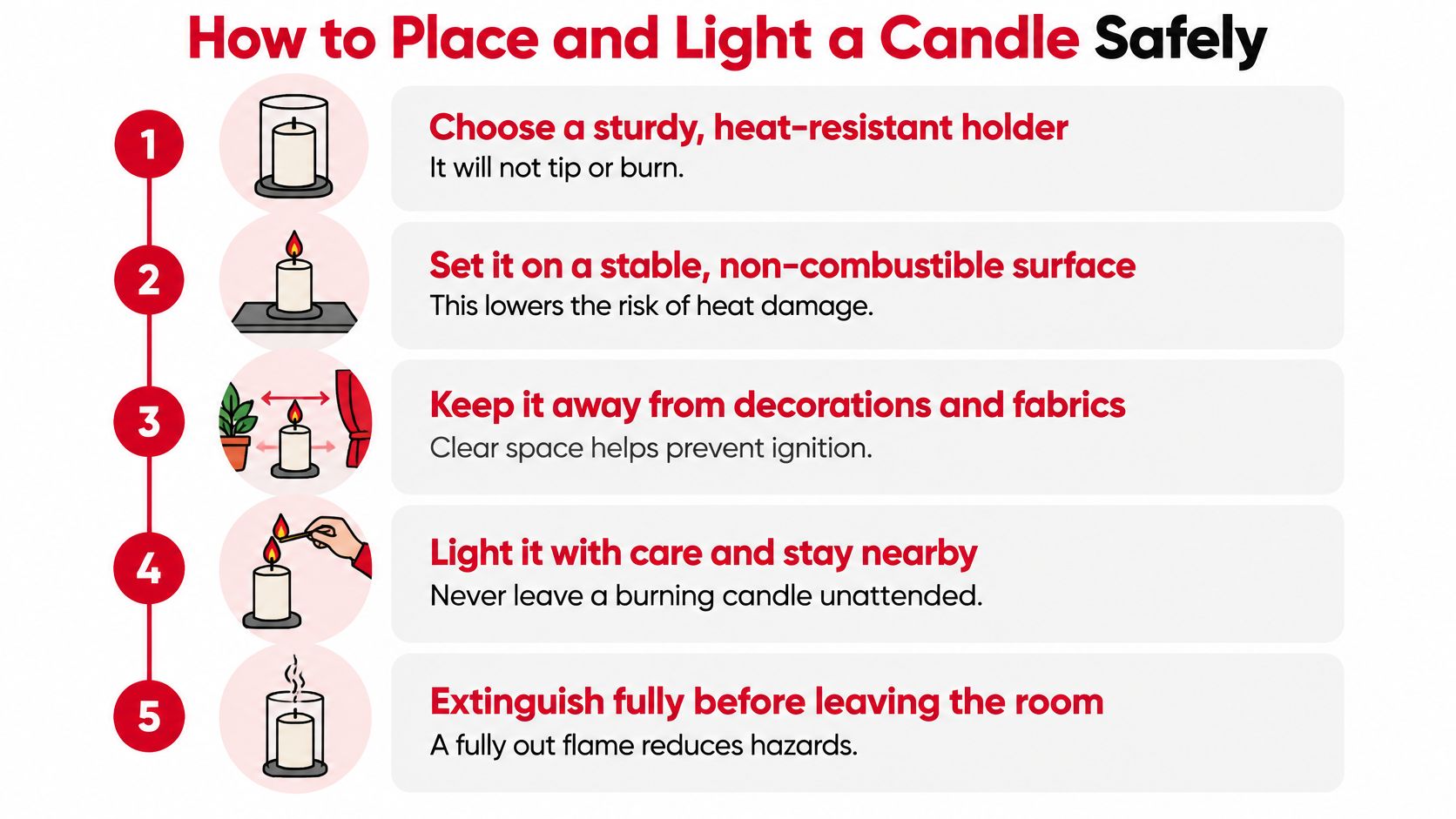
- Choose a sturdy, heat-resistant holder that won't tip or burn. A wobbling jar is the most common cause of spilled hot wax, and spilled wax near paper is a fire waiting for a match.
- Set it on a stable, non-combustible surface. A stone tray or metal coaster won't char, and heat damage to furniture often starts before anyone notices a problem.
- Confirm the flame clears 30 cm from curtains, garland, paper and wrapping, and sits outside the tree's 1 m zone. Distance is the control you can verify with a tape measure.
- Move it away from doors, heating vents, ceiling fans and open windows. Drafts push a flame toward the nearest object, and that object is usually decoration.
- Keep it out of reach of children and pets, on a surface they can't knock or climb to. A candle at toddler height is a candle that will be touched.
- Trim the wick to ¼ inch before each burn. Shivora's own guidance: a trimmed wick gives the best flame and a cleaner burn, and a long wick produces a tall, unstable flame.
- Light it only when you can supervise the whole burn. Never leave a burning candle unattended, even for a minute in another room.
- Extinguish it before you leave the room or go to bed, then glance back at the room. A final look catches the decoration that drifted too close an hour ago.
The most common slip is a candle set down among ornaments on a table runner. From standing height it looks clear of everything. At flame height, the ribbon, the paper crackers and the fabric runner are all within a hand's width. If your holiday setup involves an advent candle holder or a decorated tray, vinyl wrap tips from Quote My Wall walk through preparing the surface first, which matters when an unstable base is the exact thing you're trying to avoid.
For the fuller version of this routine, including wick care and how to retire a candle safely, see our candle safety tips.
Checklist Before the First Candle Is Lit
Run this on the product itself, before the season gets busy, not after something goes wrong.
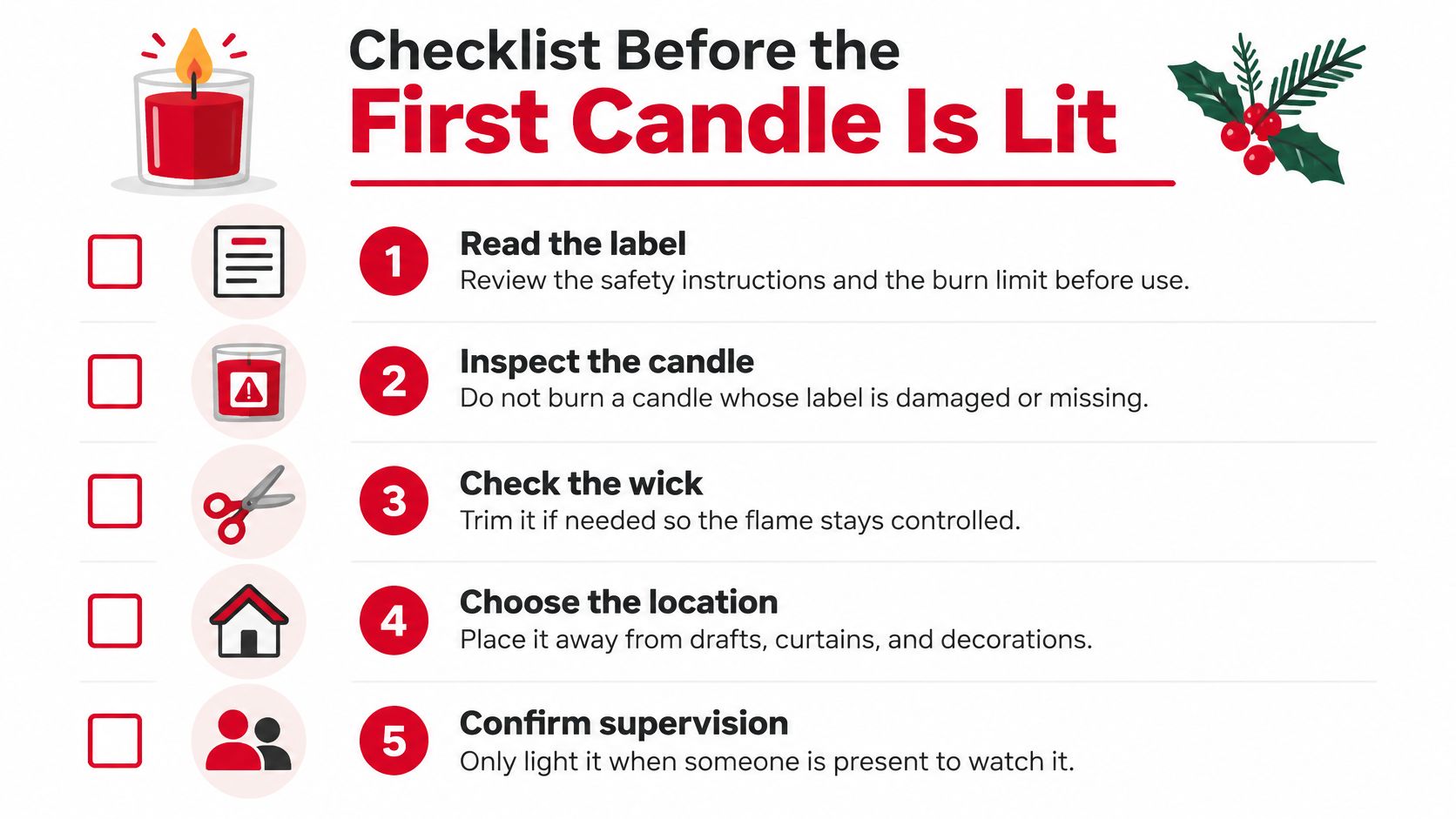
- Read the label. Safety instructions and the burn limit are printed for a reason, and a candle whose label is missing or unreadable shouldn't be burned.
- Inspect the container. No cracks, no loose parts, no decorative trim lifting away from the glass.
- Check the wick. Upright, centred, and trimmed to ¼ inch. A wick that has wandered to the side of the jar burns unevenly and runs hotter on one edge.
- Store matches and lighters out of children's reach. Do it now, while you're thinking about it.
- Test the smoke alarm in the room. One button press covers a whole season of peace of mind.
- Clear anything that could be knocked into the flame. Cords, ribbon tails, dried wreath material.
Canada's federal Candles Regulations (SOR/2016-165) include a specific performance requirement: a candle must not reignite spontaneously after it has been extinguished. That's a useful thing to check against a product's instructions and design, but compliance is a floor, not a guarantee. It doesn't supervise the candle for you.
Fix any failed item before lighting. A candle that fails the check gets set aside, not burned in a hurry.
Room-by-Room Examples for Canadian Homes
Rules get easier once you apply them to rooms you have.
- A small living room where the tree takes the only corner away from the window. The tree still needs its 1 m from the radiator under the sill, so the candle moves to the far end of the sofa table, outside the tree zone entirely. One change: shift the candle, not the tree.
- An open-plan condo with the tree standing near the kitchen. Cooking heat counts, and a stove is a heat source. Keep the tree clear of the range side of the room and put any candle on the dining table, away from the hood and the traffic path. One change: draw the boundary at the kitchen edge.
- A home with toddlers or a dog that investigates everything. The candle goes on a high, stable surface the child can't reach and the dog can't brush past, or the tree area uses a flameless option and the candle lives somewhere else. One change: raise the flame or remove it.
- A room with a fireplace and a decorated mantel. A mantel candle needs 30 cm from garland, cards and stockings, and the fireplace itself counts as a heat source for the tree. One change: measure the mantel shelf, not the hearth.
If your layout puts a candle in a window, our guide to candles for windows covers the draught and curtain problems that come with that spot.
The quick test for any arrangement: picture where the flame would reach if the holder tipped right now, then ask whether a draft could carry it toward something that burns. If either answer is uncomfortable, move the candle or switch to flameless.
Flameless and Lower-Risk Ways to Add Candlelight
Candlelight works like lighting anywhere else: you layer it, and only one layer needs a live flame. Put LED candles behind the garland where you want a low warm glow that can run all evening, let a wax warmer scent the corner beside the tree that a flame could never safely occupy, and reserve a candle for a surface someone can see from the sofa. Done this way, the room reads as fully candlelit, with the same pools of warm light and the same soft flicker against the wall, while the spots you cannot watch run on battery or electricity.
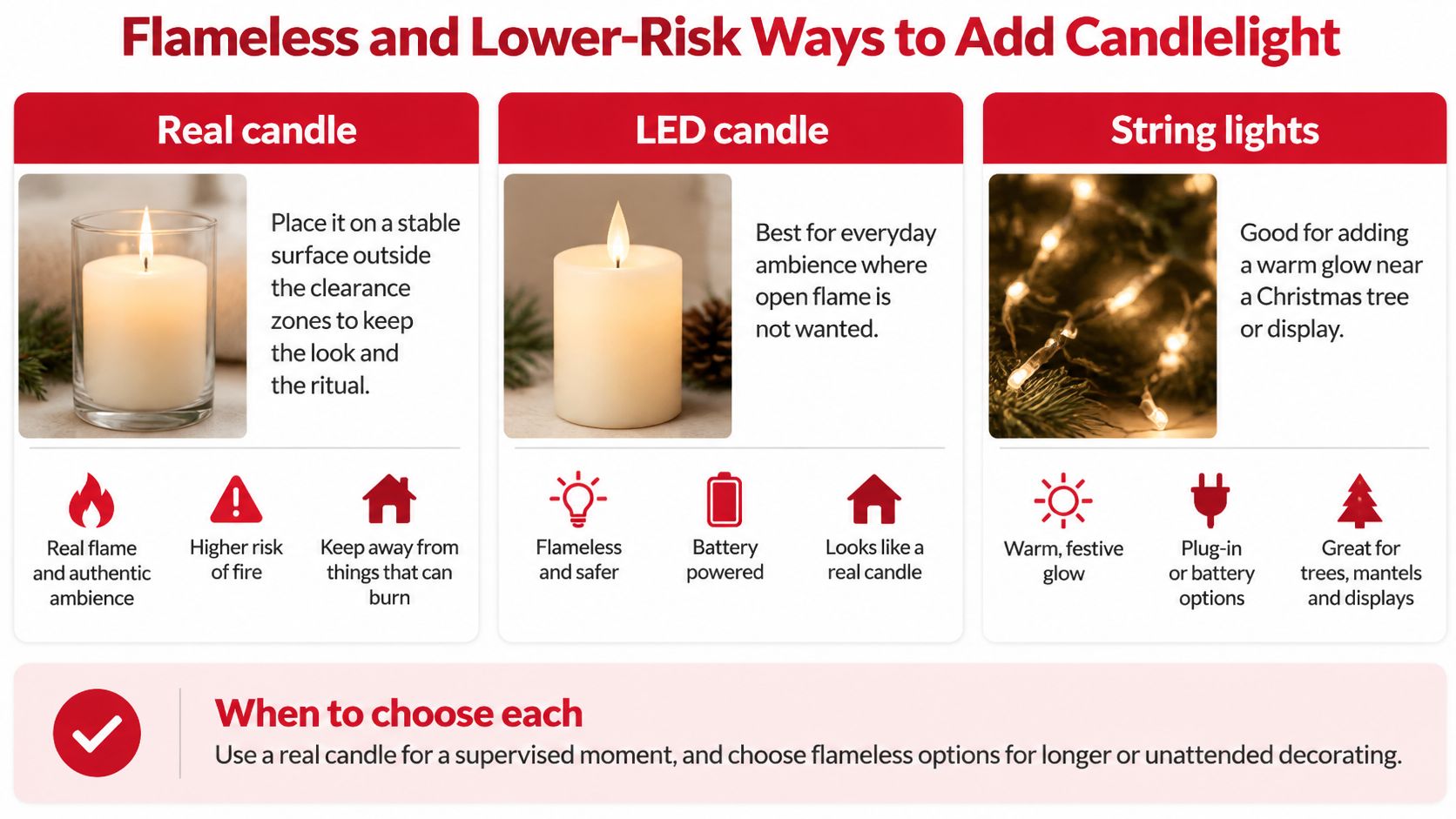
Each option handles a different part of the setup. A real candle on a stable surface outside the clearance zones keeps the look and the ritual, and it still needs someone in the room. Soy wax melts in an electric warmer give you fragrance without an open flame, which solves the tree-corner problem neatly. The warmer must still sit on a stable, dry surface away from cords and water, and you follow the warmer's instructions rather than candle habits. Our guide to how wax melts work explains the warmer side of that arrangement.
Candlelight options compared by flame, placement and trade-off
| Option | Open flame | Best placement | Main trade-off |
|---|---|---|---|
| Real candle on a stable surface | Yes | Outside the tree's 1 m zone and at least 30 cm from anything combustible | Keeps the look and ritual; the flame still needs someone in the room |
| Soy wax melts in an electric warmer | No | Stable, dry surface outside the tree's clearance zone and away from cords | Scent without a flame; the warmer must be used as its instructions state |
| Battery-operated or LED candle | No | Anywhere in the room, including beside the tree | Less natural flicker; check batteries and the fit of the holder |
If the room needs more overall light rather than one more flame, how to layer fixtures and lamps from Critelli Furniture covers the ambient side of the problem, and better room lighting reduces the temptation to over-candle a small space.
For a two-minute visual walkthrough of safe candle habits, this is worth watching before the season starts.
The setup to aim for is a deliberate mix: flameless light beside the tree and in any spot you cannot watch, plus one real candle on a stable surface well clear of it, lit for the part of the evening when someone is sitting in the room. Read each product's instructions rather than assuming any option is safe on its own.
Choose a Candle Setup for Your Holiday Room

Choose the product by the room and the purpose.
A living room where the candle sits on a side table at least a metre clear of the tree is the easy case. The Candy Cane Soy Candle fits there: an 8 oz soy candle with a cotton wick, hand-poured in Ontario and poured into a reusable amber glass jar. As one of the collection's cozy seasonal scents, it is a natural fit for holiday décor, stocking stuffers and gifting on cold winter nights, and it earns its place on a stable surface outside the tree's clearance zone.
An entryway or hallway, where people pass through and the candle is never far from a door, calls for something that stands firmly on a non-combustible surface out of the draught. The Fir Balsam & Pomander Soy Candle suits that spot and the season: an 8 oz cotton-wick candle, hand-poured in Ontario, from a collection that runs from fresh florals and warm gourmands through relaxing lavender blends to rich woods. A hallway candle only works if coats, scarves and the swing of the front door all stay clear of the flame.
For the evenings when someone will sit with the flame the whole time, wood wick candles are designed to produce a relaxing crackle and a cozy atmosphere, which is a different pleasure from fragrance alone. A wood wick asks for one extra step: before relighting, remove the loose charred portion so the wick stays short and clean. And if scent is the goal while the tree owns the corner, soy wax melts in an electric warmer deliver the fragrance with no open flame at all.
Every candle in the room follows the same burn rules covered in the placement section, whatever scent is inside the jar. Shivora candles are vegan, cruelty-free and phthalate-free, made with 100% natural soy wax and premium fragrance oils, and orders ship flat-rate across Canada, with free shipping on orders of $79.99 CAD or more. Some conditions apply.
Christmas Tree and Candles FAQs
What should I do if a candle tips or a decoration catches?
Don't reach into a fire with bare hands, and don't carry a burning candle across the room. If a fire starts, get everyone out, close the door behind you if it's safe to do so, and call 911 from outside. A working smoke alarm in the room and a home fire extinguisher within reach are the two pieces of preparation that matter most.
Are flameless candles safe to use near a Christmas tree?
They sit outside the open-flame distances, which is why they're the practical answer for the tree area. Follow each device's own instructions for placement, power and batteries, and keep cords away from water and from the tree's water reservoir.
Can a candle sit on a mantel above a fireplace?
Only if it stays at least 30 cm from garland, cards and stockings, and remember the fireplace itself counts as a heat source for the tree. The room-by-room examples above show how that plays out on a decorated mantel.
Shivora Candles hand-pours soy candles and soy wax melts in small batches in Ontario, so the holiday scents in our shop are made for exactly the kind of evening this article is about: a tree in one corner, a candle on a stable table well away from it, and someone in the room to enjoy both. If you'd rather keep an open flame out of the tree room entirely, our wax melts and electric warmers give you the fragrance without it. Have a look at the Shivora Candles collection and pick a scent for each room before the season gets away from you.

