

You blow out the match, answer a text in the kitchen, and tell yourself the candle will be fine for one more minute. That minute is where candle mistakes start, because a burning candle is an open flame and it does not pause while you do.
Many home burners learn to ask how many hours a candle lasts. The better question is what would make me stop this one right now, and the honest answer has several parts: who is in the room, how much wax is left, how long it has been lit, what the flame is doing and how the air feels. No single session should run past four hours.
Stopping is a short set of checks you run before the match and again while the wax melts. Canadian provincial guidance and Shivora care instructions can point to different wax levels, so use the earliest stop signal rather than the last one. If you are leaving the room or heading to bed, the decision is already made: put the flame out first.
Table of Contents
- Stop Signals and Limits at a Glance
- Why Supervision Matters More Than Burn Time
- How to Read the Remaining Wax Level
- Burn Session Limits for Each Candle Type
- How to Extinguish a Candle Safely
- Air Quality and Comfort Stop Signals
- Confirm the Stop Rule Before Your Next Burn
- Frequently Asked Questions About Stopping a Candle
Stop Signals and Limits at a Glance
One rule outranks every number that follows. If you're leaving the room, even for the ninety seconds it takes to answer the door or refill a glass, put the flame out first. The same applies when you head to bed, and it holds whether the jar is brand new or nearly finished.
Use the table below as a check before each burn, then as a glance-and-go list while the candle is lit.
| Stop signal | Stop when | Action |
|---|---|---|
| Leaving the room, even briefly | Right away | Extinguish before you step out |
| Going to sleep or feeling drowsy | Before bed or rest | Extinguish every candle; a burn-time rating is not permission to continue |
| Maximum single session | Four hours at most | Stop sooner if any warning sign appears |
| Remaining wax (Quebec guidance) | About 5 cm (roughly 2 inches) left | Snuff the candle |
| Remaining wax (Manitoba guidance) | Within 2 inches of the holder or decorative material | Extinguish before the candle burns completely |
| Remaining wax (Shivora care instructions) | About 1/2 inch left | Stop burning and follow the care instructions |
| Flame unusually high, flickering or smoky | At any point | Snuff, trim the wick, then relight only once the flame is steady |
| Container excessively hot | At any point | Snuff and let the vessel cool before moving it |
When the Thresholds Conflict, the Earliest One Wins
Several of these signals can land at the same moment, and when they do, you don't get to pick the convenient one. The 1/2 inch care line always arrives before the two-inch regional guidance, so that's the one to hold in your head.
Practical rule: treat every threshold as a ceiling, not a target. The candle doesn't need to reach it for the session to be over.
A long advertised burn time never cancels a stop signal. It describes how many hours the wax can deliver across its whole life, not how long one session should run. Run this table before every burn, and the rest of this guide explains the reasoning behind each row.
Why Supervision Matters More Than Burn Time
A candle can still have plenty of wax and become unsafe the moment you leave the room. For example, if you light one before a bath, then leave the bathroom to get water, the flame is burning without supervision. The remaining wax level does not change that.
Health Canada identifies unattended candles, falling asleep with a candle lit, and leaving home while candles are burning as recurring human-error factors in candle fires. Its estimate, based on data from Ontario, Manitoba, Alberta and British Columbia, found nearly 800 candle fires a year on average from 1999 to 2008, with an average of 8 deaths, 115 injuries and CAD 26.2 million in property damage annually, according to Health Canada's fire safety guidance.
Health Canada notes that Canada-wide candle-fire statistics were unavailable, so these figures reflect four provinces rather than a complete national count. Use them to gauge scale, not to measure your own risk.
Supervision is a separate stop signal from burn time and wax level. Shivora Candles advises never leaving a burning candle unattended, and keeping it away from children, pets, drafts and flammable materials. For wider household fire-prevention advice, see the Eagle Restoration fire prevention guide.
Before lighting a candle, decide whether you can remain present and attentive for the burn. If you cannot, wait until you can. A quick errand or one more minute elsewhere still leaves the flame without supervision.
How to Read the Remaining Wax Level
A wooden skewer tells you more about a candle's remaining life than the flame does. The flame gets watched all evening, while the wax depth underneath tends to go unchecked until the jar is already low.
Measure instead of eyeballing. Push a ruler or a wooden skewer straight down through the softened wax until it touches the base of the jar, pinch the point where the wax line sits, and read the depth from the base upward. The figure that matters is how much wax still sits between the flame and the bottom of the vessel.
Provincial guidance does not all draw the stop line in the same place. Some of it is set by the wax left in the vessel, and some by the space between the flame and the holder or the decorative material around it. When the marks differ, the earliest one wins, and a candle poured around decorative material reaches its stop point sooner than a plain pour at the same wax depth.
Run the container check at the same time as the measurement. Rest the back of your hand near the glass while you read the skewer, because a warm vessel is a stop signal on its own, whatever the depth says. Say an 8 oz candle sits in a glass jar on a tray and the wax has measured down to the last two inches while the glass already feels warm to the back of your hand. That is not a session to nurse along. Snuff it and let the vessel cool.
The First Burn Sets the Rest of the Jar
A candle stopped too early on its first light tunnels, leaving a ring of wax stranded along the sides that never melts into the pool again. Let the first melt pool reach close to the edge of the vessel before you snuff it. A wood wick follows the same first-burn rule with stricter upkeep: trim the wick before each burn, and before relighting, remove the loose charred portion so the wick stays short and clean.
None of this changes at the bottom of the jar. A stated total burn time describes the candle's whole life. It never overrides a wax threshold, a warm container or the end of your supervision.
Burn Session Limits for Each Candle Type
Four hours is the ceiling for a single session. We say so plainly in our care instructions, and it lines up with fire-safety guidance cited by the U.S. Coast Guard, which also puts wick trimming at 1/8 to 1/4 inch before each use. The reason is mechanical rather than arbitrary: as the wax level drops, less wax sits between the flame and the base of the jar, so the vessel absorbs more heat, and a wick that lengthens as it burns feeds a bigger flame. Heat and flame size climb together.
Long sessions also want a trim partway through. Quebec's provincial guidance advises trimming the wick every 2 to 3 hours of burning, and it repeats the 5 cm wax milestone, as noted by Quebec's fire prevention guidance. An untrimmed wick in hour four is the most common route to a flame that grows, flickers hard and starts throwing soot.
When to Stop Burning a Candle Mid-Session
| Candle type | Session limit | Before each burn | Watch for |
|---|---|---|---|
| 8 oz soy candle, cotton wick | Up to four hours at a time | Trim the wick to about 1/4 inch | Unusually high flame, smoke or a hot container |
| 8 oz soy candle, wood wick | Up to four hours at a time | Trim the wick and keep it clean | Excess char, uneven flame or crackling that grows |
| Relighting a wood wick | Only after a clean trim | Remove the loose charred portion and keep the wick short | A flame that will not settle |
| Wax melt in a compatible warmer | Follow the warmer maker's instructions | Use an appropriate amount of wax | Overheating or wax that has stopped melting evenly |
| Any candle, first burn | Until the melt pool nears the edge | Trim the wick before lighting | Tunnelling if the candle is stopped too early |
A winter evening shows how this plays out. Instead of one four-hour run in a closed living room, light the candle for two hours, snuff it, trim the wick once the wax has cooled, and relight later. You get the same evening of fragrance with a steadier flame and a container that never gets uncomfortably hot. Our guide to candle burn time explains what that pattern does to total hours if you're planning around a favourite jar.
Four hours is a ceiling, not an appointment. Any warning sign in the table above ends the session sooner, and stopping ten minutes early costs you nothing but ten minutes of scent.
How to Extinguish a Candle Safely
The stop itself takes about five seconds. Doing it in the right order is what keeps the last minute from undoing an hour of careful burning.
- Stop the moment a trigger appears. Don't wait for a convenient pause or the end of a song. The few minutes you save by finishing the episode aren't worth the risk you're carrying while you wait.
- Snuff the flame with a snuffer or a lid. Blowing can project sparks or hot wax across the surface you've been protecting, which is exactly the outcome you're trying to avoid. A snuffer works like a lid on a pot: it cuts off the air instead of scattering the flame.
- Never pour water on it. Water meeting hot wax creates a dangerous reaction, and it can also crack a warm glass vessel.
- Check for a smouldering wick or residual glow. A wick can keep burning after the visible flame drops, so confirm the flame and any smouldering wick are fully out before the vessel moves.
- Let it cool where it sits. The surface under the candle is stable and heat-resistant by design, so leave the jar there, away from drafts and anything combustible, until it's cool to the touch.
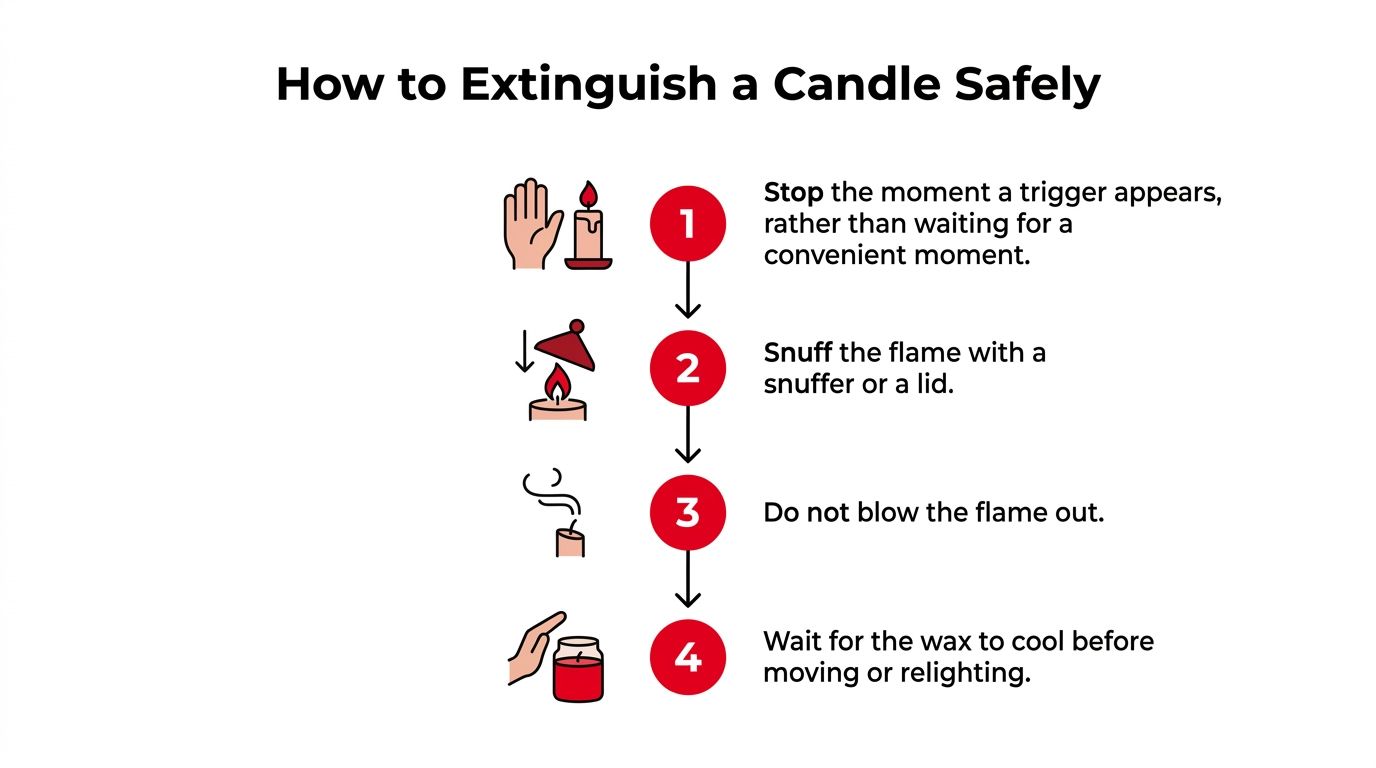
The order matters more than the speed. Snuffing first keeps sparks contained, and the glow check catches the one failure that looks finished: a wick can smoulder invisibly, like a campfire ember under ash, long after the flame appears gone. That thirty-second pause before you walk away is the difference between a candle that's out and a candle that's almost out.
When you do relight, the pre-burn trim in the session table applies again. A cooled candle is also the only safe moment to move it, since a warm jar can still mark a wooden surface or slide in an unsteady grip.
Kitchen fires follow the same lesson about acting early rather than improvising late. The mistakes to avoid during grease fires guide covers the ones that turn a small pan fire into a room fire, and the theme is identical: the first thirty seconds decide the outcome.
A clean stop looks unremarkable. No flame, no glow, a vessel that's cool to the touch, and a wick ready for the next session. Our candle safety tips cover the placement side of the same routine if you want to check where the candle sits before the next burn.
Air Quality and Comfort Stop Signals
Two slogans get repeated about scented candles, and both are too simple. One says any scented candle is a health hazard. The other says a clean-burning wax makes ventilation irrelevant. Neither survives contact with the actual numbers.
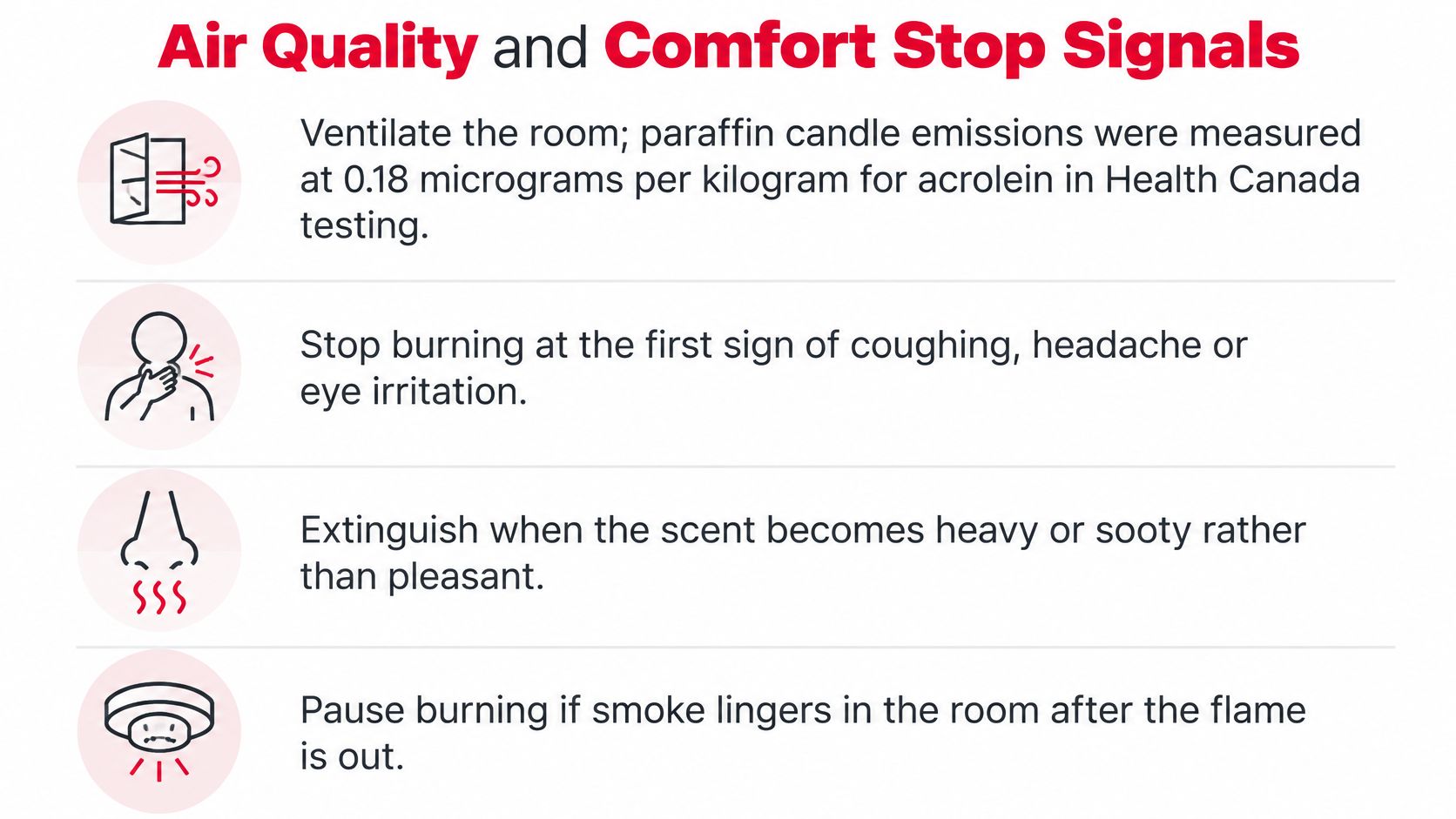
Health Canada's acrolein guidance reports a measured emission rate of 0.18 micrograms per kilogram of candle consumed from burning paraffin candles, more than 1,000 times lower than cigarette emissions, while noting that indoor sources can push indoor-to-outdoor acrolein ratios above 2.5, according to Health Canada's home fire prevention booklet. Exposure therefore depends on the candle, the burn conditions, the size of the room, the ventilation, the duration and the person sitting in it.
That makes comfort a legitimate stop signal, not an oversensitive one. End the session and ventilate if you notice any of these:
- Headache or dizziness: a small room with a long burn and no air movement is the usual setup.
- Throat or eye irritation: stop first, open a window second, and don't relight in the same room that evening.
- Coughing or a tickle in the chest: particularly relevant for anyone with asthma or fragrance sensitivity.
- Visible haze or a strong lingering odour: the scent should be pleasant from across the room, not heavy from where you sit.
The action is simple. Snuff the candle, open a window or run the ventilation, and let the room clear before the next burn. For bedrooms, nurseries and anyone who reacts easily, a wax melt in a compatible warmer is a flameless alternative: place an appropriate amount in the warmer and follow the warmer manufacturer's safety instructions. If scent is the issue rather than flame, our guide to candles for sensitive noses covers how to choose a lighter fragrance load.
Ingredient choices matter for how a candle burns, and soy wax is what we pour. They don't remove the need to ventilate a room or to stop when your own body asks you to.
Confirm the Stop Rule Before Your Next Burn
A candle can pass every check at lighting and fail one an hour later, when a draft shifts or the room empties. The stop rule is a set of signals you confirm before the match and check again while it burns. The list takes less time than finding a lighter.
- No trigger applies: you're staying in the room, nobody is heading to bed, and the wax is well clear of your half-inch line.
- The spot is right: stable, heat-resistant surface, at least 30 cm from anything that can burn, clear of drafts and out of reach of children and pets.
- The wick is trimmed: about 1/4 inch for a cotton wick, and short and clean for a wood wick.
- Someone is watching: a person in the room, in sight of the flame, for as long as it burns.
- A snuffer or lid is within reach: so the stop never waits on a search through the kitchen drawers.
A failed check means snuff the flame, fix the problem and relight once the list passes again. The tempting exception, "one more minute," is how a watched candle turns into an unattended one. When two rules disagree, follow whichever one stops you sooner.
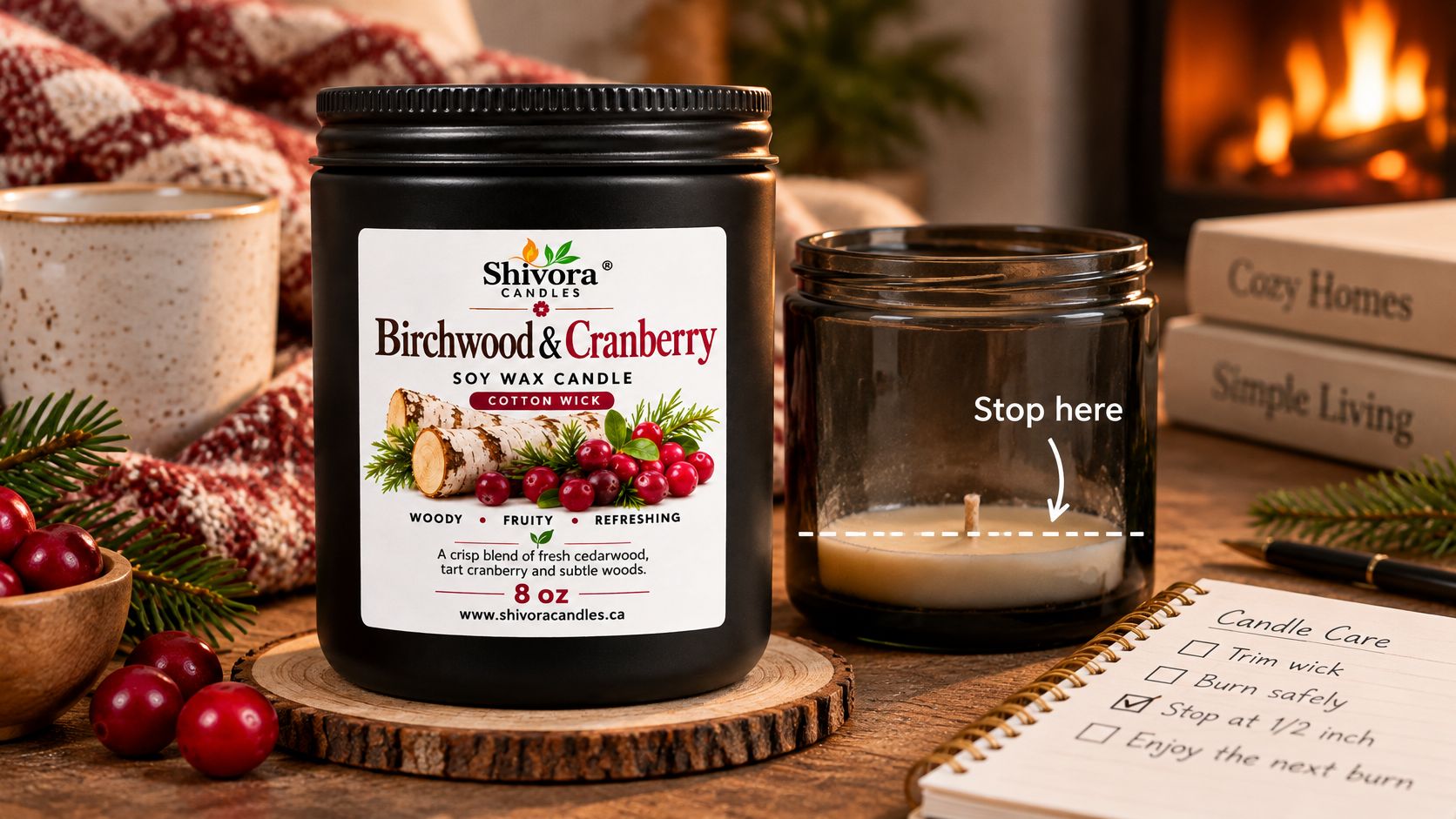
These rules fit any 8 oz soy candle with a cotton wick, including the Birchwood & Cranberry Soy Candle. If you'd rather skip the open flame, soy wax melts in a compatible warmer follow the same supervision logic with no wick to watch.
Save the list on your phone or keep a card in the drawer where the lighters live, and pair it with our Candle Care & Safety page for the fuller version of the same rules.
Frequently Asked Questions About Stopping a Candle
What should I do if a candle goes out on its own? Treat an accidental blow-out as the end of that session. Give the wax time to cool, then check the wick is no longer smouldering before you walk away. A flame that dies on its own is telling you something, usually a wick buried in melted wax or a draft you hadn't noticed, so find the cause before relighting.
How soon can I relight a candle after it goes out? Wait until the wax has cooled and the wick is dry and firm. Trim a cotton wick to about 1/4 inch first, and on a wood wick, pick off the loose charred portion so what remains is short and clean. Once prepped, the candle starts a fresh session, since the 4-hour maximum applies per burn rather than per day.
Do the stop signals change for a wood wick? The signals themselves stay the same. The upkeep differs. A wood wick needs its charred top removed before every burn, and the first burn works best when the melt pool reaches close to the edge of the vessel. Skip either step and the flame may sputter or fade, a maintenance problem that is easy to mistake for a stop signal.
Can I return a candle once I've burned it? A burned or used candle can only come back if it arrived damaged or defective, and the same applies to used or opened wax melts. Contact Shivora Candles before sending anything back, because a return sent without that step may not be accepted.
Shivora Candles hand-pours soy candles and soy wax melts in small batches in Ontario, with lead-free cotton or crackling wood wicks, in 4 oz, 8 oz and 10 oz sizes. Browse the full range at Shivora Candles, where Canada-wide orders of $79.99 CAD or more ship free (some conditions apply).


